Consumers have limited time to respond to a consultation paper published by energy regulator Nersa on 30 December, which proposes that consumers pay an additional R76 billion in electricity tariffs to compensate Eskom for mistakes the regulator made.
The amount is about 40% higher than the R54 billion settlement Nersa reached with Eskom behind closed doors in July, which the High Court in Pretoria refused to confirm after an intervention by AfriForum and Minerals Council SA.
Read:
Eskom has 13 675MW – nearly three Medupis – in cold reserve
Pressure mounts on Eskom pricing as more retrenchments loom
It ordered Nersa on 21 December to reconsider the matter after giving stakeholders an opportunity to make submissions on it.
The deadline for submissions is 21 January, according to the timeline Nersa published, and the regulator will make its final decision by 30 January.
Whatever number Nersa decides on will be recovered from tariffs according to an implementation plan that is still to be developed.
It is however expected that consumers will see further increases in electricity tariffs on 1 April for customers buying directly from Eskom and 1 July for those buying from municipalities, over and above those announced in January last year.
Nersa’s mistakes
The matter stems from mistakes Nersa made in its initial determination of Eskom’s allowable revenue for the three financial years from 1 April 2025 to 31 March 2028.
ADVERTISEMENT
CONTINUE READING BELOW
The determination translated into average tariff increases of 12.74% in 2025, 5.36% in 2026 and 6.19% in 2027.
Eskom however challenged the determination in court, pointing out that Nersa made several mistakes in the determination of the allowable revenue for the generation division.
This included omitting the closing balance of the previous period as the opening balance for the new tariff period in relation to depreciation, and several issues in relation to the value of the Regulatory Asset Base (RAB).
Eskom argued that it was short-changed by R107 billion.
Nersa acknowledged the mistakes and launched an investigation into the matter, with one staff member being suspended pending the outcome.
Eskom approached the regulator with an offer to settle on R62 billion, representing a “sacrifice” for customers. Nersa made a counter-offer of R44 billion, which Eskom rejected, but in the end the two parties split the difference and arrived at the number of R54 billion despite Nersa’s recalculations showing a shortfall of R76 billion.
The R54 billion settlement would have resulted in an increase in electricity tariffs of 8.76% instead of the original 5.36% this year, and 8.83% instead of 6.19% next year, as well as further amounts to be recovered in later years.
Not so fast with that R54bn settlement, Eskom and Nersa
Nersa entered R54bn settlement to avoid court scrutiny
The court however called the R54 billion a “thumb-suck” and the R76 billion, which consists of R14 036 million in returns and R62 030 million in depreciation, is now firmly back on the table and carries the risk of even bigger tariff increases.
This comes against the background of immense pressure on Eskom to lower tariffs for the smelter industry before the end of February, to prevent the loss of thousands of jobs as plants cease operations and lay off staff due to uncompetitive electricity pricing.
ADVERTISEMENT:
CONTINUE READING BELOW
Regulator has some room for flexibility
The determination of Eskom’s tariffs is however not merely a matter of calculation. The regulator does have some discretion.
While the Electricity Regulation Act (ERA) determines that an efficient operator should be allowed to recover its cost of supply as well as a reasonable margin, the Electricity Pricing Policy (EPP) also requires Nersa to “consider a set of objectives when determining the revenue and tariffs”.
“As some of these objectives may not always align, a careful balancing process is necessary to ensure that regulatory decisions remain fair, rational, and consistent with legislative and policy requirements.”
The objectives are:
- The efficient, effective, sustainable, and orderly development and operation of electricity supply infrastructure in South Africa;
- That the interests and needs of present and future electricity customers and end users are safeguarded and met, having regard to the governance, efficiency, effectiveness, and long-term sustainability of the electricity supply industry within the broader context of economic energy regulation in the Republic;
- That investment in the electricity supply industry is facilitated;
- That universal access to electricity is facilitated;
- That the use of diverse energy sources and energy efficiency is promoted;
- That competitiveness and customer and end-user choice are promoted; and
- That a fair balance among the interests of customers and end users, licensees, investors in the electricity supply industry and the public is facilitated.
In the consultation paper, Nersa poses 10 specific questions, including an invitation to comment on any aspect that formed part of its original determination of the Generation RAB and in line with Eskom’s original application.
Together with the consultation paper, Nersa also published on its website Eskom’s original tariff application and several documents related to the proposed settlement and court proceedings.
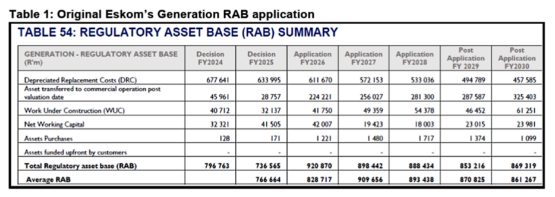
Source: Nersa
Follow Moneyweb’s in-depth finance and business news on WhatsApp here.
#Nersa #consults #R76bn #additional #revenue #Eskom #pocket