Donald Trump says the US economy is finally his. Now he’ll have to defend it.
Early in his second term the president’s team said it could take a year to assume ownership of the economy. On Super Bowl Sunday a couple of weeks back, Trump announced: “We’re there now.” But selling the country on that message – in tonight’s State of the Union address, and then over months of midterm election campaigning – will be a daunting task.
Voters apparently don’t agree with Trump’s claim, repeated Monday, that the country is enjoying the “greatest economy” ever. A recent Washington Post-ABC News-Ipsos poll found majorities disapprove of Trump’s handling of the economy, inflation and tariffs.
Presidents have historically struggled with reaping credit for good economic news while distancing themselves from the bad. There’s a bit of both for Trump in the latest data. Job markets are holding up, but inflation remains sticky — and that’s likely to be especially problematic in November’s midterms, when voters battered by years of high prices are making affordability a crucial metric.
“The actual economy is fairly solid, but voters are probably not going to see it that way,” said Stephanie Roth, chief economist at Wolfe Research. “People feel things are unaffordable, and the administration cannot fix that.”
Republicans have expressed frustration that the White House has not delivered a more cohesive message on cost-of-living concerns. Trump last week adopted a new tack: declaring at a rally in battleground Georgia that he had “won” on affordability.
ADVERTISEMENT
CONTINUE READING BELOW
Here’s what the latest indicators tell us about Trump’s economy:
Job growth, wages
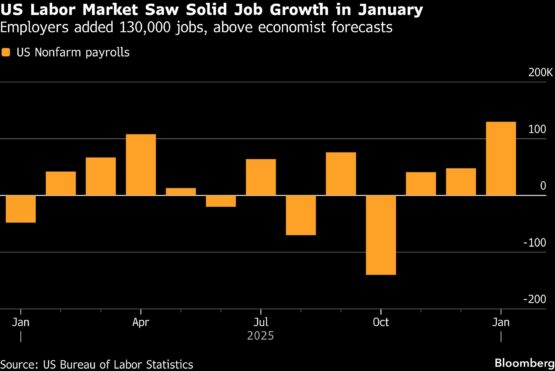
The labor market has recently shown signs of stabilising after a slowdown last year. Employers added 130 000 jobs in January – compared with an average of just 15 000 a month in 2025 — and the unemployment rate edged down to 4.3%.
Wages are also rising faster than consumer prices, allowing workers to post real income gains. Still, average hourly earnings were up only 3.7% year-over-year in January, a slower pace than before Trump took office.
Unemployment
Employers have pulled back on hiring but are largely holding on to their current workers, a job environment often shorthanded as “low hire, low fire.”
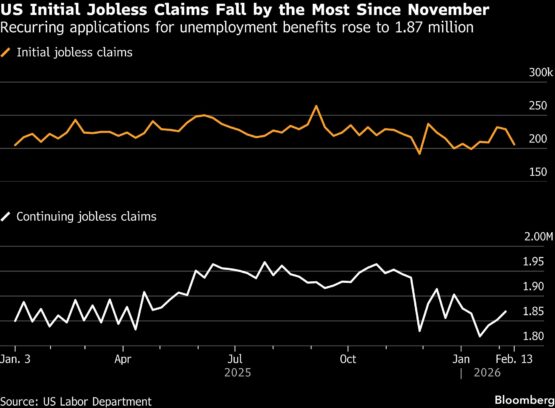
Initial jobless claims in the week ending February 14 fell by the most since November, to 206 000 — indicating layoffs aren’t widespread by historical standards. Continuing applications for unemployment benefits remain elevated at 1.87 million in the most recent reading, however, suggesting it’s tough for jobless Americans to find work.
ADVERTISEMENT:
CONTINUE READING BELOW
Inflation
Inflation has come most of the way down from its peak in 2022, but it hasn’t budged all that much since Trump took office. The Federal Reserve’s preferred gauge for underlying price pressures stood at 3% in December. Consumer prices rose a less-than-expected 0.2% in January compared to the previous month, suggesting inflation was fairly mild at the start of the year.
Overall, prices remain a political liability for a president who campaigned on a pledge to bring them down. Trump has rolled out a number of initiatives this year, including moves to ease pressure on housing markets and cap borrowing costs for credit cards.
Economic growth
Trump regularly touts the US as the “hottest country” ever. Last year was a solid year for economic growth, despite some early weakness and a slowdown at year-end.
Growth in gross domestic product came in at an annualised 1.4% in the fourth quarter, dragged down in part by a record-long government shutdown. That capped the full-year expansion at 2.2%, down from 2.8% in 2024.
Retail sales
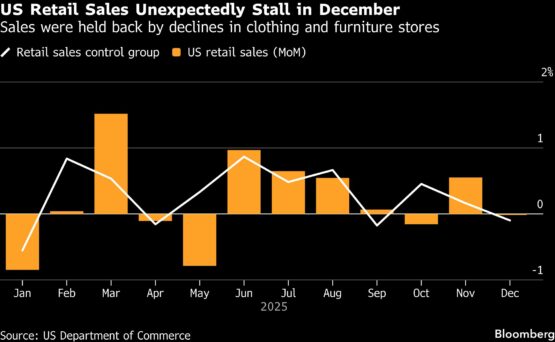
Retail sales remained relatively resilient for much of 2025, posting steady gains until momentum slowed in the latter half of the year and unexpectedly stalled in December.
ADVERTISEMENT:
CONTINUE READING BELOW
While wealthier households have continued to spend, lower-income Americans have become more cautious, perhaps because they’ve seen slower wage growth lately.
Housing
Housing is a key target for Trump’s affordability push. He’s proposing limits on how many homes big institutional investors can buy, and pressuring the Fed to lower interest rates.
The average US 30-year fixed mortgage rate is around 6% as of mid-February, down from about 7% at the start of Trump’s second term, according to Freddie Mac. While that’s the lowest in over three years, it’s still elevated compared with what Americans got used to in the decade before 2022 — offering limited relief for potential home buyers or owners looking to refinance.
Home sales and new construction remain sluggish. Sales of previously owned US homes fell in January by the most in nearly four years. And while housing starts rose to a five-month high in December, starts for the full year marked a fourth-straight annual decline.
© 2026 Bloomberg
Follow Moneyweb’s in-depth finance and business news on WhatsApp here.
#Trump #economy