J Studios/DigitalVision via Getty Images
Dear Partner,
Throughout the third quarter of 2025, Bonhoeffer Fund 1) continued to sell slower-growth firms, 2) purchased durable, faster-growing firms in temporarily depressed sectors and 3) identified similar opportunities in new industries. Our new holdings align with our longer-term growth themes of consolidation (serial acquirers), buyers from forced sellers, insurance operations, financial compounders, distribution, infrastructure investors and housing construction. In addition to the investments above, I continue to identify and analyze opportunities especially in the following areas: banks, insurance, natural resource royalties, distributors, logistics companies, housing, and specialty finance. New investments have a combined expected growth rate (return on equity (ROE) * (1-payout ratio)) plus earnings yield of at least 30 to 40%, a metric of deep value incorporating growth. Currently, about 35% of the portfolio is exposed to cyclical end markets. As a result, I will continue to diversify the portfolio to minimize exposure to potential risks of firms servicing cyclical end markets.
While in the process of executing this ongoing transformation, I have examined the sectors and stocks that have worked well over time in my non-Bonhoeffer holdings. Before I started Bonhoeffer, I held a portfolio of primarily media, telecom and finance (bank and insurance) stocks. Media and telecom stocks were prevalent in many of the early Bonhoeffer portfolios but for the most part have been removed due to the competitive markets and declining nature of many of these firms. Recently, banks have appeared in the Bonhoeffer portfolio. We have also added select insurance companies including Fairfax Financial (FFH:CA), the subject of this quarter’s case study. I have studied Fairfax for over 20 years, including attending most of their annual meetings in Toronto.
One ideal way to manage a portfolio is to invest in a set of potential investment winners, let the market work, retain the firms that maintain or increase return on invested capital (“RoIC”), and replace lagging investments with new potential investment winners. Warren Buffett has managed his portfolio this way. Examining Berkshire’s resulting portfolios, the retained firms continue to grow their earnings over time. Bonhoeffer has gone through two sets of potential winners at this point. With the first set of telecom and media, I was too patient in holding onto firms with declining RoICs for too long in the past. With the second set, I have begun to remove firms that have declining RoEs and few catalysts to increase RoEs over time. For example, Citizens Bancshares Corp. (CZBS) was recently replaced in the portfolio with newer firms that have directionally high ROEs and multiple catalysts for higher RoEs (Fairfax Financial being one example).
The Bonhoeffer Fund returned a gain of 1.3% net of fees in the third quarter of 2025. In the same time period, the MSCI World ex-US, a broad-based index, returned a gain of 6.7%, the S&P 500 returned a gain of 8.1% and the DFA International Small Cap Value Fund (DISVX), returned a gain of 10.7%. A US benchmark was added as the fund has increased exposure to the US to greater than 50%. As of September 30, 2025, our securities have a weighted average earnings/free cash flow yield of 12.8% and an average EV/EBITDA of 2.9 with 16% growth.
The current Bonhoeffer portfolio has projected earnings/free cash flow growth of about 16%. The DFA International Small Cap Value Fund had an average earnings yield of 9% with 9% growth. Bonhoeffer Fund’s and the indices’ multiples are higher than the previous quarter, primarily due to share price increases.
Bonhoeffer Fund Portfolio Overview
Bonhoeffer’s investment portfolio consists of deep value-oriented special situations, as well as growth-oriented firms that can compound value over time and have been purchased at a reasonable price. In most cases, we are paying no more than high single-digit multiples of five-years forward earning per share (EPS). The portfolio seeks:
- companies in market niches that grow organically and/or through transition or consolidation.
- companies engaged in active capital allocation through opportunistic buybacks, organic growth and synergistic acquisitions, and importantly,
- companies demonstrating durability, measured by increasing recurring revenues, high free cash flow conversion and consistent and growing RoEs.
As of September 30, 2025, our largest country exposures included: United States (71%), Canada (11%), South Korea (7%), Peru (7%) and Greece (3%). The largest industry exposures included: distribution (52%), real estate/infrastructure/finance (61%) and consumer products (7%). Some industries overlap so the total is greater than 100%.
Conclusion
We hope you and your family enjoy peaceful and blessed holidays as we celebrate the holiness of the season. As always, if you would like to discuss any of the investment frameworks or specific investments in deeper detail, then please do not hesitate to reach out. I want to thank you for the opportunity to invest by your side and welcome any questions you may have.
Warm Regards,
Keith D. Smith, CFA
Investment Themes
Some themes overlap resulting in a total percentage greater than 100%.
Distribution (52% of Portfolio; Quarterly Performance 5%)
Our holdings in car dealerships, branded capital equipment dealerships and building product distributors all fall into the distribution theme. One of the main key performance measures for dealerships is velocity, or inventory turns. We own some of the highest velocity distributors in markets around the world. The portfolio’s distribution firms include: Builders First Source (BLDR), Asbury Automotive (ABG), Ferreycorp (a Caterpillar dealer), Terravest (TVK:CA) and Autohellas.
Ferreycorp is a Central and South American Caterpillar dealer. It is run by an entrepreneurial CEO who has developed a sustainable growth strategy of outsourced equipment sourcing and maintenance for copper mining and construction clients in Peru and Central America. A significant portion of Ferreycorp is owned by the Canadian PE firm, Onex (ONEX:CA). A similar strategy is being implemented by Finning International (FTT:CA) in Argentina, Chile and Bolivia. Historically, Ferreycorp has distributed its excess cash flow to investors via dividends. Ferreycorp has a return on capital of 16% based upon a net income margin of 6.4% and an inventory turnover of 2.5 times ( ). Ferreycorp’s closest comparable, Finning, a Caterpillar dealer, with operations in Canada, Chile, Bolivia and Argentina, has a return on capital of 14% based upon a 4.5% net income and an inventory turnover of 3.1 ( ). Despite a similar return on capital, Finning sells for 3x the P/E valuation of Ferreycorp. All figures below are in Peruvian Sol. The exchange rate between Sols and US Dollars has been roughly unchanged since 2000, averaging 0.2% annual depreciation over that period.
A useful tool in evaluating returns on capital is return on incremental invested capital (“ROIC”) analysis. One way to calculate ROIC, is to divide the changes in cashflow from operations (CFO) by the capital expenditure and merger and acquisition investment over a given period of time. Ferreycorp generated mid-teens RoEs and low to mid 20s ROICs even though it was cyclical. First, the change in CFOs used to calculate the ROIC is based upon a 3-yr average CFOs. Second in this case, the 5-yr average ROIC is 24% and the 4-yr average ROIC is 29%. Below is the calculation of the Ferreycorp’s ROIC over the past 10 years:
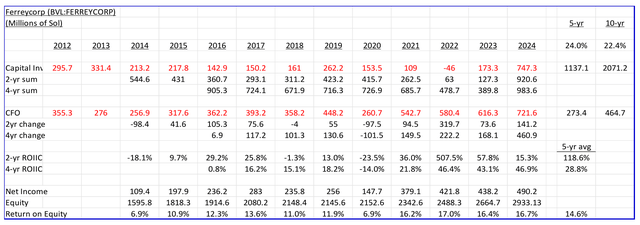
Below is the estimated growth projected to 2029. This results in a 5-year EPS growth rate of 4%, lower than the past 5-year growth rate and higher than the 10-year growth rate. Below is an updated 5-year DCF for Ferreycorp:
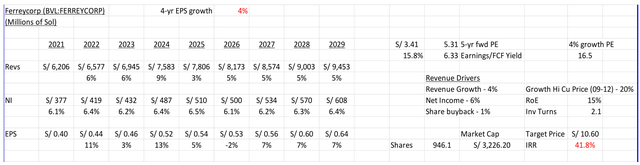
In the modest growth case, shown above, 2029 EPS will rise to S/0.64 per share. Given Ferreycorp’s exposure to copper mining in Peru, the revenue growth could be significantly higher. With these growth rates, multiples should increase to 16.5x from the current multiple of about 5x. This results in a value of about S/10.6 share range and a 4-year IRR (including dividends) of 42%.
Real Estate/Construction/Finance (62% of Portfolio; Quarterly Performance 4%)
Our current construction holdings (Builders First Source in the US and Ferreycorp in Peru) should do well as governments worldwide incentivize infrastructure programs, and new construction continues to replenish the housing deficit in the US and the UK. The bottleneck of local zoning still exists but the Federal government can incentivize local changes by withholding funding for states that do not take action on this issue. Our bank holdings, FFB Bancorp (“FFB”), United Bancorp of Alabama (“UBAB”) and Northeast Bank (“NB”) are driven by themes such as financing of low-income real estate development as well as growth in small business lending (via small business administration (“SBA”)) and the buying of forced loans from forced sellers from mergers and acquisition as well as the FDIC. Ideal bank candidates have sustainable RoEs and EPS growth rates higher than 15% that are selling for single-digit multiples and have decent underwriting. These criteria identify banks with growth rates equal to twice the price/earnings multiple. We continue to find banks that meet these criteria.
NB is growing its SBA loan book as well as buying orphan loans from sellers resulting in 37% annual loan growth. NB’s originated loans have been increasing by about 30% per year over the past year while purchased loans have made up the remainder. The purchase of orphan loans can be expected to be episodic and opportunistic and, therefore, unevenly distributed over time. By comparison, SBA loans have been assumed to be more consistent in volume. That assumption holds but NB’s SBA loan growth has slowed down due to the Trump administration’s changes to the SBA loan criteria. Management expects that once the SBA criteria are adjusted, its SBA loan levels will return to faster growth. Banking mergers and acquisitions (“M&A”) is picking up which should increase the purchased loan targets for NB. Non-performing loans increased slightly to 0.90% of loans. NB has loan loss provisions of 1.24% of loans.
FFB received a consent order in January associated with its higher risk third-party ISO transaction processing customers. The consent order allows FFB to repurchase common stock and allow continued on-boarding of low and moderate risk transaction processing customers. The impact of the consent order so far has been to decrease the Q3 2025 EPS to $2.07 from $2.70 EPS in Q3 2024 and was offset by internal growth reflected in the increase in EPS from $1.95 in Q2 2025. FFB had loan growth of 14% annually with non-performing loans (excluding SBA guaranteed loans) and loan loss provisions of 1.4% of loans.
Public Leverage Buyouts (LBOs) (30% of Portfolio; Quarterly Performance 4%)
Our building products distributors, dealerships and consumer products, fall into this category. One trend we find particularly compelling in these firms is growth creation through acquisitions, which provide synergies and operational leverage associated with vertical and horizontal consolidation. The increased cash flow from acquisitions and subsequent synergies are used to repay the debt and repurchase stock, and the process is repeated. This strategy’s effectiveness is dependent upon a spread between borrowing, interest rates and the cash returns from the core business and acquisitions. Over the past few months, long-term interest rates have been declining and short-term rates are expected to follow, so a large and growing spread is available to firms like Terravest, who have a high return on capital. One way to measure future expected returns are post-synergy cash flow ratios paid for acquisitions. Another way to measure future growth on expected returns is through incremental return on incremental invested capital (“RoIC”).
Many of our holdings used the acquisition/buyback model described above. Some of these firms have also used modest leverage to magnify the returns of equity to 20% and above, over the past five to ten years. These firms include: Terravest, Asbury Automobile, Autohellas and Builders First Source. Many of these firms are buying back stock and the modest current valuations make these buybacks accretive.
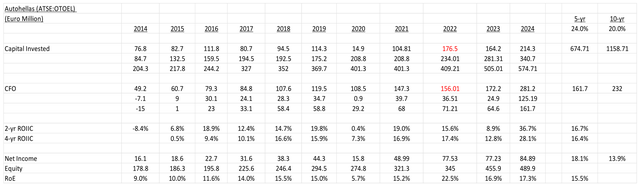
Autohellas is an example of an interesting public leveraged buyout (“LBO”). Autohellas is a consolidator of Hertz rental operations in Europe as well as automobile distribution, sales and maintenance operations across its footprint. Autohellas has followed a land and expand strategy where Autohellas purchases a Hertz franchise in a new location then opens up used car sales stores and in some locations expands into full service auto dealerships, distributorships and auto maintenance services. Autohellas has been one of the best capital allocators in its industry. Autohellas had a large distribution prior to the 2008 great financial crisis and has had one of the highest annual stock returns for Greek stocks over the past 20 years with a 16% annual return in Euros.
Below is the calculation of the RoIC over the past 10 years. As can be seen from the RoIC analysis, Autohellas’ RoE and RoIC has increased over the past five to ten years. The recent acquisition of Hertz Portugal will further increase Autohellas’ RoE. Below is the updated Autohellas RoIC analysis:
Below is an updated 5-yr Discounted Cash Flow (DCF) valuation for Autohellas:
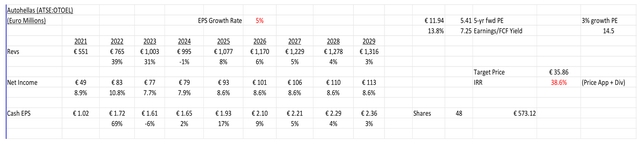
The key assumptions in this DCF include a flat operating margin. Autohellas has typically distributed excess cash flow to shareholders via dividends, currently generating a 7% dividend rate. These assumptions result in a 5% EPS growth rate, a $35 per share value and a 39% IRR.
Compound Mispricings (7% of Portfolio; Quarterly Performance 3%)
Our Korean preferred stock feature characteristics of compound mispricings. Investments in this theme should benefit over time from the closing of the various valuation gaps, such as the voting versus nonvoting shares gap, the holding company gap and the multiple business valuation gap. The thesis for narrowing the gap includes evidence of better governance and liquidity and the decline or sale of the legacy business. Corporate actions such as spinoffs, sales, share buybacks, holding company transactions and overall cash flow growth fit in the compound mispricings theme and constitute attractive opportunities if the right situations are found.
Lotte Chilsung has a plan to increase its value but has yet to deliver on the plan to date. With a leading position in the beverage market in Korea, they have been investing in and expanding its international sales of its non-alcoholic and alcoholic beverages overseas. They still hold real estate in Seoul Gangnum, however the development process has been delayed. These delays have increased the opportunity cost of holding Lotte Chilsung versus other growing Korean firms.
Telecom/Transaction Processing (0% of Portfolio; Quarterly Performance N/A%)
Millicom was sold during Q3 so the portfolio has no telecom/transaction processing exposure. We continue to look for businesses in this theme to invest in the future.
Consumer Product (7% of Portfolio; Quarterly Performance 3%)
Our consumer product retailing and beverage firms comprise this category. The defensive nature of these firms can lead to better-than-average performance. One theme we have been examining is the development of category-killer retail franchises. These firms have developed local franchises which have higher inventory turnovers, margins, and sales per square foot than competitors. These factors resulted in great unit economics and high returns on incremental invested capital. These businesses have some unique characteristics. Examples include dominant local brands with a vision to expand overseas. One current holding in this theme is Lotte Chilsung described above.
Asset Allocation and Exposure Non-Common Risks
The Bonhoeffer Fund has always had the objective to provide diversification to investors through exposure to risk factors other than the most easily obtained factors found in size in the large indices, like the S&P 500. These risk factors include the value factor risk, or our expected return on investing in growing businesses through value priced securities. Another example is peril or catastrophe risk, or the potential returns from investing in insurance firms which in turn assumes non-correlated peril risk and/or catastrophe risk. About 50% of the weight of the S&P 500 provide exposure to the value factor while less than 3% of the S&P 500 provide exposure to the catastrophe risk. We have begun by increasing our insurance risk exposure. Examples of Bonhoeffer’s current opportunity set of expected returns include:
- about 8% for common stocks;
- 4% for treasuries,
- low teens % for value stocks, and
- mid-teens for insurance firms (assuming mid-single digits returns for an investment portfolio levered at more than 2x plus underwriting income of about 5% of capital).
In some cases, you can have multiple risk factors present in one security. An example is in insurance companies whose investment portfolio assume equity and fixed income risk while the underwriting operations assume some mixture of peril and catastrophe risk. As a result you can think of some insurance firms as a leveraged portfolio of equity and debt financed by the company’s underwriting profits, or simply a leveraged balance fund. This combination has led to outsized returns over time in firms such as Berkshire Hathaway and Fairfax Financial. We have been focusing on firms who focus on both sides of the insurance balance sheets. They have good underwriting which provides low or negative cost float to invest in a high performing balanced fund portfolio.
With changes in interest rates, fixed income securities have generated more income than in the past five years. Insurance investment portfolios include large allocations to fixed income securities (greater than 80% in most cases). Insurance company portfolios have benefitted from higher interest payments from their fixed income portfolios over the past few years. Historically, insurers in the aggregate have become more aggressive in their underwriting during similar periods, ultimately resulting in increasing combined ratios, a measure of insurance company peril risk as well as expenses. At this point, good underwriters have seen declining but positive growth rates in premiums.
Successful Use of Leverage Ii (Leveraged Balanced Funds)
In the Q2 2025 letter, I discussed the successful use of leverage and provided several historical examples. Continuing this discussion, here are additional examples of successful use of leverage including leveraged balanced funds insurance companies and BDCs. WisdomTree US Efficient Core Fund (NTSX) is an exchange traded fund (“ETF”) that implements the leveraged balance fund strategy with 150% leverage (90% equity and 60% bonds) using futures to borrow close to the current treasury rate. This ETF has had good performance of 12.5% return over an interest rate cycle of about 7 years.
Another type of financial company where one can find compounders that use leverage via float is insurance companies. Especially interesting are insurance firms that use a dual approach of generating negative/low cost float through low combined ratio underwriting to invest in high returning assets. Berkshire is the best known example of this type of insurance compounder, generating 13% annual returns over the past 15 years using this strategy. Fairfax, described above, is another example and has generated 11% annual returns over the past 15 years. Other less well known compounders include Arch Capital who generated 17% annual returns over the past 15 years and WR Berkely who also generated 17% returns over the past 15 years. Other overseas examples include Tokio Fire & Marine who generated 13% per year over the past 15 years and Meritz Financial who generated 24% returns over the past 10 years as a public company.
Fairfax Financial, similar to Berkshire, has levered its equity via insurance float equal to 160% of its equity. The average float has financed 160% of Fairfax’s ownership stake in operating businesses and its investment portfolio with a cost of -2.1% per year. Fairfax’s float finances both operating businesses and an investment portfolio similar to Berkshire’s. Historically, Fairfax has generated 7.7% per year return on its investment portfolio. If we assume the float generated 2% return on equity via underwriting profits per year, we get a total after-tax return of 17% on book value [ ]. Fairfax’s target return on equity is 15% per year.
In essence, insurance investors fund growing income producing assets with a low cost of funds. In looking for investment opportunities in financial services, specifically insurance companies and banks, there are opportunities for firms to generate float or obtain low cost of borrowing to finance the purchase of higher expected return investments.
The Bonhoeffer portfolio includes Fairfax Financial and Meritz Financial as an insurance example and include community banks, FFB, NB, UBAB and Mission Bancorp.
Other investments that deserve evaluation include income producing assets (like business development companies (“BDCs”) and royalty firms). These investments could be financed by low cost leverage from brokerages or options based strategies like box spreads.
As an example an investor could buy well underwritten BDCs that generate returns in the low teens that can be levered to mid to upper teens returns. BDCs are private debt funds that invest in debt issued by primarily private firms. Most BDCs invest in debt with interest coverage ratios in the B-/CCC range or lower from firms in capital intensive mature industries with high risk of principle impairment and thus sell at a discount to NAV. Some of the well-underwritten BDCs, purchase debt with high yield coverage ratios (B/BB) in capital light non-cyclical growing industries and sell at or higher than NAVs. The advantage of loans issued by the better BDCs is they include equity warrants or are in lending niches. One niche would be specialization in well covered asset-backed loans to distressed firms that can be flipped to debtor-in-possession (“DIP”) loans where there is limited competition. Also, in many cases, the loan collateral is growing versus the declining for mature high-yield borrowers. These well underwritten BDCs have total returns (yield plus NAV appreciation) of 10.5% to 12.5% and current yields of 8.5% to 10.5%, much higher than a typical high-yield mutual fund, like Vanguard High-Yield, which yields 6.3%. In addition to yield, these BDC have NAV appreciation of 2% per year from fees and other means.
Assuming, the average current yield of the well underwritten BDCs of 9.5% will converge over the next 7 to 10 years on the high-yield mutual fund yield of 6.3%, implies the price of well underwritten BDCs would appreciate by 50% ( ) or roughly about 5% per year for the next 7-10 years. Taking the previously discussed 11.5% total return and adding this implied annual 5% potential price increase from yield convergence results in an expected return of 16.5% per year with over half of this expected return based on its current yield.
Case Study: Fairfax Financial (FFH.TO)
Fairfax Financial is a global insurance company who uses insurance (via insurance float) to finance a balanced portfolio of developed world fixed income securities and enterprises and global equities. The CEO and the investment team have contacts and relationships in India which provide an insiders advantage for investing in India. Fairfax provides commercial, specialty, workers compensation, Lloyd’s of London insurance and re-insurance globally. Fairfax has a decentralized business model, in which it can finance premium growth or contraction in its business lines and geographies. Fairfax has strategically acquired insurance firms as well as enterprises as part of investing its insurance float. About 67% of Fairfax’s current premium written has been from insurers acquired since 2009. Fairfax has implemented its underwriting discipline in its acquired insurance firms over time. This is illustrated by the acquired firms combined ratios which have declined from a weighted average of 107% a year after acquisition to 91% in 2024. In addition, Fairfax has 5-year cumulative reserve redundancies of $2 billion on $110 billion in premiums written.
Since 2009, management strategically acquired businesses in direct negotiation with sellers for an average of 1.7 times premium written. Through operational improvements and addition profitable underwriting, the acquired firms were purchased for 0.76 times today’s premium written. The businesses are independently operated after acquisition. Acquisitions provide both line of business and geographic areas to re-invest profits and float. As insurance is a cyclical business these acquisitions allow for more efficient allocation of profits and float to niches that have limited capacity at a given time. The business acquisitions are financed primarily by cash or debt which is paid down from cash flow generated by the acquired firms. Over the past ten years, management has acquired three firms. The acquired firms from 2009 to 2017 have ranged in purchase price from $1.3 billion to $4.9 billion.
The investment portfolio is an important part of the profit and book value growth of Fairfax. The portfolio ($67.4 billion) primarily consists of bonds (74%), equities and businesses (26%). Since inception in 1985, this portfolio has generated returns of 7.7% per year and 5.2% over the past 10 years. The bonds are primarily high-grade short duration, with 70% of the bonds having a maturity of less than 3 years and 70% having a credit rating above A. The liability side of the balance sheet includes float ($37.4 billion), debt and preferred stock ($8.0 billion) and common equity ($22 billion). The 10-year cost of float has been -3.2% per year (combined ratio-1) and the current cost of debt and preferred stock is 5.4%. The resulting total cost of liabilities is -1.7%. The equity leverage is 3x (portfolio/common equity). Using the 10-yr average return on investments of 5.2% times leverage (3x) assuming a slight underwriting profit (98.8% combined ratio) results in a RoE 15% (Fairfax’s current RoE target).
Fairfax has four levers for earnings growth: 1) buying another insurance firm; 2) expanding underwriting within its existing markets; 3) the growth of the investment portfolio or 4) repurchasing stock. Management is selective in the firms they acquire. When they can’t find a suitable acquisition, they can invest in their public equity and private business portfolio. This approach is similar to Berkshire Hathaway which has a large public equity and private business portfolio.
Fairfax historically has allowed acquired insurance firms to be run as independent business units but has shared best practices across insurance businesses. Over time, Fairfax has acquired different lines of insurance thus diversifying the cash flows from different insurance businesses. Fairfax began majoracquisitions in 2009 after a period of turning around poorly run previously acquired firms such as Crum & Forester in 1998. In 2009, Fairfax acquired Odyssey Group and The Zenith in 2010. In 2015, Fairfax acquired Brit and Allied World in 2017.
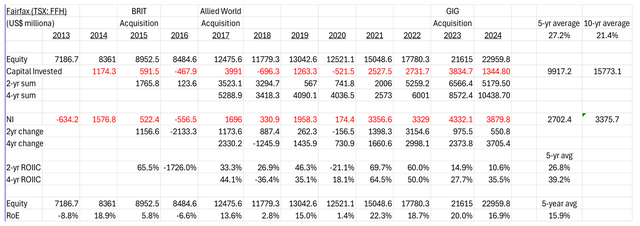
With the integration of the last two acquisitions (Brit (2015) and Allied World (2017)), the 5-yr trailing ROE increased to 12% from 4.6% before these acquisitions. The resulting unlevered RoIIC (see calculation below) has been around 39%, which includes returns from both organic growth initiatives and acquisitions.
Industry Segments
Fairfax competes in numerous insurance markets in North America, Global and International. These businesses have been purchased over the years by Fairfax’s management. In 2024, Fairfax generated 27% of revenues and 23% of profit in their North American segment, 53% of revenues and 66% of profit in their Global segment and 20% of revenues and 11% of the profits in their International segment.
Sources of growth for Fairfax include organic and acquisition growth in their insurance segments. Organic growth in these segments is expected to be 3% annual growth rate with any other growth coming from acquisitions (the largest portion of growth historically) or share repurchases.
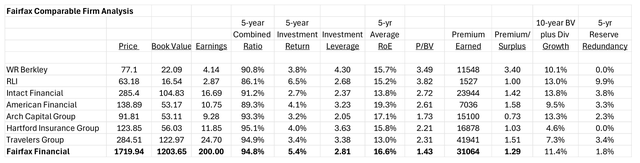
Fairfax operations have become better over time, as a value-added acquisition strategy and a disciplined investment strategy have yielded rewards. The 5-yr trailing returns on equity have increased from 4.5% in 2017 to 15.9% in 2024. The drivers included consistent combined ratios in trailing 5-yr combined ratios from 94.5% in 2017 to 94.8% in 2024, the increase in 5-yr investment returns from 1.9% in 2017 to 5.4% in 2024 and increases in premiums written from $9.7 billion in 2017 to $31 billion in 2024, a 18% CAGR. The investment leverage was also maintained at 3.0x between 2017 to 2024.
The incremental return on invested capital over the past five years is close to 27%, which has increased Fairfax’s RoE over the previous five years. See the calculations below.
Downside Protection
Fairfax’s risks include both operational leverage and financial leverage. Operational leverage in the insurance market is based upon the fixed vs. variable costs of the operations. Insurance operations
profitability is based upon underwriting capabilities whose accuracy is dependent upon technology to quantify, monitor and model risk factors and expert underwriters which lead to modestly high fixed costs. These factors lead to economies of scale for the larger operators.
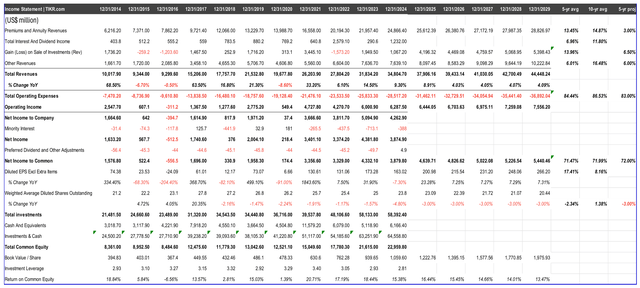
Financial leverage can be measured by the investment leverage ratio. Fairfax has a modest investment leverage ratio of 2.8 versus other insurance firms and lower than Fairfax’s history. The history and projected financial performance for Fairfax is illustrated below.
Management and Incentives
Fairfax’s management team has developed an M&A engine and operationally efficient firms in profitable niches of the insurance industry. They perform acquisitions when targets are available at the right price. At times, the acquisitions are financed by equity and capital is returned to shareholders via buybacks when there are not opportunities to invest organically or via M&A.
The base compensation for the management team (defined as the top three executives except the CEO) is roughly the same amount of $750k to $1.25 million per year. The CEO has modest compensation of $600k and also owns about 6.7% of Fairfax ($2.6 billion). The next top three executives have the highest total compensation, $10.6 million collectively, primarily due to performance-based compensation and share-based compensation. Over the past three years, their total compensation was about $14 million per year, about 0.36% of net income per year. The CEO and executives currently hold 2.1 million shares and options (8.8% of shares outstanding worth $3.4 billion), which is more than 300 times their 2024 salaries and bonuses of $10.6 million. Non-options-based incentive compensation for the executive team is set and approved annually by the board of directors. Over the past two years, 0.75% shares outstanding per year were issued to employees.
Board members have a significant investment in Fairfax. The board and management owns about 9% of total shares outstanding.
Valuation
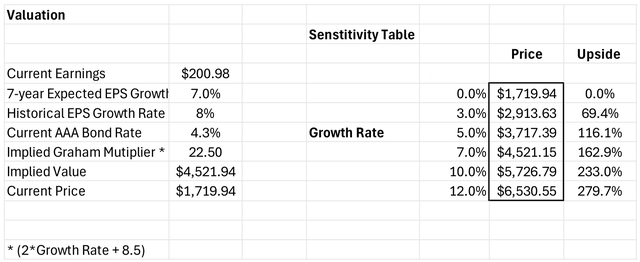
The key to the valuation of Fairfax is the expected growth rate. The current valuation implies an earnings increase of 0% in perpetuity using the Graham formula ((8.5 + 2g)). The historical 10-year earnings growth has been 23% per year including acquisitions and the current return on equity of 8%.
A bottom-up analysis based upon market growth rates of Fairfax’s markets’ (insurance and re-insurance) results was used to estimate an organic growth rate of 3% for Fairfax. This does not include any future acquisitions. If we include 1% growth for acquisitions, then the base revenue growth rate is 4%. Incorporating operational leverage and buybacks results in 8% EPS growth rate. Historically, Fairfax’s EPS growth rate was 8% per year including three acquisitions over 10 years. If we assume no acquisitions over the next seven years the forward EPS of 7% growth per year is conservative. Using a 7% expected growth rate, the resulting current multiple is 23x of earnings, while Fairfax trades at an earnings multiple of 9x. If we look at insurance comparables, which are larger but have slower growth prospects, they have an average earnings multiple of 15x. If we apply 15x earnings to Fairfax’s estimated 2026 earnings of $215, then we arrive at a value of $3,225 per share, which is a reasonable short-term target. If we use a 7% seven-year growth rate, then we arrive at a value of $4,520 per share. This results in a four-year IRR of 27%.
Growth Framework
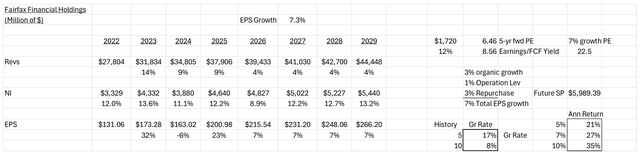
Another way to look at growth and the valuation of companies is to estimate the EPS four years into the future and see how much of today’s price incorporates this growth. Using the same revenue described above results in a 2029 of $266.20, or 6.5x the current price. If we assume a steady-state growth rate from 2030 on of 7%, then this results in a fair value Graham multiple of 22.5x or $5,989 per share, similar to the four-year-forward valuation above of $4,520 per share.
Comparables and Benchmarking
Below are comparable insurance firms (high RoE broad-based insurers). Compared to these firms, Fairfax has investment returns on the high end of the range and has underwriting results on the low end of the range (but still positive) and a below-average multiple. Fairfax also has an above average 5-year RoEs (including the up part of the recent underwriting cycle) and one of the highest ten-year BV + dividend growth rates. 10-year BV + dividend yield was examined to look at growth over an entire underwriting cycle.
Risks
The primary risks are:
- slower-than-expected acquisition growth;
- lower-than-expected growth in Fairfax’s insurance end markets; and
- a lack of new investment opportunities (mergers and acquisitions) coupled with higher stock prices making buybacks less accretive.
Potential Upside/Catalyst
The primary catalysts are:
- higher-than-expected acquisition growth;
- faster growth in Fairfax’s insurance end markets; and
- increased local scope or purchase of local scale in new markets.
Timeline/Investment Horizon
The short-term target is $3,225 per share, which is almost 88% above today’s stock price. Assuming a modest 7% per year earnings per share growth over the next five years, then a value of $5,254 per share. $5,254 is the midpoint of the two methods described above and would result in a 25% IRR over the next five years.
Original Post
Editor’s Note: The summary bullets for this article were chosen by Seeking Alpha editors.
#Bonhoeffer #Capital #Management #Letter