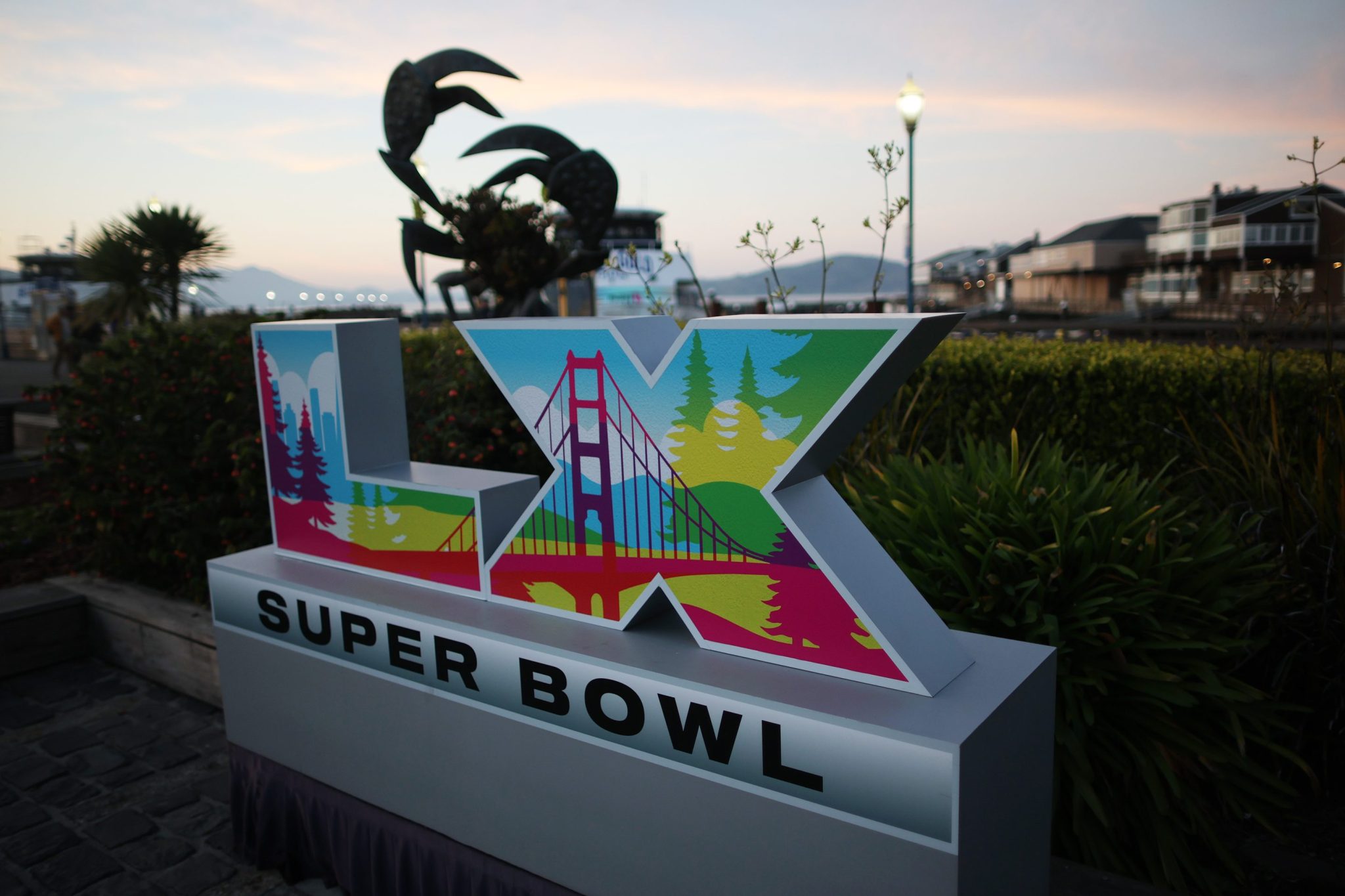
The Super Bowl is supposed to be the highlight of the calendar for gambling companies. This year, though, a cloud has descended over the industry as the big game approached.
The stock of Flutter Entertainment Plc, which runs one of the most popular US gambling apps, FanDuel, is on an eight week skid, the longest in 23 years. It’s main competitor, DraftKings, is trading around the lowest levels since 2023, and is down more than 60% from its all-time high five years ago.
The matchup between Seattle-New England — with less celebrity appeal than last year’s Taylor Swift-soaked event — is partly to blame. But the bigger concern hanging over the industry is the rise of prediction markets like Kalshi, which have come out of nowhere over the last year to offer a new way to bet on sports, bypassing the state-level gambling regulations that have restricted the spread of older gambling apps.
Jordan Bender, senior equity analyst at Citizens, is expecting record breaking trading volumes on prediction markets this weekend at the same time that legal wagering on traditional sportsbooks — or handle as it is known — falls 2% from last year.
“A big piece of why we think Super Bowl handle will be down is that prediction markets are taking a bite out of that,” Bender said.
It is quite the reversal of fortunes for gambling companies that seemed to be riding to ever greater heights in recent years as the American obsession with gambling took off in the wake of a Supreme Court decision in 2018 that allowed states to legalize sports betting. The amount wagered on the Super Bowl has grown for eight years straight.
The threat to these businesses came from an unexpected direction. Until early last year, Kalshi, the leading US prediction market startup, was using its status as a federally regulated financial exchange to offer niche financial contracts tied to pop culture events and elections. The agency overseeing all this, the Commodity Futures Trading Commission, had indicated that so-called event contracts tied to sports were off limits.
Then Donald Trump won the election. Kalshi tested the waters by offering its first wagers on the Super Bowl in early 2025 and the CFTC did not step in to stop them. Those first contracts were little more than an experiment, but sports have since come to account for more than 90% of the trading volume on Kalshi.
Several industry analysts still expect the existing US sportsbooks to take in a record Super Bowl haul this year. Ed Birkin, a senior analyst with H2 Gambling Capital, is forecasting that total wagers — before prediction markets are taken into account — will jump 9% from last year, to $1.78 billion. But said he expects prediction markets will attract $630 million in bets for the Super Bowl and account for 80% of the year-over-year growth in wagering activity for the event.
Wall Street analysts’ average fourth-quarter adjusted earnings per share estimate for Flutter have plunged a whopping 49% over the past three months, according to data compiled by Bloomberg, while revenue expectations have taken a 6.3% hit. For DraftKings, earnings estimates are down 29% while revenue projections have fallen 2.6% in the same period.
Some gambling executives have said that prediction markets are not threatening them in states where they are already operating and are instead primarily gaining ground in the dozen or so states where traditional online gambling is not allowed, including big ones like California and Texas.
BetMGM, which has its own online sports app, announced this week that it attracted record sports bets in the fourth quarter of 2024, helping drive a 63% jump in revenues from a year earlier.
“We can’t see any impact that we can identify that is attributable to prediction markets,” the company’s chief executive officer, Adam Greenblatt, said in an interview.
Greenblatt said the newcomers have also drawn much of their business from the more skilled bettors — known as sharps — who tend to be less profitable for gambling companies.
Read More: Gambling Pros Adjust to a Super Bowl on the Prediction Markets
Older gambling apps, meanwhile, are running up against the limits of their expansion across the country, after the rapid growth that immediately followed the Supreme Court decision. This year, the only new state to allow legal betting on the Super Bowl is Missouri, a relatively small market.
“The Super Bowl 60 outlook reflects a transition from expansion-driven growth to incremental growth as nearly all states with a viable path to legalization are already live,” Benchmark analyst Mike Hickey wrote in a note to clients on Jan. 29.
Still, even in states where gambling has been legal — the strongholds of DraftKings and FanDuel — there have been signs of weakness. Around 10% of DraftKings users were also using Kalshi in January, and Kalshi’s app was downloaded four times as much as either FanDuel or DraftKings, according to the data firm Apptopia.
Part of the allure of Kalshi is that it is using its novel structure to open up betting on everything from the length of the half time show to the likelihood of Jeff Bezos attending the event, while DraftKings and FanDuel are almost exclusively focused on the scoring and outcome of the game.
“Kalshi’s growth is fueled by ad campaigns, earned media, social virality and, above all, superior depth, breadth, and distribution compared to traditional online sportsbooks,” analyst Edwin Dorsey wrote in one of several recent posts on Substack about why he is bearish on DraftKings.
DraftKings and FanDuel have been taking the threat seriously. In December they both launched their own prediction market apps, which are now available in all the states where their traditional apps are not allowed. But together they got just under 100,000 downloads in January, compared with Kalshi’s 1.9 million downloads, according to Sensor Tower data.
On Friday, DraftKings announced that it had struck a partnership with another early prediction market exchange, Crypto.com, to offer a wider array of event contracts.
Gaming regulators in several states have gone to court to try to shut Kalshi and its peers down, and many analysts assume these cases will eventually go to the Supreme Court. But in the meantime, the new chair of the CFTC, Michael Selig, recently indicated that he will allow sports contracts to move forward and is not planning to cede oversight of the territory to the states.
#Gambling #stocks #sag #prediction #markets #steal #Super #Bowl #bets