The significant surge in international oil prices following the attack on Iran by US and Israeli forces, and Iran’s subsequent retaliation in several Middle Eastern countries, will filter through to the South African economy – mostly via the negative impact of higher fuel prices, according to independent economist Elize Kruger.
Kruger commented two days after the American attacks that set off a chain of events which converted the Strait of Hormuz – through which roughly 20% of global oil supply flows – into “a war zone, forcing major shipping lines to halt operations and sending hundreds of vessels to seek shelter in open waters”, as maritime news service gCaptain put it.
Read:
Economists gauge hit from Mideast war as China seen among losers
Wall Street turns to ‘haven-first’ strategy amid Iran crisis
Oil spikes as Middle East war all but halts Hormuz ship strait
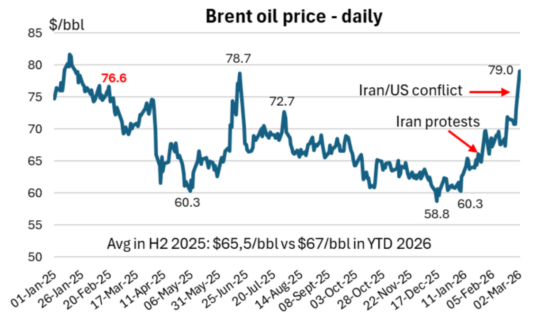
The international oil price – which has been on an upward trajectory since December, also fuelled by protest action in Iran and rising tension between the country and the US – surged to almost $80/barrel.
Analysts from JPMorgan and Barclays are quoted as saying it could spike to $100-130 per barrel if the conflict results in prolonged supply disruption.
Source: Elize Kruger; Macrobond
Maritime movement
Although Iran has not officially closed the Strait of Hormuz, the Joint Maritime Information Centre (JMIC), an initiative established in February 2024 to provide security information to the commercial shipping industry, has raised the regional threat level to critical – its highest level – and noted attacks on merchant vessels with no link to the conflict.
Listen: What’s so special about the Strait of Hormuz?
ADVERTISEMENT
CONTINUE READING BELOW
Major shipping lines have withdrawn from the region and insurers have cancelled coverage. Some that are still prepared to operate have drastically increased their tariffs, which will add to the landed cost of Brent.
gCaptain reported on 2 March: “South Korea’s Sinokor is asking the equivalent of about $20 a barrel to transport oil from the region to China on very large crude carriers, according to shipbrokers. That compares with an average of about $2.50 last year. A smaller ship, controlled by Greece’s Dynacom Tankers Management, was provisionally leased out at about double Friday’s rate.”
Alternative export routes exist, but remain severely limited.
“Saudi Arabia can utilise a pipeline into the Red Sea carrying about 5 million barrels per day, while the UAE can pipe 1.5 million barrels daily to Fujairah for export. Iraq can move some crude into the Mediterranean but only from northern oil fields. Others, including Iran, have no options but to transit Hormuz via ship for export,” gCaptain reports.
Trigger effects
Kruger says higher fuel prices will push up both consumer and producer inflation rates via the direct effect of petrol and diesel as items in the price basket.
Read: Fuel price hike for March … and worse could be on the cards
Depending on how long fuel prices remain elevated, it could also trigger a more broad-based secondary impact. That will result in higher fuel prices, triggering an upward trend in other product prices, also due to costs such as logistics and freight costs that might be notably higher if shipping routes get disrupted for a prolonged period.
“Given the heightened risk environment, the expected upward pressure on prices will likely push out any chance for a near term interest rate cut in SA. But also, the spike in oil price is unlikely to trigger an interest rate hike,” Kruger says.
ADVERTISEMENT:
CONTINUE READING BELOW
The sharp rise in the oil price will reduce the trade benefit that South Africa enjoyed for most of 2025.
However, the weakening of the rand caused by the caution in global markets may be limited because the gold price has also risen sharply, as investors moved their money into safer assets — and gold is one of their main choices, says Kruger.
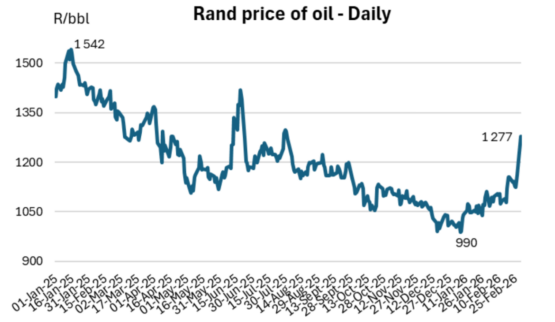
She says fuel prices are correlated with the rand price of oil, which has increased by about 29% since the beginning of 2026, but remain below levels from one year earlier.
Source: Elize Kruger; Macrobond
If the conflict continues for three months and the fuel price increases by a total of R2.50 per litre in April, May and June, Kruger says it could push SA’s average consumer inflation (all else being equal) from an expected average pre-war of 3.5% to 3.8/3.9%, thus moving closer to the upper end of the 1% tolerance band for consumer price inflation.
It would however not derail SA’s lower inflation narrative completely, she says, adding that the impact will critically depend on how long the oil price remains on elevated levels.
An added negative would be pressure on household budgets, as higher transport costs erode spending power, says Kruger.
Uncertain future
ADVERTISEMENT:
CONTINUE READING BELOW
Professor Adrian Saville from the Gordon Institute of Business Science (Gibs) said on MoneywebNOW that the US attack was clearly signalled before the weekend and extremely well-coordinated by the evacuation of embassies and the movement of markets.
Listen: Iran strike: The risks that outlast the missiles
He expressed his concern that although much has changed since the events of the weekend, nothing has been resolved and referred to the “well-worn path of large military forces going into countries saying ‘We’ll sort things out’,” only to leave a vacuum afterwards.
This leaves a trail of directionless countries that end off worse than before the intervention, he said.
Saville also expressed his hope that Iran – whose citizens had been desperate for change – will now end up on a better path, emphasising that its fate will have a huge impact on global markets, since it is so rich in resources.
Listen/read: Middle East crisis pressures SA trade, oil and rand
You can also listen to this podcast on iono.fm here.
#Iran #conflict #delay #local #interest #rate #relief