When Block laid off nearly half its staff this week, co-founder Jack Dorsey offered a seemingly simple explanation: artificial intelligence was allowing the company to do more with fewer employees.
The announcement, though, landed at the center of a complex debate over AI and the future of work: on one side, genuine fear that the technology will displace jobs at an unprecedented pace; on the other, deep cynicism that companies are exploiting that fear to dress up old-fashioned cost-cutting as technological futurism.
The possibility that companies are spinning employees and investors and using AI as a shiny excuse for ugly layoffs has become widespread enough that it has a nickname: AI-washing.
Block’s recent history suggests that AI adoption is not the only factor influencing its staffing decisions. The company loaded up on workers during and after the pandemic, more than tripling its employee base between 2019 and 2022, and has been slower than peers to scale back. Its stock had fallen roughly 40% since the beginning of 2025, a trajectory that had nothing to do with AI and everything to do with a business that had grown unwieldy.
“When I look at the overall employee number, this is more about the business being bloated for so long than it is about AI,” said Zachary Gunn, a senior analyst at Financial Technology Partners, an investment bank focused on fintechs.
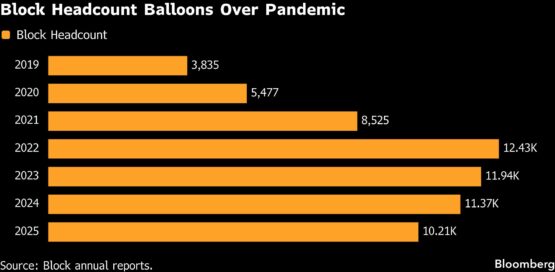
While companies are eager to show investors they are embracing new technology, experts on workplace automation say that AI tools have not gotten to the point where they are causing significant cutbacks in the labor market.
ADVERTISEMENT
CONTINUE READING BELOW
A note from Goldman Sachs published Friday argues that fears of an imminent AI jobs apocalypse are “excessive.” The bank’s economists estimate that sectors like tech that are impacted by AI are shaving just 5 000 to 10 000 jobs per month from overall payroll growth in the US. Goldman forecasts a 0.5 percentage point increase in the unemployment rate as adoption rises.
European Central Bank President Christine Lagarde told lawmakers in Brussels this week that ECB economists are monitoring for signs that AI is causing job losses and are “not yet seeing” the “waves of redundancies that are feared.”
White-collar risks
When Amazon announced sweeping layoffs last year, it went to pains to say that AI was not the explanation. Asked about the cuts on an October earnings call, Amazon CEO Andy Jassy told analysts that the decision was “not really financially driven and it’s not even really AI-driven. Not right now, at least.”
Similar questions have come up over and over in the past year as a growing number of companies, including Salesforce and HP, cite AI efficiencies as the reason for job cuts.
The questions about Block were especially pointed because the company’s announcement came just days after a viral Substack newsletter, from a small outfit called Citrini Research, sketched out a nightmare scenario of mass unemployment, sending stocks tumbling.
That report caught fire in no small part because big AI companies have been pumping out new, more powerful models. One of the leading players, Anthropic, recently released a number of tools that take on the bread and butter of American corporate work, such as financial analysis and legal research. Large language models have proven to be particularly adept at coding, and software engineers have been among the loudest proponents of the idea that big changes are coming.
“If you’ve spent time with tools like Claude Code or Codex, you can see how smaller teams really can ship more,” said Gad Levanon, chief economist of The Burning Glass Institute, a labor market research nonprofit that studies AI’s impact on jobs.
ADVERTISEMENT:
CONTINUE READING BELOW
“The risk to white-collar work over the next few years is real, and workers, managers and policymakers should be planning for that world now,” he added.
Messages like those may turn out to have been prudent, but they’re also magnifying the anxiety many workers already have about a tough job market. US companies announced more than 108 000 job cuts in January, the most in the first month of the year since 2009, when the country was in an economic meltdown.
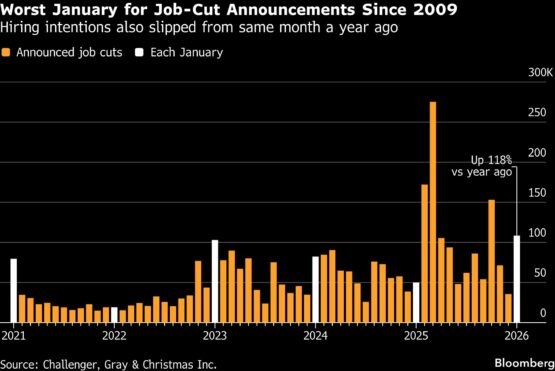
A recent survey of global executives published in the Harvard Business Review found that while AI has been cited as the reason for some layoffs, those cuts are almost entirely anticipatory: executives expect big efficiency gains that have not yet been realised.
‘Two options’
In the letter Dorsey sent to his employees, and shared on social media, he put less emphasis on jobs at Block that have already been replaced by AI and more focus on what he expects to happen in the future.
“i had two options: cut gradually over months or years as this shift plays out, or be honest about where we are and act on it now,” he wrote. “i chose the latter.”
ADVERTISEMENT:
CONTINUE READING BELOW
Dramatic restructuring moves may indeed be necessary to capture the benefits of AI, said Kristina McElheran, an associate professor of management at the University of Toronto Scarborough.
“Sometimes, if you really need to make a big change and you need everyone to understand a new direction — your employees, your partners, your customers, the market — you have to do something really big and irreversible, like burning the apocryphal boat,” she said.
For Dorsey, the situation also plays into older concerns about his interest in unproven technological bets and his reputation for struggling with financial discipline. At Block, he has come under fire for directing resources into Bitcoin-related projects, at the expense of the more proven parts of the business, like the Cash App and the Square retail payment technology. Twitter, the other company he co-founded, was famously gutted by Elon Musk, who quickly cut 80% of the staff when he bought the social-media network.
Dorsey took to social media on Friday to respond to one critic who pointed to the accusations of bloat that have dogged his companies. Dorsey acknowledged that the company had “over-hired” during Covid, and operated inefficiently when it ran Square and Cash App as two separate businesses. But he said Block had corrected for all that, and that it now aims to generate more than $2 million in gross profit per employee, quadruple what it was generating pre-pandemic.
“We are taking bold and decisive action here, but we’re doing it from a position of strength,” Block Chief Financial Officer Amrita Ahuja said in an interview with Bloomberg.
The reaction so far on Wall Street is likely to drown out any doubters. Investors sent Block’s shares up 15% on Friday in the wake of the layoff announcement. Disentangling how much of that stemmed from excitement over the company’s adoption of AI and how much was due to relief at a smaller payroll may be beside the point in a market that often rewards job cuts.
© 2026 Bloomberg
Follow Moneyweb’s in-depth finance and business news on WhatsApp here.
#Jack #Dorseys #job #cuts #block #arouse #suspicions #AIwashing