Tech titans and stock market investors are increasingly unified in their forecast that artificial intelligence will permanently eliminate millions of white-collar jobs and render traditional employment obsolete.
Software and services stocks have taken a beating, with software multiples pulling back by roughly 33% since late 2025 as investors fret over AI’s potential to automate vast swaths of knowledge work. Earlier this year, Elon Musk predicted that AI and humanoid robots will make work completely “optional” within the next 10 to 20 years, ushering in a post-scarcity economy where money itself becomes irrelevant. He joins a growing chorus of tech executives issuing stark warnings about human obsolescence; OpenAI CEO Sam Altman recently cautioned that superintelligence could soon outperform even top corporate executives, while Microsoft AI chief Mustafa Suleyman and Anthropic CEO Dario Amodei have projected that sweeping white-collar automation could arrive in one to five years. Economists remain skeptical of the timeline, noting that the apocalyptic narrative may be as much a tool to justify astronomical tech valuations as it is an impending economic reality.
But a new, cross-asset research report from Morgan Stanley offers a remarkably grounding message for anxious employees and jittery markets: most of you won’t be permanently unemployed; you are just going to find new jobs, many or most of which don’t exist yet.
Addressing the widespread concern that AI will “replace millions of jobs and increase unemployment by an equivalent amount,” a large team of Morgan Stanley analysts pointed directly to history. Over the past 150 years, sweeping technological shifts—from electrification and the tractor to the computer and the internet—have fundamentally altered the labor force, but they “did not replace labor”.
When the spreadsheet was popularized in the 1980s, for example, it automated tedious financial modeling and reduced the need for certain bookkeeping clerks. However, it simultaneously freed up analysts’ time to do more complex work and birthed entirely new financial professions. Similarly, the firm argues, AI will merely change “job types, occupations, and needed skills”.
“While some roles may be automated, others will see enhancement through AI augmentation and other, entirely new roles will be created,” the report said. Rather than a mass extinction event for the white-collar worker, in short, the bank sees the corporate landscape is simply preparing for an evolution.
The jobs to come?
So, what will these new jobs look like? Morgan Stanley outlines several emerging professions that it predicts will soon become corporate staples. As AI becomes central to business strategy, companies are expected to hire executive-level “Chief AI Officers” to guide technology adoption across departments. There will also be a massive surge in AI governance roles focused on data compliance, policy oversight, and information security, particularly in sensitive sectors like healthcare.
The tech sector could see the rise of blended roles, such as the product manager-engineer hybrid. Empowered by natural language coding tools, product managers will increasingly engage in “vibe coding”—prototyping and iterating concepts themselves before handing them off to engineers for deployment.
Highly specialized roles could also emerge across various industries. In the consumer sector, “AI personalization strategists” and “AI supply chain analysts” will blend data science with customer experience. In industrials, we will see “predictive maintenance engineers” and “smart grid analysts,” while healthcare will demand “computational geneticists” and specialists dedicated to AI diagnostic oversight.
For financial markets, the current panic over AI disruption appears premature, if not entirely misplaced, in the bank’s view. Morgan Stanley notes that the services and cyclical industries that have recently seen outsized underperformance due to disruption fears make up only about 13% of the S&P 500’s market cap.
Fortune previously reported on a similar finding from other Wall Street economists: the market appears to be talking itself into a panic that the fundamentals don’t justify, a trend likely exacerbated by the increasing number of retail investors in the equities market. Apollo Global Management Chief Economist Torsten Slok warned on Wednesday that the “entire market [is] exposed to a big move,” reasoning that the share of S&P 500 names moving more than 10% in a single day has increased, while options activity remains “extremely elevated, consistent with heavy retail speculation and leverage-like exposure.” This leaves the market structure “more fragile and more vulnerable to an abrupt, outsized move.”
But what if this time is different?
The Morgan Stanley report offers welcome reassurance — but it may be telling a comforting story that doesn’t fit the technological and economic realities of 2026. While it’s true that past waves of automation created as many jobs as they destroyed, AI may represent a qualitatively different shift, targeting cognitive, creative, and decision-making tasks once thought immune to automation.
In a new paper released the same day, two Nobel-winning economists (Daron Acemoglu and Simon Johnson) and another, massively influential one (David Autor, known for his work on “the China Shock”) argued that this time really could be different. In “Building pro-worker artificial intelligence,” published by The Hamilton Project, they warned that “pure automation technologies” do the opposite of collaborating with workers: “they commodify human expertise, rendering it less valuable and potentially superfluous.” The specific stock of specialized, human expertise could become “obsolete” with wide deployment of such technology.
While the Morgan Stanley thesis reflects historical optimism, history’s lessons may not apply cleanly in a situation with a shift from tools that amplify labor to systems that replace cognition. As warned in the speculative essay by Citrini Research, AI could produce productivity gains that decouple corporate profits from employment even more than in the computing era. If firms can scale output with largely automated workforces, they would have little incentive to rehire at historic rates.
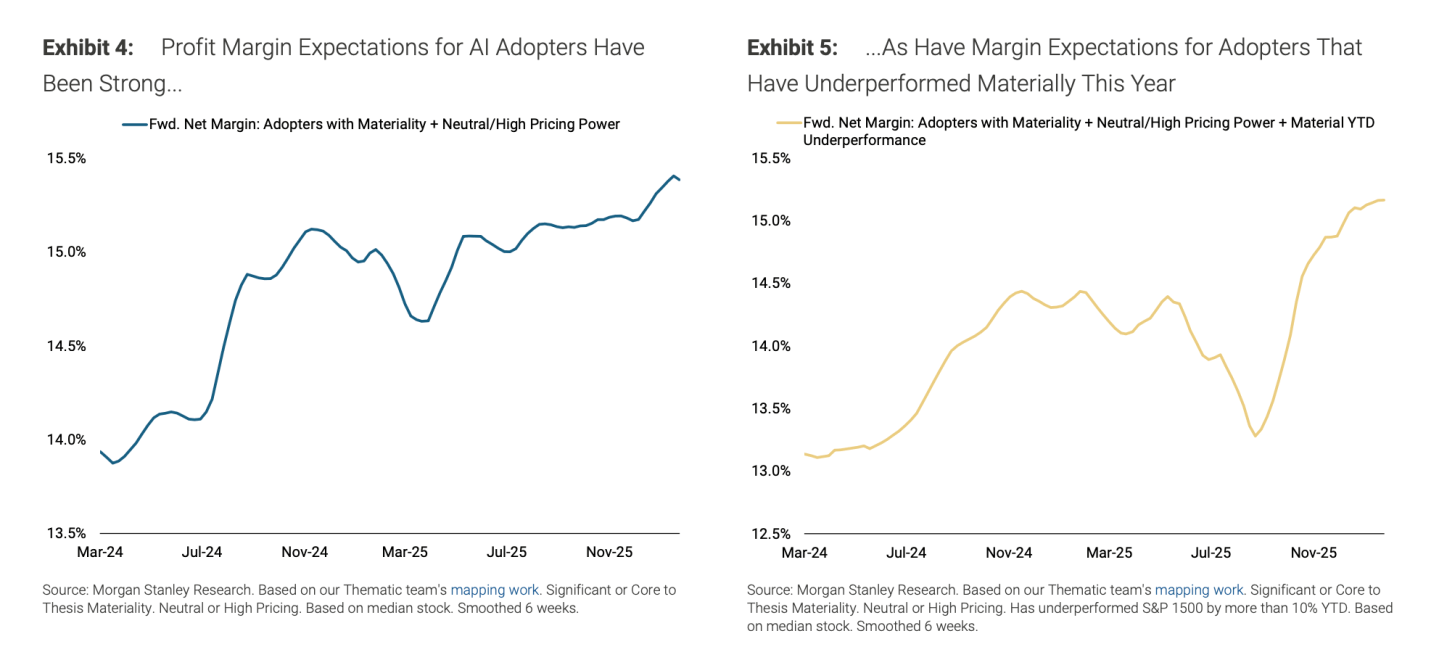
Morgan Stanley cites evidence that corporate America is already reaping tangible rewards from AI adoption. By the fourth quarter of 2025, 30% of companies identified as AI “adopters” reported quantifiable financial or productivity benefits from the technology, up from just 16% a year prior. As a result, forward profit margin expectations are actively accelerating for companies successfully utilizing AI. How those margins continue to increase, and how many new jobs those companies create as a result, will bear out whether Morgan Stanley’s prediction is right.
For this story, Fortune journalists used generative AI as a research tool. An editor verified the accuracy of the information before publishing.
#Morgan #Stanley #predicts #change #work #future #job #exist