Government has adjusted several critical thresholds that have had a detrimental effect on entrepreneurship. It has also disincentivised company growth and expansion for smaller businesses for several years.
Finance Minister Enoch Godongwana announced in his 2026 Budget Review that the compulsory threshold for value-added tax (Vat) registration will increase from R1 million to R2.3 million.
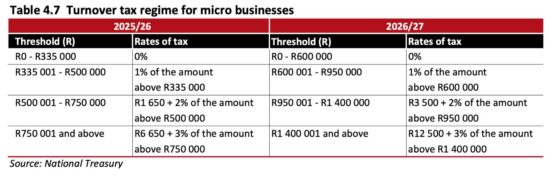
The annual turnover limit for the turnover tax for very small businesses has been lifted from R1 million to R2.3 million. These two thresholds have not been adjusted since 2009.
Given the low threshold for the turnover tax, there has not been a significant uptake of this favourable tax regime for micro businesses.
National Treasury has now removed the restriction on tax year-end dates, making the regime more attractive.
Many small businesses have indicated that the low thresholds have forced them to stay small rather than be pulled into the Vat net and deal with the administrative burden of Vat compliance.
Charles de Wet, tax executive at ENSafrica, previously noted that if the Vat threshold had been adjusted for inflation it would have been close to R2 million. This increase to R2.3 million is in line with expectation.
Read:
Budget 2026 and Vat: The quiet revenue lever Sars is pulling
Calls for medical and mental health professionals to be Vat-exempt
ADVERTISEMENT
CONTINUE READING BELOW
Mental healthcare providers say the current Vat regime leaves them stuck: expand their practices and tip over the R1 million threshold into the Vat net, or remain small to stay price-competitive.
Once turnover exceeds R1 million, they must register and add 15% Vat to their fees. Yet with few input costs to claim back – as they are largely selling their time – there is little scope to offset the additional tax burden.
Move welcomed
Several tax commentators have welcomed the long overdue increase in the mandatory registration threshold.
Nicolaas van Wyk, CEO of the Chartered Institute for Business Accountants (Ciba), says the threshold had not kept up with inflation and increased compliance cost and administrative complexities.
It created an “abyss effect” where growth meant a significant increase in the administrative burden, cash flow pressure and regulatory risks.
By increasing the threshold it removed these barriers to growth.
It makes it much more rational for small businesses to remain formal and to expand, rather than limit growth or have to fragment their businesses to remain under the threshold.
ADVERTISEMENT:
CONTINUE READING BELOW
“From a fiscal perspective, this is not a weakening of the tax bases, but must be seen as an expansion of the base,” says Van Wyk.
Participation and formal economic expansion will lead to increased tax collections over the long term in the form of income tax, employee taxes and corporate income tax.
“A sustainable tax base is built on growth and participation and not through continued pressure on a small group of registered taxpayers,” he adds.
Charles de Wet, tax executive at ENSafrica, has been advocating for an increase in the threshold for a long time.
The increase is long overdue and will now offer smaller businesses the opportunity to grow, he said in response to the budget announcement.
Faith Ngwenya, head of education at Ciba, says the increase in the Vat registration threshold can be seen as “arguably one of the most small and medium sized-friendly measures in the budget”.
She also welcomed the inflationary relief for individuals and says it is “mildly positive”. It protects them from “inflation tax” and offers slightly better savings incentives.
Read our compressive Budget 2026 coverage here.
Follow Moneyweb’s in-depth finance and business news on WhatsApp here.
#Vat #registration #threshold #updated #time