After three days without power in sub-zero temperatures, tech entrepreneur Anastasiya Stepula decided to leave her apartment in central Kyiv in search of heat.
Stepula, 37, had been wearing a ski suit to try and keep warm since a Russian attack on the capital’s energy infrastructure took out the power to her block among hundreds of others. But with nighttime temperatures plunging to minus-19 degrees Celsius (minus-2 Fahrenheit), she headed out to look for somewhere warmer, recharge her devices, and to continue working.
Not far from her house, she saw windows glowing in an office building and was surprised to find that it was a hub for software developers like her equipped with its own electricity supply, a powerful generator, tea, coffee, places to sleep, and even house slippers.

Anastasiya Stepula working at the Lift99 office. Image: Julia Kochetova/Bloomberg
“Finally, I can type with hands that are not trembling from the cold,” she said at the office, called Lift99, as she waited for her son to join her there from school.
Later that day, President Volodymyr Zelenskiy imposed a state of emergency in Ukraine’s energy sector, with a coordination headquarters established to address the situation in Kyiv and repair crews working around the clock. “The consequences of Russian strikes and deteriorating weather conditions are severe,” he posted on X late on Wednesday.
As President Vladimir Putin’s war on Ukraine approaches the end of its fourth year, energy infrastructure has once again become a major target of Russia’s attacks, intensifying from September to December heading into the worst of winter. That’s placing a huge additional burden on Ukraine’s government, energy companies and local authorities to carry out emergency repairs, and attempt to shore up public morale.
Last week, large-scale missile and drone attacks targeted power-grid facilities in the Dnipropetrovsk region, leading to blackouts of entire cities there and in neighbouring Zaporizhzhia. Russian forces subsequently struck energy infrastructure facilities in Kyiv — a city of some 4 million — as well as the surrounding region, leaving households without power, heating and in some cases water.
Electronics chains are seeing a rush for portable power devices, while spaces like Lift99 offer some temporary respite. Lift99 was almost completely destroyed in a missile strike last fall; by late December, it had been restored and reopened as a safe place with constant heat and light. It has just announced a “free week,” when it’s ready to assist at least 100 people regardless of whether they are developers or not.
ADVERTISEMENT
CONTINUE READING BELOW
Oleksandra, a marketing consultant who like most of those interviewed asked to give her first name only, was there with her dog. A former manager at the hub, she said she comes “not only for communal benefits, but for people, atmosphere and support.”
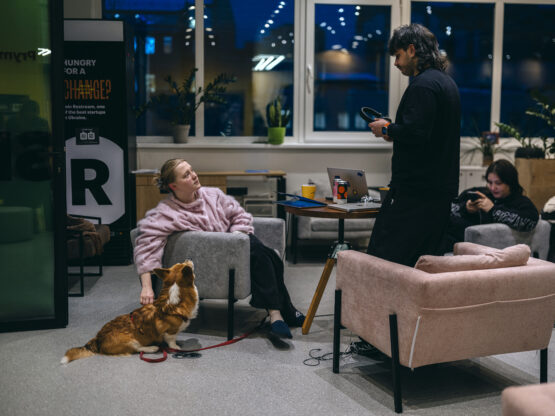
Oleksandra with her dog at Lift99, where there is constant power and stable WiFi. Lift99 was damaged by a Russian strike last fall, but quickly repaired. Image: Julia Kochetova/Bloomberg
It’s still a daily struggle for most residents of the capital in these darkest days of winter. Kyiv Mayor Vitali Klitschko encouraged residents to seek temporary refuge outside the city on Jan. 9 after a Russian barrage that caused widespread outages. With temperatures of minus-14 degrees Celsius during the day this week, some don’t need persuading.
“Cold in wartime is a powerful weapon,” Zoriana Hoshovska, who evacuated to the west of Ukraine, said by phone. “It affects people’s ability to work and think clearly — the body switches into survival mode.”
Like many others, Hoshovska, 44, faced a choice between cold radiators in her Kyiv apartment and slightly warmer conditions outside the capital. Her decision was predictable.
Spending her vacation in Ukraine’s West, Hoshovska, a communications manager, knew from her Kyiv building’s group chat that municipal engineers had turned off heating as the temperature sank. She opted not to return, instead temporarily moving with her young son to her native city of Rivne. While power and heating supplies there are extremely limited, conditions are slightly better than in the capital, she said. Power outages, for example, are more predictable and follow a schedule.
She says local authorities were poorly prepared for the cold season — a sentiment echoed by Zelenskiy, who said that “time was lost” by the capital that requires the government to step in.
She still plans to return to Kyiv after neighbours told her that heating had been restored. Mindful of a repeat, Hoshovska has a contingency plan — friends have offered her a place to stay in cities such as Ivano-Frankivsk and even Warsaw, where she spent a year and a half immediately after Putin sent troops into Ukraine on Feb. 24, 2022.
“If the issue persists, our western allies should brace for a new wave of migrants from Ukraine,” she said.
ADVERTISEMENT:
CONTINUE READING BELOW
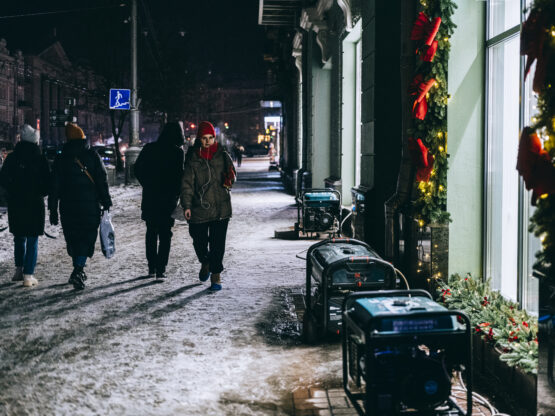
Generators power stores in downtown Kyiv. Image: Julia Kochetova/Bloomberg
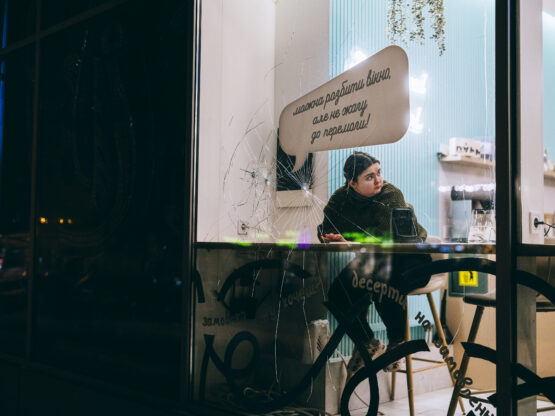
A coffeeshop sign in Kyiv reads: They can break our window but not our will to win. Image: Julia Kochetova/Bloomberg
Downtown Kyiv is still full of people going about their daily lives, albeit wrapped in multiple layers of clothing. Traffic jams remain a regular occurence. The Kyiv metro, whose deep stations offer shelter from Russian bombardments, double up as places of relative warmth.
On one afternoon this week, there was a queue of more than five people at a hiking equipment store in downtown Kyiv, most in search of gear for indoors rather than outdoors.
“People come and ask, how can we keep warm?” said Bohdan Hriazev, 24, a sales assistant. The store has been without heating for about a week, and Hriazev wore a hat, a zhyletka, or padded vest, gloves and Crocs, which he said protect well against the cold. A headlamp was a useful addition to his gear.
“After they buy a sleeping bag, a tent, a camping mat and a gas heater, people start thinking: why not spend some time outdoors? And they actually go,” he said. “Culture is changing because of the hardships.”
Back in 2022 after the first Russian shelling of Ukraine’s capital, so-called invincibility hubs were established in schools, shops and emergency service tents to offer citizens access to heat and electricity to charge their phones. They are making a comeback as the situation has again become more critical, above all on the left bank of the Dnipro River which flows through the capital and cleaves the country between west and east.
According to latest assessments by the European Union, if attacks continue at the current pace and scale, entire left-bank regions of Ukraine — home to around 15 million people prior to 2022 — risk losing access to electricity supply. Energy companies report that equipment reserves have been exhausted, with no remaining stocks of power transformers or other critical supplies.
ADVERTISEMENT:
CONTINUE READING BELOW
Sitting in an “invincibility hub” tent on Kyiv’s left bank, Natalia, the mother of a six-year-old child, said she’d been without heating for almost five days and electricity for three days as of Wednesday afternoon. It’s 15 degrees Celsius in her apartment when they cook on a gas stove; otherwise the temperature is low, she explained. “The refrigerator became the warmest place in my house,” she said.
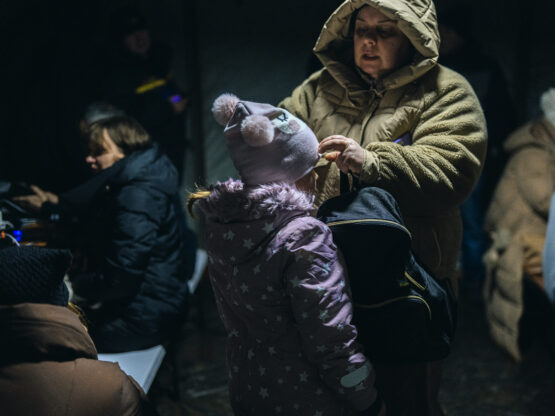
Natalia and her daughter Mila came to the invincibility hub to warm up and charge their phone. They have had no heating for 5 days. Image: Julia Kochetova/Bloomberg
Almost all those at the invincibility point have either small children or older relatives whom they won’t leave behind in Kyiv. A few have so-called dachas, typically small country houses, which are not suitable for living in during winter. All are tired of wearing at least three sweaters and padded trousers. “But we hold on,” said Eugenia, another visitor.
Mark, 19, a student who was chatting with friends while charging his phone, had come to the invincibility point for the first time, as “it’s too cold and there’s no Internet at home.” The Education Ministry has recommended online studying, at least in Kyiv, during the blackouts.
Tetyana, 62, a left-bank pensioner, was recharging her power banks while reading a book about the Ukrainians who fought and died protecting the capital during the initial Russian assault on the city in early 2022. Her son was among them, she said.
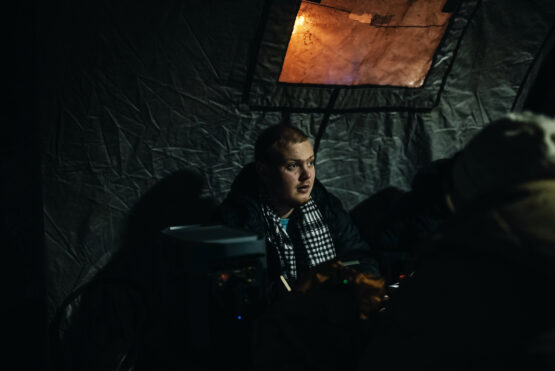
Mark at the resilience point on Kyiv’s left bank. These points include heated tents with chargers, hot tea, and coffee. Image: Julia Kochetova/Bloomberg
Without heating for five days, Tetyana at least had gas, “so we can cook some food, though it’s only warm in this place.” Asked if she’d move elsewhere as the mayor had suggested, she said that she lives with her 92-year-old father-in-law. “I came to Kyiv to live with him and help him, how can I move somewhere else?” she said.
In any case, her biggest challenge isn’t heat or power. “We will recharge everything,” she said. “The biggest grief is that young people keep on dying.”
© 2026 Bloomberg
Follow Moneyweb’s in-depth finance and business news on WhatsApp here.
#power #Kyivs #residents #confront #cold #weapon #war