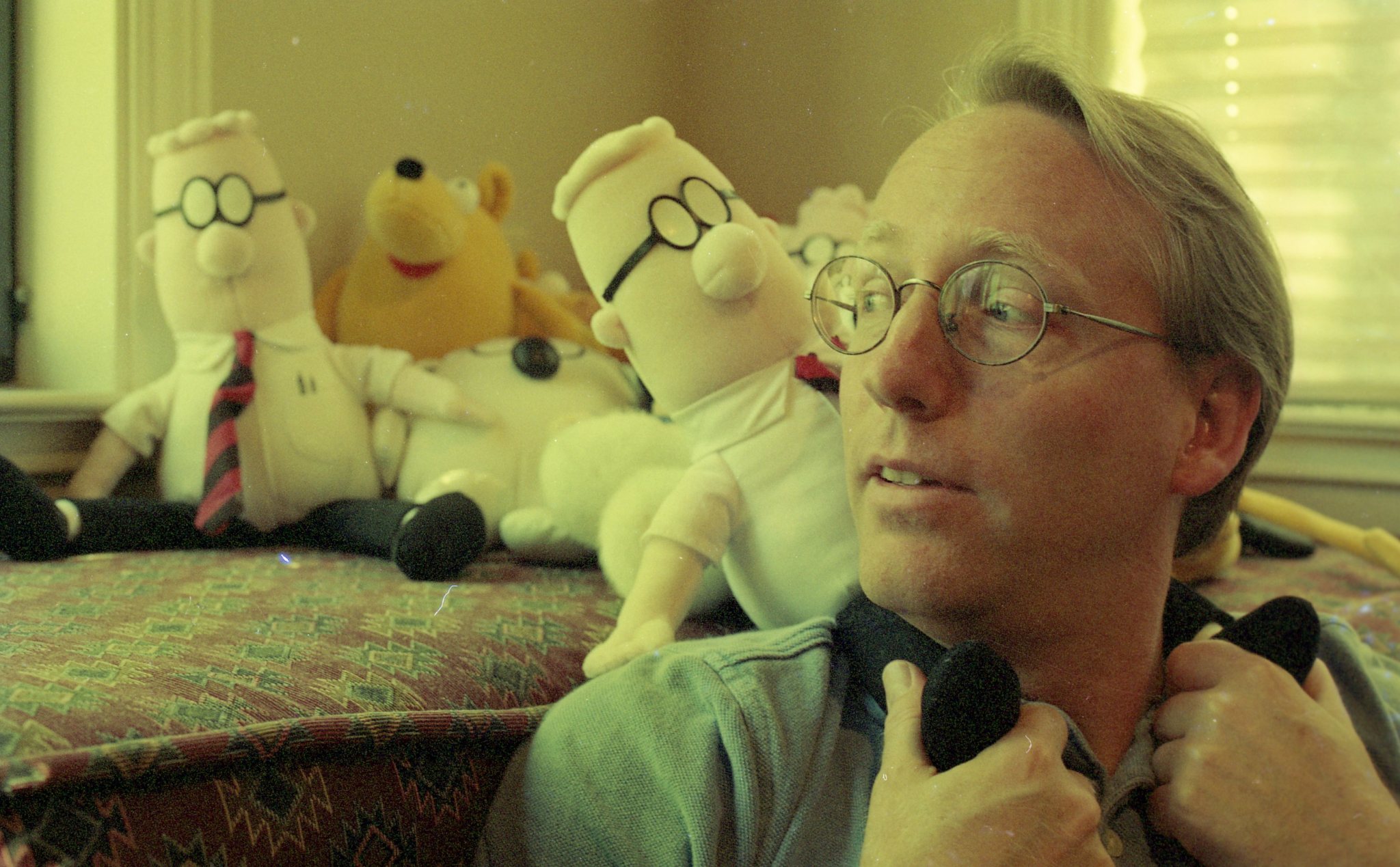
“If you are reading this, things did not go well for me.” That’s how Scott Adams’ X account announced his death on Jan. 13, reaching an enormous global audience in much the way he had for decades throughout a career that spanned both the cartoon pages and front pages of newspapers for the controversial personality.
Adams, creator of the satirical office comic strip “Dilbert” and later a polarizing conservative-leaning online commentator, died in Pleasanton, Calif., at 68 from metastatic prostate cancer. His death came after months of rapidly declining health, including paralysis from the waist down and hospice care in his final days.?
Adams’s first ex-wife, Shelly Miles, told TMZ on Jan. 12 Adams had entered hospice care as his condition worsened, and he died the following day. He had publicly disclosed in May 2025 he was battling aggressive prostate cancer that had already spread and said “the odds of me recovering are essentially zero.” In late 2025, Adams described a tumor near his spine that left him paralyzed from the waist down, telling viewers: “I can’t move any muscles. I do have feeling, I just can’t move any muscles.”?
In his final weeks, Adams continued recording and posting YouTube videos from home while receiving end-of-life care, with family members and a nurse tending to him around the clock. On Jan. 13, his X account posted “a final message from Scott Adams,” which was datemarked Jan. 1, describing his evolution from “Dilbertoonist” to what he described as an author of “useful books.” Framing his later career as oriented around helping people, he wrote, “I had an amazing life. I gave it everything I had.”
Appeal for treatment and political ties
Adams used his social media platforms to detail his treatment, including an appeal in November 2025 for access to Pluvicto, an FDA?approved drug for metastatic prostate cancer. On X, he claimed Kaiser of Northern California had approved the drug, but “dropped the ball” on scheduling the IV, adding, “I am declining fast. I will ask President Trump if he can get Kaiser of Northern California to respond and schedule it for Monday.” Trump reposted Adams’ plea with the response “On it!” on Truth Social, and Health and Human Services Secretary Robert F. Kennedy Jr. also publicly engaged on the issue, after which Adams said an appointment for Pluvicto had been arranged.?
Adams had long cultivated a reputation as an admirer of Trump’s political style and as a commentator on persuasion and media framing, frequently praising Trump’s communication skills. In later updates, Adams told his audience radiation treatments for the spinal tumor had delayed his Pluvicto regimen and left him uncertain whether he had “missed [his] opportunity” with the drug.?
Critics at the time praised the fact Adams was able to receive the treatment, but bemoaned the fact others don’t have the president’s ear—or the means—to access similar treatment.
“Our health system shouldn’t be one where we need the intervention of the president or the HHS secretary to weigh in on behalf of a high-profile political backer,” Anthony Wright, the executive director of Families USA, told NPR.
From office cubicles to culture wars
Born in 1957, Adams worked in corporate offices before launching “Dilbert” in 1989, a strip that skewered white?collar life and eventually ran in thousands of newspapers worldwide. The popularity of “Dilbert” led to best?selling books such as “The Dilbert Principle,” speaking engagements, and a media presence that made him one of the most recognizable cartoonists of the 1990s and early 2000s.?
His reputation shifted dramatically in 2023 after a YouTube livestream in which he reacted to a poll about the phrase “It’s OK to be white” with remarks widely condemned as racist, prompting major newspaper chains to drop “Dilbert.” This was far from the first time Adams made shocking comments that leaned in a conservative direction, though. For instance, he said in 2011 women are treated differently by society in a manner similar to children and the mentally disabled: “It’s just easier this way for everyone.” And he once remarked 2016 GOP presidential candidate Carly Fiorina had an “angry wife face.”
Fans and critics alike are now debating how—and whether—to separate the enduring image of the perpetually frustrated office worker from the man who drew him, whose last public acts included a very modern attempt to shape the story of his own illness and death through social media and carefully prepared final statements.
#Scott #Adams #Dilbert #creator #cubicle #wars #culture #wars #posts #open #letter #time #death