Rising interest in the health benefits of fibre has prompted food and beverage makers to fortify everything from soda to snacks. That’s now boosting the earnings outlook for the suppliers of the raw ingredients.
PepsiCo recently just released a prebiotic soda after proclaiming that “fibre will be the next protein.” One of the companies making the all-out push into fibre possible is British household staple Tate & Lyle Plc, which has traded its historic roots as a sugar refiner to make a range of ingredients, including various dietary fibres.
“We’re definitely seeing a broader and deeper range of products being considered for added fibre,” Nick Hampton, chief executive officer of the UK-based maker of sweeteners, texturizers and nutrients, said in an interview. “There’s a lot of excitement around this consumer trend.”
Demand for the nutrient is growing, buoyed by “fibremaxxing” content on social media and the rapid expansion of weight-loss drugs. Fibre helps with satiety and acts as a prebiotic that feeds good bacteria, making it appealing to both GLP-1 users who are trying to maintain their weight and consumers more broadly who care about gut health and general wellness.
That’s great news for suppliers of ingredients to the food industry. “It’s a huge opportunity,” Goodbody analyst Patrick Higgins said in an interview. “Consumers globally are much better educated as to what they’re putting in their bodies and what they’re lacking in.”
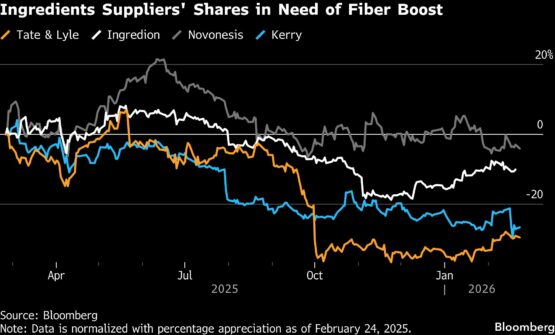
Denmark’s Novonesis A/S, Ireland’s Kerry Group Plc and US-based Ingredion Inc. are some of the other names that stand to benefit from the growing fibre trend, operating behind the scenes as business-to-business providers of fibre.
ADVERTISEMENT
CONTINUE READING BELOW

This fibre moment is reminiscent of the protein craze, which has brightened prospects for yoghurt giants, makers of workout shakes and poultry producers alike.
The difference, according to Barclays analyst Alex Sloane, is that the world really does need more fibre. Average global consumption remains at around 18 grams per day against recommended intakes of 25 to 38 grams per day for adults, highlighting a “sizable structural gap,” he said.
Even a small increase toward the lower end of the recommended range implies a compound annual growth rate of 7% in incremental fibre demand over the next five years, Sloane calculates, clearing a significant growth runway for ingredients suppliers.
Tate & Lyle has the largest exposure, with about 20% of sales, according to Sloane. The company is a leader in soluble corn fibre, one of the top dietary fibres globally. Kerry specialises in acacia-based fibres, while Novonesis, though not a traditional supplier of dietary fibres, has introduced enzyme technology to better extract fibre from corn.
Being a supplier of this key nutrient could be a bright spot for companies facing share price pressure. Investor enthusiasm for packaged food firms — and by extension, their suppliers — has been dented by concerns that sales could decline amid the increasing popularity of obesity drugs and the growing backlash against ultra-processed foods, Sloane said.
“Therefore, where there might be a perception of structural growth potential, where there is an unmet need like there is with fibre or protein, you’re going to want to talk that up,” he said.
ADVERTISEMENT:
CONTINUE READING BELOW
Tate & Lyle has been posting about #fibreFebruary on LinkedIn, and other companies are starting to catch on to the trend.
“It’s just a matter of time” before the fibre trend moves from beverages to other food categories like pastas and baked goods, and “we have the right portfolio of fibre to play in these segments,” Sebastian Smith, Ingredion’s director of fibre fortification and healthful solutions, said in an interview.
While Ingredion reported tepid fourth-quarter results at the beginning of the month, the texture and healthful solutions portfolio, which develops fibre products and sugar reduction technologies, grew and is expected to continue doing so.
“You’ve got a tale of two stories here. In the texture and healthful solutions, the portfolio is really well aligned with a lot of these secular trends, whether it’s protein, fibre, clean label,” said Kristen Owen, an analyst at Oppenheimer. “The other two businesses are offsetting that growth, and those are businesses that are more impacted by megatrends like GLP-1s or cleaner, healthier eating.”
The earnings boost for ingredients companies will probably happen “very gradually,” said Morningstar analyst Seth Goldstein. Tate & Lyle’s Hampton expects the benefits from the company’s work with Pepsi to come through in the next couple of years.
ADVERTISEMENT:
CONTINUE READING BELOW
“What we’re seeing in the immediate term is lots of exploration and formulation going on, less product launches,” Hampton said. “That’s going to have to pick up.”
As innovations ramp up and marketing tactics evolve, ingredients suppliers run the risk of being accused of “health washing,” or making products appear healthier, more natural or more nutritious than they actually are, according to Sloane.
Unlike intrinsic fibre — naturally found in foods — additive fibres face higher scientific, regulatory and consumer scrutiny amid a wider pushback against ultra-processed foods. “Some would say there’s a fibre gap, but really you want to close it by eating an apple, right?” Sloane said.
With fibre being added to everything from soda to yoghurts, there might be a limit to what the consumer is willing to accept. “There are categories where it just doesn’t feel sustainable, like junk food,” Goodbody’s Higgins said.
Still, the “overarching opportunity” is there for ingredients suppliers, according to Higgins. “It’s backed by science, it is a key nutrient that consumers should have more of, and so that should mean it has longevity as a trend.”
© 2026 Bloomberg
Follow Moneyweb’s in-depth finance and business news on WhatsApp here.
#Fibre #protein #fuels #supplier #growth