Danielle KayeBusiness reporter

 Getty Images
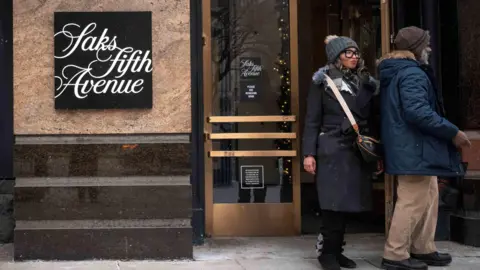
On a recent January morning, tourists admired the rows of Balenciaga and Burberry handbags on display at Saks Fifth Avenue’s flagship midtown Manhattan location.
But a conversation on the second floor hinted at financial troubles at one of America’s most iconic luxury department stores.
Penelope Nam-Stephen, a longtime customer, approached the Diptyque counter in search of a home fragrance that she had typically bought at Saks. Nam-Stephen, who splits her time between New York City and Boston, had been surprised to find the product unavailable at the Boston store just after Christmas.
She hoped the New York location would have better inventory.
“Do you have anything in the Berries fragrance?” she asked an employee. His response: “Everything is out of stock – candles, diffusers.”
Saks Global, which owns Saks Fifth Avenue and Neiman Marcus, is expected to file for bankruptcy protection imminently as it struggles to shore up its finances, leaving big questions among shoppers, vendors and investors about the retailer’s future.
Saks has been plagued by worsening financial woes since Saks Fifth Avenue’s parent company acquired Neiman Marcus in 2024 to create the luxury retail giant. Executives had argued the $2.7bn deal would cut costs and bolster the brands.
The department stores had already been under strain amid growing debt burdens and shifting shopping habits that benefited e-commerce rivals. Saks Fifth Avenue began reporting double-digit quarterly sales declines in early 2023.
But the touted benefits of the acquisition did not materialise. Saks failed to make a $100m interest payment to creditors due in late December, tied to roughly $2.2bn of debt that it took on to fund the merger.
The missed deadline comes as Saks continues to draw frustration from its vendors, who have bemoaned months-long payment delays and many of whom have halted shipments of their products.
Saks did not respond to requests for comment on inventory shortages and its plan to pay vendors.
The company’s former chief executive, Marc Metrick, resigned abruptly from the firm in early January. He was replaced by Richard Baker, Saks’ executive chairman who had led the Neiman Marcus deal.
A restructuring process at Saks Global, which also owns Bergdorf Goodman, would not necessarily mean Saks would soon shutter.
But retail analysts and longtime vendors question whether the company can regain its footing after strategic missteps tied to the acquisition just over a year ago.
“This company has exhibited all of the characteristics of a train wreck,” said Mark Cohen, the former head of retail studies at Columbia Business School.
The retail giant has in recent months tried to raise cash. It sold assets including a Beverly Hills property.
Still, the company’s distress persists.
 Danielle Kaye/BBC
Some of Saks’ woes, Cohen said, predate its acquisition of rival Neiman Marcus, which had previously filed for bankruptcy.
He traced the problems back to Baker’s takeover of Saks more than a decade ago. At that point, the retailer’s leadership focused less on the integrity of the business and more on negotiating new deals that ultimately harmed the company, he argued.
Brands that fill Saks’ in-store aisles and online catalogues have complained about delayed payments since before the Neiman Marcus acquisition – an early sign of cash flow constraints.
The merger two years ago intensified existing financial problems. Saks took on billions of dollars of debt to finance the deal, adding to the money it already owed its vendors.
“Right out of the gate, they stopped paying their bills,” Cohen said.
“You can’t stay upright as a retailer, whether you’re a discount retailer or a luxury player, without having a reliable, consistent financial relationship with your suppliers.”
‘Less likely’ to shop at Saks
For shoppers, the company’s financial turmoil has appeared in the form of less inventory on shelves and online – and, in recent weeks, cancelled orders.
Richard Browne, 66, has been buying men’s trousers, shirts and sweaters from the Saks Fifth Avenue online catalogue for five years. The marketing consultant, who lives in Winston-Salem, North Carolina, was drawn to the retailer’s “good quality clothing at decent prices”.
But last summer, there were early signs of changes afoot. He noticed that several items were marked as out of stock.
The inventory issues did not immediately dissuade Browne from shopping at Saks. He placed an order on 1 January on the Saks Fifth Avenue website for a pair of Michael Kors jeans, discounted at $77.
To his surprise, he received an email the following day notifying him that the pants were sold out. “We needed to cancel your order,” Saks Fifth Avenue wrote in an email reviewed by the BBC.
“It was just frustrating that I had spent the time to find an order, and then they said, ‘We’re sorry, tough luck’,” Browne said.
He said he is now “less likely” to shop at Saks.
 Danielle Kaye/BBC
Payment delays and cancelled orders
In October, Saks slashed its full-year financial outlook, citing falling sales in part because of inventory challenges.
Tensions with vendors have escalated since the 2024 merger with Neiman Marcus, which had been billed as a move to resolve the retailer’s cash flow problems.
Last February, Metrick, the company’s former chief executive, sent a letter to vendors saying overdue payments would be made in 12 instalments.
It did little to put brands at ease.
Some vendors have kept doing business with Saks for fear of fracturing a business relationship with a leading player in the luxury space.
Others have recently severed their ties with the company.
Finance firm Hilldun, which guarantees orders for about 130 brands that work with Saks, said in November it would stop approving new Saks orders. The announcement marked a notable shift for a company that had just months earlier reiterated its confidence in the department store.
“We had no choice,” said Gary Wassner, Hilldun’s chief executive. All orders remain on hold.
One vendor, who spoke to the BBC and requested anonymity for fear of a backlash from Saks, said he was still owed at least $20,000 in late payments for shipments that went out to customers last year. (His company ships items directly to customers, who place orders through the Saks catalogue – a process called dropshipping.)
On top of those late payments, the vendor said his firm has more than $35,000 worth of unfilled orders that have been held up since October, when Saks instructed him to halt all shipments.
“Even though we had two or three issues like this in the past, this time, the answer of, ‘Let’s cancel the orders’, seems to be a desperate move,” he said.
“Nothing they do makes any sense.”
#wrong #luxury #retailer #Saks