Shehnaz KhanWest Midlands

 Getty Images
West Midlands Police said there was “no conspiracy” as they reiterated a decision to ban Israeli football fans from attending a match in Birmingham was “based on safety”.
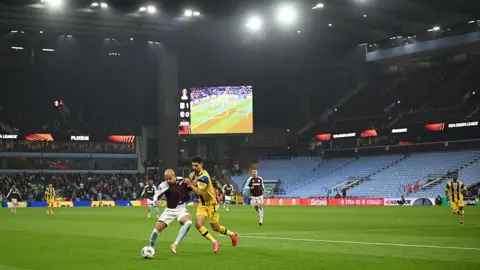
Senior police officers and Birmingham City Council leaders were questioned by MPs over the decision not to allow Maccabi Tel Aviv fans to attend a match against Aston Villa on 6 November.
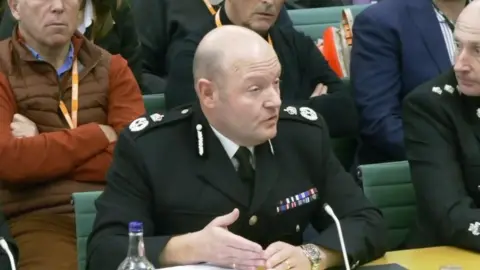
West Midlands Police Chief Constable Craig Guildford said he stood by the accuracy of intelligence after a letter from Dutch police appeared to contradict claims police made about Maccabi fans’ previous behaviour, which were used to justify the ban.
The Home Affairs Committee has said it will get further information from Dutch police.
Birmingham’s Safety Advisory Group (SAG) deemed the Europa League match a “high risk” because of unrest during previous Maccabi matches.
The BBC obtained a letter from the Dutch police inspectorate in December, which appears to contradict claims made by the West Midlands force about Maccabi fans’ previous behaviour.
The decision to ban fans by the SAG, which is made up of representatives from the council, police and other authorities, was also criticised by politicians, including prime minister Sir Keir Starmer.
Guildford told the Home Affairs Committee he did not doubt the “integrity” of his officers.
The force pointed to violent clashes and hate crime offences during the 2024 Europa League match between Ajax and Maccabi Tel Aviv as part of its justification.
Asked by MPs if the number of Dutch police officers deployed to the fixture in Amsterdam had been “made up”, Guildford said: “No, that’s not right. That’s that’s really not fair.
“It was a professional assumption of what would be required over the period of days.”
Labour MP Joani Reid said there were meeting minutes that highlighted the decision to ban fans was made in the absence of intelligence.
Asked if he would make the same decision again, Guildford said: “We’re not an organisation that doesn’t learn from things, and we treat each event on its own merits.”
He said he also does not believe there was any political influence involved in the decision-making.
In a statement following the evidence session, the Home Affairs Committee said it would consider what was heard and awaits additional evidence from the hearing’s witnesses.
“We will publish our findings once we have considered this, as well as gathering further relevant evidence including from the Dutch police force,” it added.
 Getty Images
Guildford took questions alongside match commander and Assistant Chief Constable Mike O’Hara, Ch Insp Mick Wilkinson and Chief Constable Mark Roberts, national lead for football policing and UK Football Policing Unit.
Chair Dame Karen Bradley said it felt to the committee police were “scraping” to find a reason to justify the ban.
“I’m really sorry if it comes across in that way. That was absolutely not the case,” Guildford replied.
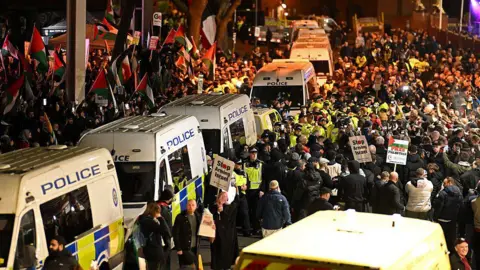
The committee heard police thought “vigilante groups” from the local community posed a threat to Maccabi fans when it decided to ban them from the game.
“We got a lot of information or intelligence to suggest that people were going to actively seek out Maccabi Tel Aviv fans and would seek violence towards them,” O’Hara added.
MPs also questioned city council bosses over why police intelligence from a meeting with Dutch police, considered as crucial to the decision to ban Maccabi fans, was not included in minutes by the SAG.
Council leader John Cotton was joined at the hearing by Richard Brooks, executive director of city operations, and Anthony Cox, director of law and governance.
Cotton added he had concerns over “some of the information” that was placed in front of the SAG.
He refused to say whether he had confidence in Guildford and said he had “serious questions” he would like to see addressed following the inquiry.
“That [safety advisory] group can only work on the basis of candor and confidence of the material that’s placed before it,” he said.
The committee criticised the minutes as giving a “biased picture” of the meeting and said it showed pressure coming from two councillors who pressed away fans should not attend the game.
Brooks said the minutes may be an “incomplete picture” and “not a perfect record” of the meeting but he did not agree that it was a “biased picture”.
The committee also questioned whether it was appropriate for councillors who were “campaigning publicly” to stop the football game in its entirety, to be on the SAG.
Cotton and Cox were both asked if the councillors in question were facing standards inquiries, and if they had breached council principles.
Cotton said they were not facing inquiries but would look at what the next steps might be.
 PA Media
Following the session, shadow home secretary Chris Philp said Guildford’s position was “untenable”.
“If he doesn’t resign then the home secretary must use her powers to sack him, and even more importantly explain exactly what she knew and when,” he added.
Ahead of the hearing, the committee had published further evidence relating to decision-making around the policing of the football match.
Letters and supporting documentation requested by the committee have been provided by West Midlands Police, Birmingham City Council, the UK Football Policing Unit and the Home Office Policing Policy Unit.
The Independent Office for Police Conduct previously said it may investigate West Midlands Police’s handling of the decision to bring in the ban.
Lord Mann, the government’s independent adviser on antisemitism, told the same committee in December that he had “struggled” with some “inaccurate” details given by the force.
#MPs #probe #West #Midlands #Police #decision #ban #Maccabi #fans