Ben Wright,Presenter, Westminster Hourand
Kate Whannel,Political reporter

 EPA
EPAMPs and peers will have to make a big decision soon on whether or not to move out of the Houses of Parliament, to allow billions of pounds worth of essential maintenance work to take place.
The building is “just waiting for some disaster”, says House of Cards writer and peer Lord Dobbs.
He says his advice to visitors is: “If they see somebody running please don’t stop to find out why they’re running, just follow them.”
Former Labour minister Lord Hain agrees something needs to change.
“This is a Notre Dame inferno in the making,” he says in a reference to the Parisian cathedral which caught fire in 2019.
“The Commons could burn down at any time.”
A parliamentary committee report from a decade ago warned that the Palace of Westminster “faces an impending crisis which we cannot responsibly ignore”.
“Unless an intensive programme of major remedial work is undertaken soon, it is likely that the building will become uninhabitable,” it said.
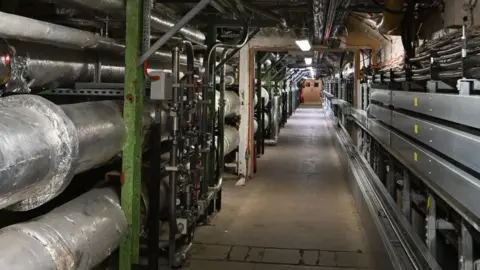
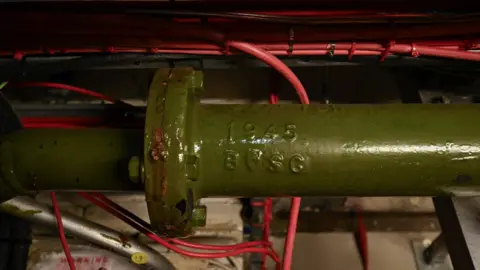
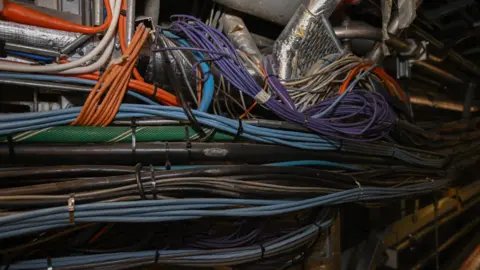
A decision has been postponed for years, but now with falling masonry, lingering asbestos, regular fires and exploding toilets, everyone agrees the work needs to be done.
While there is general agreement on that, there is no consensus on how.
 House of Commons
In the early weeks of 2026, parliamentarians are expected to be presented with three options for carrying out the work:
- A full decant that would see both the Houses of Commons and Lords temporarily moved to a different location
- A partial decant moving out the House of Lords while the Commons remains onsite
- An option labelled “enhanced maintenance and improvement” which would carry out the improvements as part of a rolling sequence of works. This option would likely take the longest.
Alternative locations for a decanted Parliament have been put forward, including the nearby QEII Conference Centre, Richmond House in Whitehall and even a floating barge in the Thames.
A previous report from 2022 suggested that a full decant could cost £7bn-£13bn with the building entirely vacated for between 12 and 20 years.
Keeping MPs in Parliament, but using the House of Lords chamber would prolong the works by between seven and 15 years and increase costs to £9.5bn-£18.5bn.
Allowing the House of Commons to operate throughout the works was estimated to increase the project by 27 to 48 years and boost costs by around 60% to £11bn-£22bn.
A report from the Renewal and Restoration Client Board – made up of MPs, peers and lay members – is expected to set out the updated costs, risks and benefits of each option and provide a recommendation for the best, or least painful, choice.
Then, once the government schedules a vote, it will be up to MPs and peers to make the final decision.
 House of Commons
Lord Hain is firmly behind a full decant, arguing that previous reports have found it to be the cheaper option.
He also points out that Parliament has already voted to leave. In 2018, MPs narrowly accepted the principle of fully vacating the building.
However, concerns about the costs of the project and the prospect of moving out, led to a rethink and a new body – the Restoration and Renewal Client Board – was set up to re-examine the options.
Lord Hain despairs at the delays. “It’s a terrible advertisement for parliamentary democracy,” he says.
“People would be horrified if it [Parliament] fell apart in a raging fire… and then I think that the focus would be back on the politicians who dodged and weaved and backslid and kicked the can down the road.”
“It’s got to be done now and it’s got to be done properly,” he says.
Baroness Smith, the government’s most senior minister in the House of Lords, told Radio 4’s Westminster Hour she believes there is “no decant-free option” and her preferred choice is for both houses to move out.
“The amount of money spent keeping the building going in a poor condition would be better spent getting the building into a good condition.”
Conservative peer Lord Dobbs isn’t so keen on parliamentarians leaving the building.
“Are we going to take a great holiday from Parliament and democracy while the builders get this done?” he asks.
While he says he believes the House of Lords does “an exceptional job” he acknowledges that the chamber is not popular with the wider public.
“Unless we can turn that lack of understanding and unpopularity around, it’s very possible that we will go off to the QEII Conference Centre and never come back.
“It will be the end of the House of Lords – an expert will simply put a line through on a piece of paper and just rub us out.
“Moving us out I think is going to cut off so much of our credibility and authority and our ability to do anything at keeping the government and the House of Commons under some sort of control.”
As a senior minister between 2019 and 2022, Sir Jacob Rees-Mogg was partly involved in the decision to order a rethink of the options.
He is sceptical both about the estimated cost of MPs staying in Parliament while the work is completed and suggestions the building is on the brink of a destructive conflagration.
“I was on the committee that looked into it in the 2010-2015 Parliament, when we were told that the whole place would be ruined if we didn’t act immediately,” he says.
“And here we are 10 years or more later – we haven’t acted immediately and the place still seems to be standing.”
He defends blocking the previous plans calling the scheme “crazy, over-elaborate and too expensive”.
Like Lord Dobbs, Sir Jacob doesn’t back a full decant, instead preferring the work to be done in stages.
“Once you move out that’s when the builders really have you and that’s when the prices go up.
“Builders are wonderful people, and many of them are voters, so they’re great people, but they have a commercial interest.”
 House of Commons
Whichever option parliamentarians pick, the government is going to have to foot a bill to pay for the works, running into many billions.
Jayne Kirkham, a Labour MP elected for the first time in 2024, is keenly aware of the need for repairs.
Her office is below the Speaker’s House where she says the “gents’ toilets” are “regularly exploding with sewage”.
She is going to wait for the final report before deciding what to do but says if moving out means the work can be done more safely and for less money “that would seem like the most sensible option”.
She reflects on the dilemma facing politicians – as a new MP she says there are “a million things that I want to be doing for Truro and Falmouth” and fixing the building is not at the “absolute top of the priority list”.
At the same time she says parliamentarians have “a duty” to preserve Parliament “for future generations”.
“This is an amazing building – we’re so privileged to have it. It’s iconic and for anything to happen to it would be terrible.”
Another new MP from the 2024 intake has a different take.
Posting on social media, Lib Dem MP Edward Morello wrote: “Unpopular opinion: Move us out permanently. Make it a museum.”
You can listen to the interviews on BBC Radio 4’s Westminster Hour at 2200 BST on Sunday and then on BBC Sounds.

#year #MPs #peers #agree #repair #Parliament