The images that Bloomberg photographers took in 2025 captured a world in flux, as politicians jockeyed over rare minerals and trade tariffs, European war games imagined a conflict with reduced US support and national guard troops patrolled the streets of major American cities.
The year was bookended by devastating fires, from the wildfires that burned across swathes of Los Angeles in January, to the fire that tore through a Hong Kong housing estate in November.
In between, it was a year of firsts: the first woman elected as prime minister of Japan, the first-time humanoid robot athletes have competed on a world stage, the first chainsaw brandished at a major political conference. It was also a year of lasts: Jerome Powell’s final speech at Jackson Hole as chair of the US Federal Reserve, and the last few months before the East Wing of the White House was demolished to make way for a gigantic new extension.
This collection of 20 photographs documents the events that reshaped the world in 2025, chronicling communities strained by disaster, governments redefining authority and markets jolted by rapid shifts in policy and innovation.
Los Angeles Fires
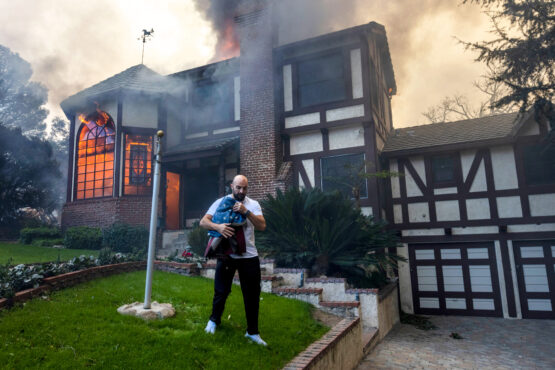
A resident carries an American flag outside a burning house during the Eaton Fire in Altadena, California on 8 January 2025. Image: Jill Connelly/Bloomberg
At least five massive blazes burned across the Los Angeles region in January, as hurricane-strength wind gusts spread flames across neighborhoods and forced more than 200 000 residents to flee. The biggest wildfires — in Altadena and the wealthy coastal community of Pacific Palisades — burned more than 11 000 homes, with estimated losses of as much as $75 billion for the insurance industry.
As of September, less than 10% of property owners had permits to rebuild.
Palestinians Return
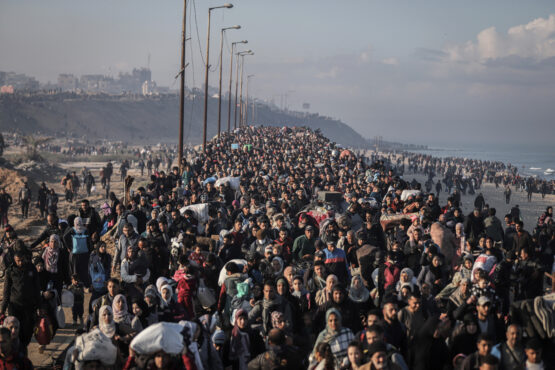
Palestinians walk towards their homes in northern Gaza on 27 January. Image: Ahmad Salem/Bloomberg
Two weeks into a temporary ceasefire in the Israel-Hamas war in January, tens of thousands of displaced Palestinians started returning to their devastated neighborhoods in northern Gaza. Access to the area — including Gaza City — had been banned shortly after the start of the war in 2023, as Israel bombarded the territory’s largest urban center with an air and ground campaign.
A more permanent ceasefire was announced in October 2025, though the truce remains fragile, with each side accusing the other of violations.
Musk at CPAC

Elon Musk holds a chainsaw gifted to him by Javier Milei, during the Conservative Political Action Conference in in National Harbor, Maryland on 20 February. Image: Jason C. Andrew/Bloomberg
At this year’s Conservative Political Action Conference in February, billionaire Elon Musk, the face of President Donald Trump’s initiative to slash the federal government’s workforce and spending — aka DOGE — wielded a chainsaw on stage while wearing dark glasses and a cap emblazoned with Trump’s signature “Make America Great Again” slogan.
He touted the power tool — gifted to him by Argentina’s President Javier Milei — as “the chainsaw for bureaucracy.”
Trump’s Deportation Drive
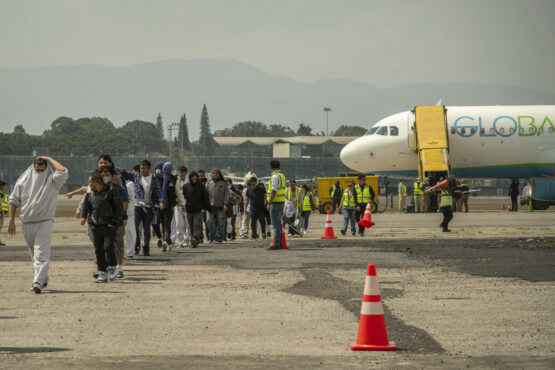
A charter flight carrying 104 deported Guatemalans arrives from Alexandria, Louisiana, at the Guatemalan Air Force base in Guatemala City on 26 February. Image: Daniele Volpe/Bloomberg
At the start of his second presidency, Trump signed sweeping executive actions designed to crack down on illegal border crossings and target undocumented migrants already in the US. He promised record deportations, and Secretary of Homeland Security Kristi Noem joined immigration officers on highly publicized raids in US cities.
As migrants have left the US on chartered flights, international governments have been working out how to reintegrate the deportees, some of whom have spent decades in the US.
Oval Office Clash
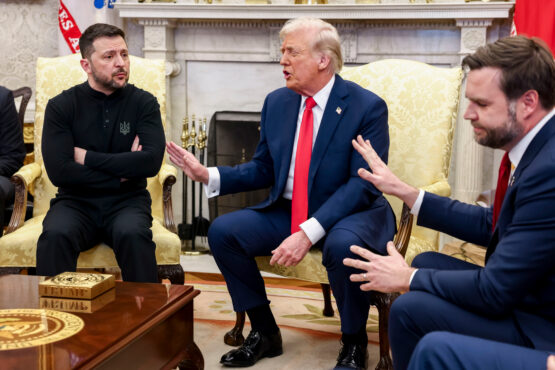
Volodymyr Zelenskiy, Donald Trump, and JD Vance during a meeting in the Oval Office of the White House in Washington on 28 February. Image: Jim Lo Scalzo/EPA/Bloomberg
ADVERTISEMENT
CONTINUE READING BELOW
A meeting that was supposed to end with the signing of a critical minerals agreement devolved into a fiery exchange in February, as Trump and US Vice President JD Vance argued with Ukrainian leader Volodymyr Zelenskiy for several minutes in front of cameras in the Oval Office.
The meeting had been intended as a moment of unity between the leaders, with the natural resources agreement designed to satisfy Trump that US aid would be repaid. The meeting exploded when Vance criticized Zelenskiy for not respecting the event and repeatedly urged him to show more appreciation for the president. The deal was eventually signed in April, and Zelenskiy returned to the White House in August and October.
Congo Mining
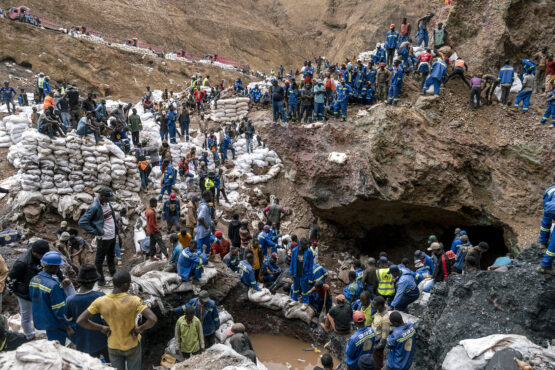
The Shabara artisanal copper-cobalt mine near the town of Kolwezi, Lualaba province, Democratic Republic of the Congo, 21 March. Image: Arlette Bashizi/Bloomberg
The Democratic Republic of the Congo shocked commodity markets by suspending all cobalt exports in February, after a flood of the battery metal sent prices tumbling. Congo is home to around 110 million people, as well as a vast array of mineral resources to power everything from wind turbines to next-generation weapons systems.
The country is also the second-largest producer of copper. The boom in demand for the critical minerals has led to an increase in illegal artisanal mining, in which tens of thousands of laborers dig for ore using rudimentary tools. They often work in dangerous conditions for uncertain income, and the government has struggled to keep child laborers away from the sites.
Reciprocal Tariffs
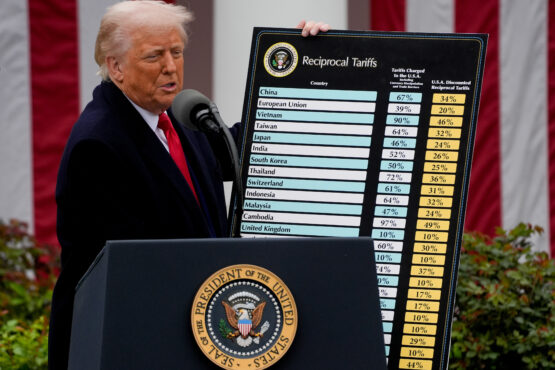
US President Donald Trump holds a reciprocal tariffs board in the Rose Garden of the White House in Washington on April 2. Photographer: Kent Nishimura/Bloomberg
In early April, Trump laid out his plans for a 10% tariff on all imports entering the US, with additional duties for major trading partners depending on their perceived barriers. The event — which he labelled “Liberation Day” — delivered on campaign promises based on his belief that the US got a raw deal as globalization swept across trading systems.
The tariffs were suspended just hours after they went into effect as turmoil spread through financial markets, with an August deadline introduced for countries to strike deals to reduce the additional duties. Negotiations with many countries — including India, Thailand and Vietnam — are ongoing.
Robot Games
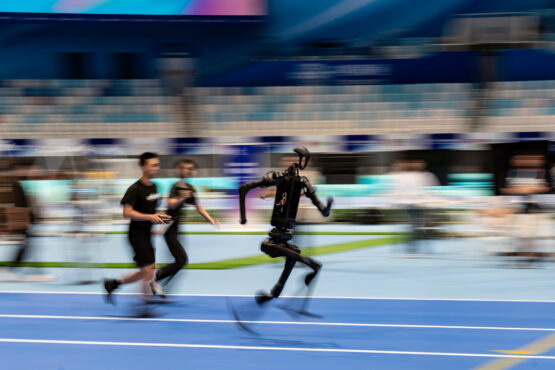
A humanoid robot runs during a trial run ahead of the opening ceremony of the World Humanoid Robot Games in Beijing on 14 August. Image Qilai Shen/Bloomberg
A three-day event in Beijing acted as the latest showcase for China’s advancements in robotics, as humanoid robots competed against each other in the first World Humanoid Robot Games.
Robots manufactured by companies like Unitree Robotics showed off various athletic feats, from running in a 1 500-meter race to grappling in boxing rings and squaring off in soccer matches — though some tripped and one even lost an arm in the process. Nvidia Corp. boss Jensen Huang has said robotics have the potential to grow into a multitrillion-dollar industry.
Putin Meeting
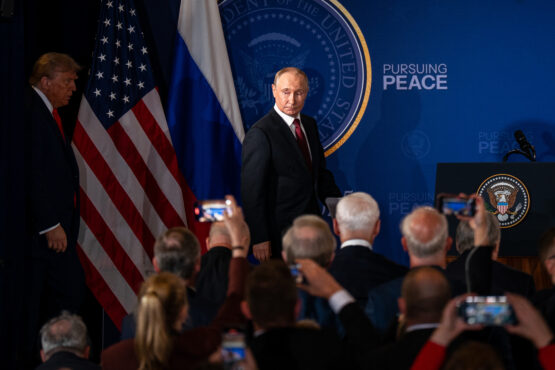
Vladimir Putin, right, and Donald Trump arrive for a joint news conference in Anchorage, Alaska, on 15 August. Image: Al Drago/Bloomberg
In August, a more than two-hour meeting in Alaska marked the longest ever face-to-face talks between Trump and Russia’s President Vladimir Putin, culminating in a joint briefing in front of the press. Trump and Putin described talks as “constructive” but offered scant detail on any progress made toward ending the war in Ukraine.
It was Putin’s first time on US soil in nearly a decade. In early December, a US national security strategy document signed by the president said European officials “hold unrealistic expectations for the war.”
Jackson Hole Speeches
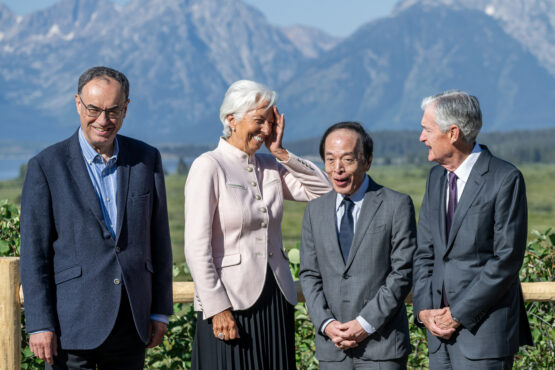
From left: Andrew Bailey, governor of the Bank of England; Christine Lagarde, president of the European Central Bank; Kazuo Ueda, governor of the Bank of Japan; and Jerome Powell, chairman of the US Federal Reserve, during the Jackson Hole Economic Policy Symposium on 22 August. Image: David Paul Morris/Bloomberg
ADVERTISEMENT:
CONTINUE READING BELOW
In his final Jackson Hole speech as US Fed chair, Jerome Powell surprised markets with a shift in his signaling on near-term monetary policy, suggesting he was open to lowering rates in September. Stocks and Treasuries surged, and the dollar advanced.
US central bankers repeatedly came under fire from Trump in 2025. He nicknamed Powell “Mr. Too Late” for not lowering rates as fast as the president would like and threatened to remove Federal Reserve Governor Lisa Cook over mortgage fraud allegations that she has denied.
National Guard
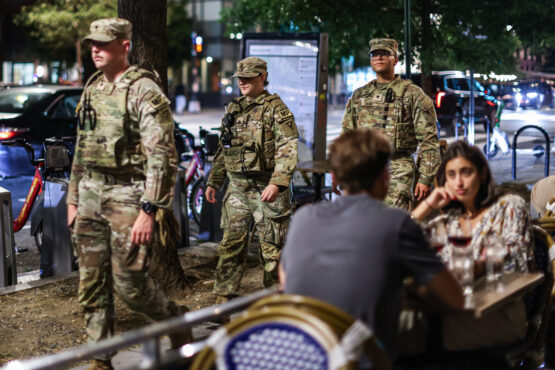
Members of the Ohio National Guard patrol near diners on in Washington on 23 August. Image: Valerie Plesch/Bloomberg
In August, Trump announced he would take federal control of Washington DC’s police department and deploy 800 National Guard troops there. Trump has sought to flex his authority over states and cities run by Democrats since returning to power, arguing their policies have led to rampant crime.
Earlier in the year, Trump deployed the National Guard to quell protests over immigration raids in Los Angeles. He’s also sent troops to Chicago, Memphis and Portland, Oregon.
Mangione on Trial

Luigi Mangione arrives for a pretrial hearing at New York State Supreme Court on 16 September. Image: Michael Nagle/Bloomberg
Luigi Mangione, the 27-year old accused of shooting Brian Thompson, a UnitedHealth Group Inc. executive, in midtown Manhattan last December, made multiple court appearances in 2025. In September, a New York state judge dismissed first-degree murder charges against Mangione but allowed a lesser murder count to go to trial, ruling that prosecutors failed to show that he committed the crime as an act of terrorism.
His appearances often attracted dozens of supporters, some of whom dressed in green as a reference to the Luigi character from the Super Mario video game series.
US Government Shutdown
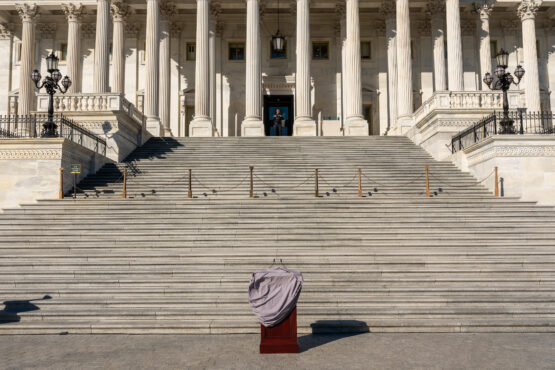
A covered podium outside of the House of Representatives in Washington on 15 October. Image: Eric Lee/Bloomberg
The longest government shutdown in US history encompassed all of October and half of November — a 43-day impasse that halted food aid to millions of households, canceled thousands of flights and forced federal workers to go unpaid for more than a month.
In the end, the House of Representatives voted 222 to 209 to pass interim funding through Jan. 30. Democrats largely opposed the bill because it didn’t include their central demand in the shutdown fight: the renewal of subsidies for Affordable Care Act health insurance policies set to expire at the end of the year.
Japan’s Female Prime Minister
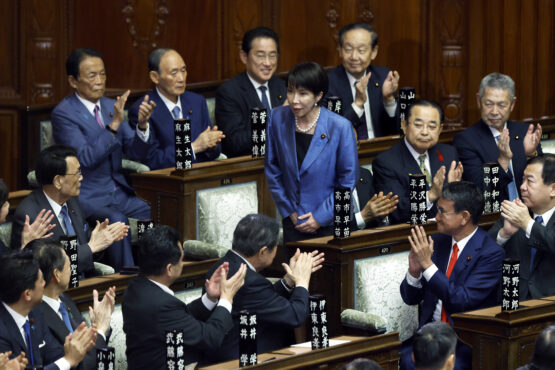
Sanae Takaichi won the lower house of parliament vote to become Japan’s prime minister on 21 October. Image: Kiyoshi Ota/Bloomberg
Sanae Takaichi made history in October by becoming Japan’s first female prime minister, marking a watershed moment for Japan’s male-dominated society.
She won the vote with the help of a new coalition with the right-leaning Japan Innovation Party, also known as Ishin, signaling a shift to the right as an increasing number of Japanese people express dissatisfaction over living standards, the influx of foreigners into the country and concern about rising security tensions in the region.
Nvidia’s Dealmaking
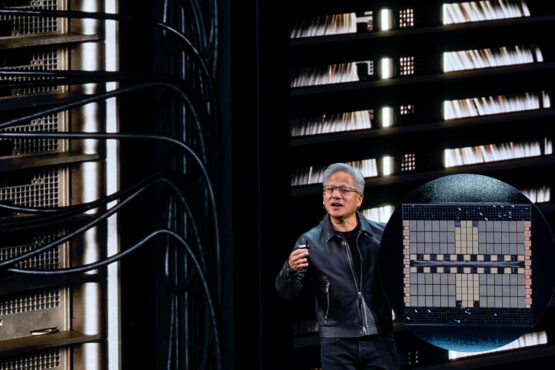
Jensen Huang, chief executive officer of Nvidia Corp., at the company?s GTC conference in Washington on 28 October. Image: Kent Nishimura/Bloomberg
Even as fears of a trillion-dollar AI bubble grew among investors and executives, the industry’s biggest cheerleaders kept on striking deals — none more so than Nvidia Corp. CEO Jensen Huang. In one extraordinary week in October, Nvidia added almost $400 billion to its market capitalization as Huang announced deal after deal with companies including Nokia Oyj, Uber Technologies Inc. and Eli Lilly & Co. Huang used his keynote speech at a developer conference in Washington, DC, to detail the tie-ups, telling a packed convention hall that the company had reached “our virtuous cycle, our inflection point.”
Since then, global semiconductor stocks have foundered, and Nvidia shares are down from their highs.
ADVERTISEMENT:
CONTINUE READING BELOW
Suspended Food Aid
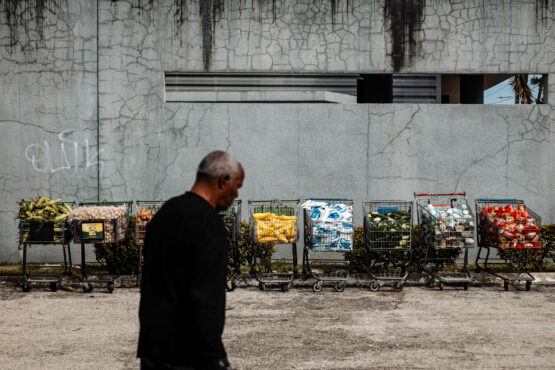
Donated food items at Curley’s House Food Bank in Miami on 4 November. Image: Eva Marie Uzcategui/Bloomberg
As the government shutdown dragged into November, Trump suspended funding for US food aid benefits, cutting off the 42 million Americans who rely on government assistance to feed themselves and their families.
Food banks across the country saw surging demand, with some reporting three times the number of calls they usually received requesting assistance. Full funding was restored following the end of the federal government shutdown, but disputes over the program continue.
NATO Training

NATO troops test rapid brigade deployment capabilities during the Dacian Fall military training exercises in Cincu, Romania, on 13 November. Image: Andrei Pungovschi/Bloomberg
A November wargame in Transylvania showed NATO members preparing to defend Europe as Trump reduces US deployments on the continent.
As the White House pushes for an end to the war in Ukraine, its threats to shut off remaining military support for Kyiv raised the possibility of European powers having to defend the country — and perhaps even the rest of Europe’s eastern frontier — with limited US backing.
White House Renovations
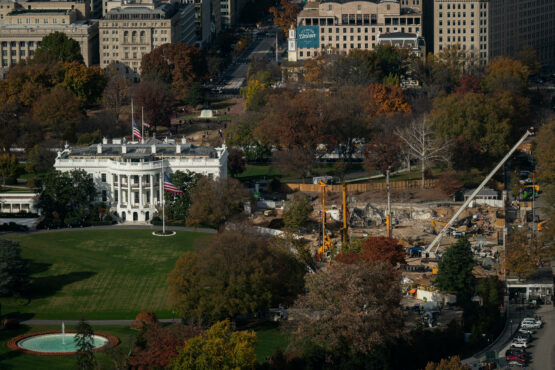
Demolition of the East Wing of the White House in Washington on 14 November. Image: Al Drago/Bloomberg
As the end of the year approached, demolition crews began pulling down the East Wing of the White House to make space for a new, 90 000-square-foot ballroom.
Trump had teased the project for months, but the administration didn’t originally say that construction of the ballroom — whose estimated price has swelled to $350 million — would require the entire East Wing to be razed. The new complex will be much larger than the main White House building, which is about 55 000 square feet.
Hong Kong Fires
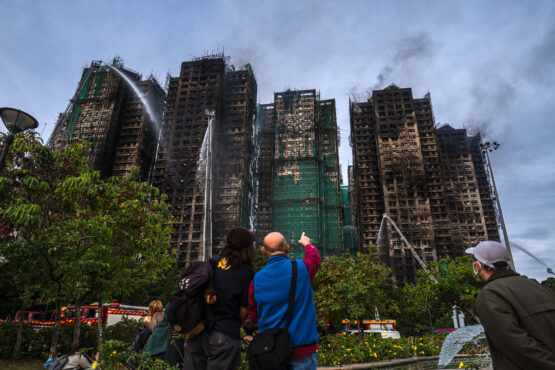
Bystanders watch smoke rise from buildings at the Wang Fuk Court residential estate in Hong Kong on 27 November. Image: Lam Yik/Bloomberg
One of the worst blazes in Hong Kong’s history killed at least 151 people at a residential complex in the Tai Po district. The buildings had been undergoing renovation work, and officials say the Nov. 26 blaze began on the lower floor of one of the towers after construction netting attached to the bamboo scaffolding on the building exterior caught fire.
More than a dozen people have been arrested as investigators point to the use of cheaper, substandard materials, which they say allowed the fires to spread quickly.
Venezuela Tensions
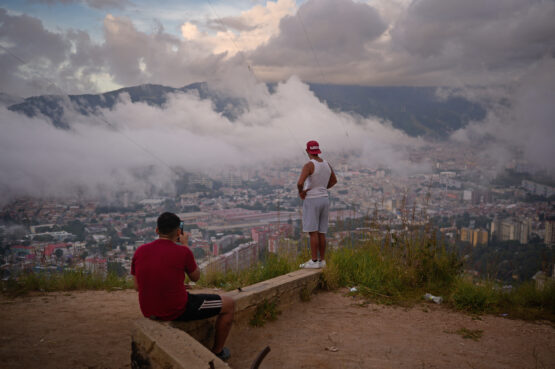
Residents look out from a view point over the skyline of Caracas on 30 November. Image: Bloomberg
In late November, Trump said airlines should consider the airspace above and around Venezuela to be closed as his administration threatened yet more aggressive steps against President Nicolas Maduro’s government.
US forces have been massing in the region as Trump weighs military action that would go beyond the nearly two dozen US strikes on boats that Washington has claimed are ferrying narcotics toward the US.
© 2025 Bloomberg
Follow Moneyweb’s in-depth finance and business news on WhatsApp here.
#Wildfires #chainsaws #White #House #demolition #Photos #defined