Maddy SavageBusiness reporter, Kalmar, Sweden

 BBC
BBCStaff at a major Swedish pharmacy chain are being given paid time off to spend with friends, as Sweden’s government calls on businesses to help play a role in tackling loneliness.
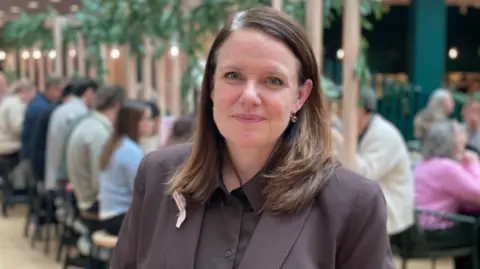
Yasmine Lindberg, 45, is one of 11 participants taking part in the pilot “friendcare” scheme for the pharmacy group Apotek Hjärtat.
She works shifts at the company’s outlet at a retail park in Kalmar, a small seaside city in southern Sweden.
“I’m really tired when I go home. I don’t have time or energy to meet my friends,” she explains, before restocking a shelf of paracetamol.
Yasmine spends a lot of her free time with her teenage children who live with her every other week. But she admits feeling “quite lonely” since separating from her partner four years ago, which led to fewer social invitations with couples in their network.
Now, thanks to the Apotek Hjärtat pilot scheme, which started in April, she’s granted 15 minutes a week, or an hour a month during working hours to focus on strengthening her friendships or making new connections.
She can use this allotted friendcare time to chat on the phone, make plans over text, or meet up with someone in person.
“I wanted to make it better for myself… like, kick myself in the back to do stuff,” says Yasmine.
“I feel happier. You can’t live through the internet like most people do these days.”
Like all participants in the pilot project, she has been given 1,000 kronor ($100; £80) by Apotek Hjärtat to help pay for friendship-based activities during the year-long trial.
The volunteers have also received online training in how to recognise and tackle loneliness, which the pharmacy chain has made available for all its 4,000 employees across Sweden.
Monica Magnusson, Apotek Hjärtat’s CEO, says the inspiration for the company’s friendcare project comes partly from a previous collaboration with the mental health charity Mind. She says that helped demonstrate how short meaningful conversations between pharmacists and customers could help the latter group feel less isolated.
The company wanted to test if providing a short amount of ring-fenced friendship time for its employees could also impact their wellbeing.
Volunteers could also sign up if they weren’t lonely, but wanted to spend more time with isolated people in their network.
“We try and see what the effects are from having the opportunity to spend a bit of time every week on safeguarding your relationships,” explains Ms Magnusson.
The project’s title, friendcare or “vänvård” in Swedish is also a wordplay on “friskvård”, a benefit already offered by many Swedish businesses, who give employees a tax-free annual wellness allowance to spend on fitness activities or massages. Some Swedish companies also offer staff a weekly wellness hour called “friskvårdstimme”.
“This is a reflection on that, but targeting loneliness and relationships instead,” explains Ms Magnusson.
Apotek Hjärtat’s project comes as Sweden’s right-wing coalition government is putting the spotlight on loneliness. In July, Sweden’s Public Health Agency released Sweden’s first national strategy aimed at minimising loneliness, commissioned by the government.
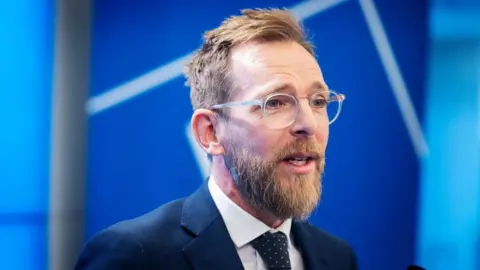
A core part of the strategy is increased collaboration between the business community, municipalities, researchers and civil society. Health Minister Jakob Forssmed has described loneliness as major public health concern, citing global research linking the problem to an increased risk of illnesses including coronary heart disease and strokes, and a greater likelihood of early mortality.
Businesses should be worried about it, he suggests, since their employees and customers are at risk, and public finances are impacted by healthcare and sick leave costs linked to loneliness.
“We need to… have a greater awareness about this, that this is something that really affects health, and affects [the] economy as well,” says Forssmed.
A national loneliness epidemic? Research for the EU suggests around 14% of Sweden’s population report feeling lonely some or all of the time, slightly higher than the EU average.
A separate study for the state’s number-crunching agency Statistics Sweden in 2024 found that 8% of adults in Sweden don’t have a single close friend.
Daniel Ek, a Swedish psychologist and co-author of The Power of Friendship, a handbook on how to develop deeper relationships, argues that in Sweden the country’s cold, dark winters can discourage people from socialising, alongside cultural factors.
“The Swedish mentality is like – you shouldn’t disturb others. We value personal space a lot, and we have a hard time breaking the ice,” he says. Sweden’s housing may also play a role, Ek suggests.
More than 40% of homes are occupied by just one person, and a July’s report by Sweden’s Public Health Agency indicated there are higher levels of loneliness amongst this group.

At Apotek Hjärtat’s headquarters in Stockholm, Ms Magnusson says it is too soon to decide whether the friendcare project is rolled out more widely, but the results of self-assessment surveys so far indicate higher levels of life satisfaction amongst participants on the friendcare scheme, compared to before it started.
Forssmed, the Health Minister, is monitoring the pharmacy chain’s efforts.
“I think this is very interesting and I’m following what they’re doing,” he says. “[But] I’m not going to give you any promises that the government is going to scale this up or give a tax deduction or something like that.”
Apotek Hjärtat is also part of a business network called ‘Together against involuntary loneliness’, initiated by Forssmed in 2023.
It includes around 20 major Nordic brands, such as Ikea, Strawberry, a hospitality chain, and HSB, Sweden’s biggest federation of cooperative housing, who meet to share their experiences and strategies for tackling loneliness.
Ms Magnusson says there has already been “a lot of interest” in the friendcare project from the other businesses in the network. Representatives from the other firms have even participated in the pharmacy chain’s online loneliness training.
“It’s quite a different approach to working together,” says Ms Magnusson, “collaborating as companies in an area where you just let competition go, and instead try and figure out ‘how can we tackle this common obstacle that we have?’.”
 AFP via Getty Images
Earlier this month, a separate project launched in Piteå in northern Sweden, with 20 businesses offering wellness grants for employees to attend group cultural experiences, such as concerts and plays, in an effort to boost wellbeing and improve social inclusion.
Mr Ek, the psychologist, agrees these sorts of initiatives can have a positive impact in helping “lower the threshold” to increased social interaction, which in turn, can pave the way for deeper friendships and reduced levels of loneliness.
But he is calling for more research and reflection on some of the potential structural issues that may also be impacting loneliness in the Nordic nation.
“What is happening in society that makes us have to have those lower thresholds for meeting and connecting? I think that’s an important thing to look at,” he says. Mr Ek points to Sweden’s high unemployment rate (8.7%), rising income inequality, and young Swedes spending more time on digital devices than the average across the 27-member countries of the Organisation for Economic Co-operation and Development.
“Income differences matter. Availability to events and places matter. How we build cities matters,” says Mr Ek. “So those structures are important to look at to work out the plan for the future.”
#Swedish #workers #trial #friendship #hour #combat #loneliness