The City of Cape Town says at least 30 000 trees within its municipal boundaries may be at risk from the invasive polyphagous shot hole borer (PSHB) beetle, following the latest confirmed detections in the City Bowl and Hout Bay.
Although the full extent of the infestation in these areas has not yet been quantified, the metro has expanded surveys across surrounding suburbs amid growing concern over the potential impact on the Mother City’s urban canopy.
Read:
Cape Town is losing its trees
Cape Town advised to clear alien trees to boost water supply
Positive DNA confirmation of PSHB has been recorded in City Bowl locations, including Long Street, St Georges Mall, Military Road and Tamboerskloof. The beetle was also detected along Victoria Road in Hout Bay.
These areas are characterised by mature trees, and any significant loss of trees could affect the visual character and environmental quality of the identified locations.
The presence of the invasive species was confirmed by Stellenbosch University’s Entomology Department.
“We are extremely concerned about the latest sighting and request the assistance and cooperation of residents and businesses that work with plant material,” said Eddie Andrews, deputy mayor and mayoral committee member for spatial planning and environment.
Listen/read:
Borer beetle detected in Nelson Mandela Bay [Jul 2024]
Tree-borer beetle found in Northern Cape pecans [Aug 2018]
Experience from other parts of the world shows that once the PSHB becomes established, the impact on urban trees can be severe.
In parts of the United States, particularly California, infestations have resulted in widespread loss of street trees and trees along the banks of rivers, streams and wetlands.
Israel and Western Australia – notably Perth – have also reported extensive damage after early containment efforts failed.
Researchers often point to these cases as a warning that cities with diverse and mature urban canopies, such as Cape Town, could face significant tree loss if the spread of PSHB is not contained.
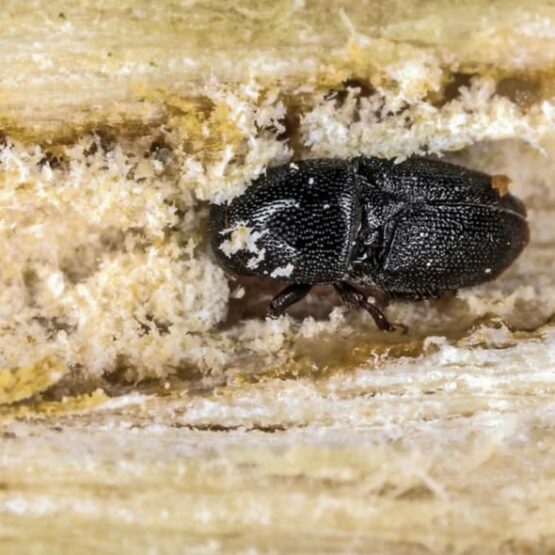
The invasive polyphagous shot hole borer (PSHB) beetle. Image: Supplied
ADVERTISEMENT
CONTINUE READING BELOW
PSHB – the pest commonly referred to as the borer beetle in South Africa – is an invasive ambrosia beetle that operates in tandem with a symbiotic fungus, Fusarium euwallaceae.
The beetle, which has been described as the size of a sesame seed, bores into trees to create galleries and inoculates them with the fungus, which then spreads through the tree’s vascular system.
The beetle-fungus combination can cause branch dieback and, in some cases, the death of the entire tree.
Not all trees respond in the same way. Some species allow the beetle to reproduce successfully and become reservoirs that amplify its spread, while others may be attacked without sustaining beetle populations.
First detection
PSHB was first scientifically confirmed in South Africa in 2017, following DNA analysis of beetle samples collected from damaged trees in KwaZulu-Natal.
Researchers believe the beetle may have been present for several years before its formal detection, as infestations often remain hidden until populations are well established and external symptoms become visible.
Since then, PSHB has been detected in multiple provinces across the country.
Read: Invasive Kariba weed blankets Joburg dams, threatens ecosystems
In August 2018, the beetle was discovered in pecan trees in the Northern Cape.
The beetle poses a huge threat to other crops, including avocados and macadamias.
Apart from the new detections in the City Bowl and Hout Bay, PSHB has to date been confirmed in the following areas in the Cape Peninsula, including:
- The Helderberg Basin, including Somerset West, Gordon’s Bay and Strand;
- Areas in the southern suburbs such as Newlands, Rondebosch, Claremont, Pinelands, Rosebank, Observatory, Kenilworth, Wynberg, Constantia; and
- Durbanville, Parow North, Bellville, Brackenfell and Kraaifontein in the northern suburbs.
Risk to Cape Town’s urban forest
ADVERTISEMENT:
CONTINUE READING BELOW
In an emailed response to Moneyweb, Andrews noted that preliminary data from 2024 show at least 30 000 reproductive (competent) host trees within the city’s municipal boundaries are at risk of infestation.
However, no formal city-wide model has yet been released to quantify potential canopy loss.
“The city is actively collaborating with researchers at Stellenbosch University and other institutions to assess the potential impact of PSHB on Cape Town’s urban forest,” Andrews added.
The city’s current survey zones extend 400m to 1 000m from confirmed detection points and include streets across the CBD, Foreshore, Gardens and Tamboerskloof, excluding District Six and Vredehoek, which are scheduled for surveying in the near future.
Mass surveys are also underway in Hout Bay, including parks, riverbanks, canals and forest edges. The city expects survey results to be available by the end of January 2026, after which the findings will be made public.
Trees most at risk
The city classifies host trees into three categories: non-reproductive hosts, competent (reproductive) hosts, and kill-competent (highly susceptible) hosts.
Trees that are highly susceptible and prioritised for removal include:
- Box elder (Acer negundo)
- English oak (Quercus robur)
- Castor bean (Ricinus communis)
- Weeping willow (Salix babylonica)
Removal versus monitoring
Andrews says the city uses an “integrated management approach” that combines frequent monitoring, including early detection, with the removal of susceptible tree species.
Decisions to remove trees depend on the host category, extent of infestation, tree health, likelihood of recovery, and the location and risk to surrounding trees, people, and property. Trees on the edges of infestation zones are considered higher risk for further spread of the beetle.
The city says it has put protocols in place for the handling of infested trees and green waste, including the chipping and solarisation or incineration of infected material in line with approved phytosanitary methods.
It has also placed strong emphasis on public education to limit human-mediated spread of PSHB through the movement of green waste. The city says it is only able to remove infested trees on public land, with private landowners responsible for managing and removing affected trees on their own properties.
ADVERTISEMENT:
CONTINUE READING BELOW
Read: Alien species threaten food supply, public health and cost $423bn [Sep 2023]
It adds that additional funding to deal with large-scale removals would depend on PSHB being formally declared an alien and invasive species by national government. While the city has been engaging with national authorities on such a declaration, it says no decision has yet been made.
Treatment options and research
According to the city, there is currently no proven effective treatment for PSHB. Although biological control measures and trials involving Trichoderma are underway, these have so far shown no positive results in field conditions.
Trichoderma is a naturally occurring fungus sometimes used to fight harmful fungi in plants and trees. In the case of the borer beetle, it has been tested as a way to limit the fungus spread by the beetle inside trees, but so far it has not been shown to work effectively in real-world conditions.
“The city continues to work with academic researchers as efforts to identify viable treatment options continue,” said Andrews.
He stresses that the city is currently not considering issuing compulsory removal notices for reproductive host trees that may pose a risk to surrounding areas.
“Our focus is only on the removal of infected and infested highly susceptible hosts, and any infected host tree.”
Public reporting and monitoring
The city says it reviews and verifies reports logged on iNaturalist as part of its weekly surveys and monitoring work, with the ten-day response window applying mainly to inspections on private land.
iNaturalist is a free online platform and mobile app where members of the public can record and share observations of plants, animals, and insects.
The city has also encouraged residents to log box elder trees in particular, as this species tends to show signs of borer beetle infestation quickly, allowing new outbreaks to be detected early, before the beetle spreads further.
Follow Moneyweb’s in-depth finance and business news on WhatsApp here.
#Treeborer #beetle #spreads #Cape #Town