After the US warned that more strikes may follow its surprise Christmas Day attack on suspected terrorist targets in Nigeria, officials in the West African nation suggested they’d be open to continued intervention.
“I believe this is an ongoing thing and we’re working with the US,” Nigerian Foreign Minister Yusuf Tuggar told Channels Television Friday. “It’s a new phase of an old conflict.”
Read: Nigeria declares security emergency after mass abductions
Nigeria is coordinating the effort with the US and more American attacks are expected, according to senior Nigerian officials who asked not to be identified to discuss matters that aren’t public.
The US hasn’t said anything publicly about possible further strikes, but Pentagon chief Pete Hegseth included the words, “more to come” in his tweet announcing the attack on Christmas Day. President Donald Trump, spending the holidays at his Mar-a-Lago club in Florida, reposted his announcement of the strike Friday without further comment.
While Trump ran on a platform of pulling the US back from conflicts around the world, he’s spent much of his first year in office on foreign policy.
He’s used force far from US borders repeatedly, from attacks against alleged terrorists in Somalia, Yemen and Syria to a massive strike on Iran’s nuclear installations. The president has mounted a widening campaign against Venezuela’s government, involving seizing oil tankers and striking boats that are allegedly ferrying drugs.
Read:
ADVERTISEMENT
CONTINUE READING BELOW
The strikes in Nigeria drew praise from some of Trump’s allies, including far-right provocateur Laura Loomer, who has criticized the US military’s actions in the Caribbean.
The president has called out Nigeria in recent months for what he and his supporters claimed were attacks targeting Christians.
Nigerian officials strongly rejected that characterization, saying the threat was from terrorists and part of broader unrest across that part of Africa, highlighting the political complexities around the administration’s latest international military action.
“Simplistic labels don’t solve complex threats,” Tuggar wrote on X Friday. “Terrorism in Nigeria is not a religious conflict; it is a regional security threat.”
He said the US strikes were based on intelligence from the government in Abuja and followed a conversation with Secretary of State Marco Rubio. Rubio spoke with Nigeria’s foreign minister multiple times Thursday before the attacks, according to a US official familiar with the matter.
The US released no details on the strikes themselves — beyond a video of a missile being launched from a warship in a social media post from the Pentagon — or what damage they had done.
Trump told Politico in an interview published Friday that the attack “decimated” terrorist camps. He also said he’d delayed the strike by a day to land on Thursday, calling it a “Christmas present.”
ADVERTISEMENT:
CONTINUE READING BELOW
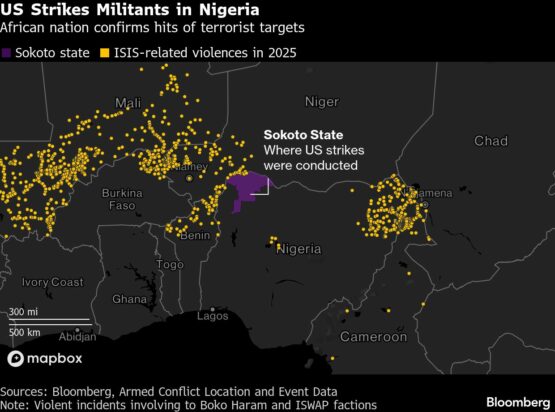
The attack hit the Sokoto region of northwestern Nigeria, an area where a local Catholic bishop said in October that Christians aren’t facing persecution. The Defense Ministry said the targets were linked to Islamic State.
Nigeria’s information minister, Mohammed Idris, said on X that the strikes were launched from vessels in the Gulf of Guinea and used MQ-9 Reaper drones. They fired 16 GPS-guided munitions that neutralized Islamic State elements seeking to enter the country from the Sahel corridor, he said.
“Given what we know for now about the attacks, they are largely a signal for something larger,” said Confidence MacHarry, a security analyst at SB Morgen Intelligence in Lagos. “It is very likely that future attacks will do more damage.”
The country of about 230 million people, by far the most populous in Africa, is split roughly evenly between Muslim and Christian populations and has been riven by violence for decades.
“It seems as if we’re at the moment where the Nigerian authorities have finally realized that they can’t do this thing alone, they need help, and the United States government appears more than willing to give that help,” said Ebenezer Obadare, a senior fellow for Africa studies at the Council on Foreign Relations in Washington.
In November, Trump threatened military action if attacks continued. Shortly afterward, terrorists abducted more than 200 children from a Catholic school. They were released earlier this week, according to the government.
© 2025 Bloomberg
Follow Moneyweb’s in-depth finance and business news on WhatsApp here.
#Trump #strike #terrorists #Nigeria #open