Cape Town’s dam levels slid sharply at the start of summer, raising concerns about the risk of a new drought cycle as demand rises and rainfall remains below average across key catchments.
The city’s latest Water Dashboard shows that the dams supplying Cape Town and other users in the Western Cape Water Supply System (WCWSS) were 75.3% full as at 15 December 2025, down more than two percentage points in a single week and about 18% lower than at the same time last year.
Read: City of Cape Town’s desalination plant is six years away
Although still well above the crisis levels seen during the 2015-2018 drought, the city has already shifted to “early drought caution” status, signalling an increased risk if current trends persist.
Day Zero threat
Cape Town’s water vulnerability came sharply into focus during that period, when the city warned that it was “weeks away” from a Day Zero scenario – the point at which residents would face water cuts.
At the time, residents were instructed to limit water usage to 50 litres per person a day, down from 85 litres. Major dams in the water supply system fell to around 28.7% of capacity, compared with about 93% in 2014.
Read:
How AI can help solve South Africa’s water crisis
Cape Town residents told water supply likely to be cut off [Jan 2018]
According to the most recent dashboard, overall WCWSS storage declined from 77.6% the previous week to 75.3%, with the total volume stored falling to about 676 billion litres.
The decline has coincided with a sharp rise in daily water use, which averaged 1 029 million litres a day (MLD) in mid-December – well above the city’s collective target of 975 MLD.
Storage levels are uneven across the water supply system, however.
2025 dam levels
ADVERTISEMENT
CONTINUE READING BELOW
Theewaterskloof, the backbone of Cape Town’s supply, was down to 70.2%, compared with more than 93% a year ago.
Berg River stood at 78.6%, Voëlvlei at 83.8% and Wemmershoek at 76.9%.
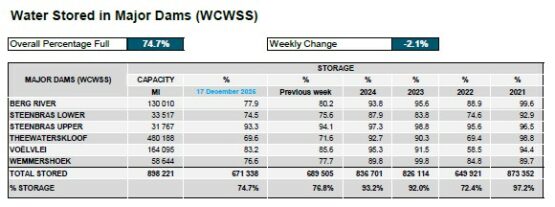
Dam levels in the Western Cape Water Supply System. Source: City of Cape Town
Responding to questions from Moneyweb, the city’s Mayoral Committee Member for Water and Sanitation, Zahid Badroodien, said the rate of decline differs from dam to dam because the WCWSS is managed as an integrated system.
“This year, due to a drier winter, the drawdown began earlier than in previous years. It is also worth noting that the summer drawdown is dependent on other users,” he says.
By October, these indicators prompted the city to formally move from “Water Wise” to “Early Drought Caution” under its Bulk Water Drought Monitoring and Response Framework.
Read: South Africa gets its first climate index to track weather risks
“It was clear by October that the WCWSS was unlikely to exceed 95% full by 1 November based on detailed hydrological modelling and a review of available climate data,” Badroodien said.
He stresses, however, that the shift does not mean restrictions are imminent, but forms part of a proactive risk-management approach.
“While there is no immediate reason for concern and no expected restrictions for the next year, this updated drought risk status is part of the city’s proactive approach to monitoring for and managing future droughts,” he says, adding that the status and actions are set out in the city’s Water Outlook 2023 and reflected in the latest dashboard update.
The immediate challenge, however, is demand.
Higher temperatures fuel demand
ADVERTISEMENT:
CONTINUE READING BELOW
“Demand has been consistently above 975 MLD since the beginning of December, hovering around 1 025MLD (+-5%). This has been driven by the high temperatures over the last weeks,” Badroodien says.
Dashboard data shows water use peaking above the target on multiple days, eroding storage faster than planned at the start of summer.
Despite this, the city believes the 975 MLD target remains achievable.
“A target of 975 MLD is challenging, but reasonable. Almost 150 MLD is estimated to be used outdoors during the peak, so with heightened water awareness and compliance with the existing water bylaws, this target could be achieved,” Badroodien adds.
Read:
Heavy rain or not, Cape Town’s water supply remains constrained [July 2024]
Action needed to reduce Cape Town’s water usage, says expert [Feb 2023]
For now, no new restrictions are planned. Instead, the city is intensifying awareness campaigns about declining dam levels to encourage residents to reduce consumption during summer and keep track of the collective target of 975 MLD.
Residents are being asked to avoid swimming pool top-ups where possible, to water gardens only before 09:00 and after 18:00, and to be water-wise throughout summer.
Outdoor use – particularly irrigation and swimming pools – has been identified as the main driver of peak demand.
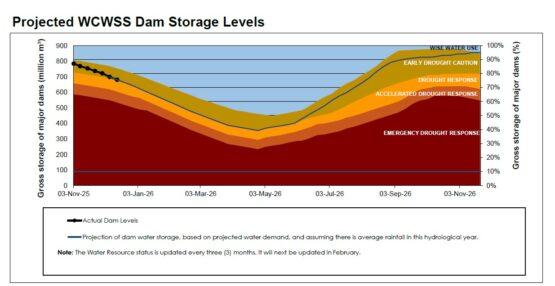
Source: City of Cape Town
Infrastructure investments
At the same time, the city says it is continuing to invest heavily in infrastructure resilience to limit losses.
The past three years have seen more than 171km of ageing water pipes replaced. In the current financial year alone, 23.2km of pipes had been replaced by the end of October 2025.
ADVERTISEMENT:
CONTINUE READING BELOW
Listen/read: Toilet water to tap water: The shift to recycled wastewater in SA
Through its leak detection and repair programme, the city reports daily savings. Since July 2025, about 5 828 kilolitres a day have been saved.
New sources
Badroodien says there are no major infrastructure risks currently flagged that could worsen supply pressures.
Looking further ahead, Cape Town plans to add around 300 MLD to the system shortly after 2030 through new water sources, including desalination, groundwater and reuse.
As part of this strategy, the city plans to develop its first permanent desalination plant at Paarden Eiland.
The facility is expected to be operational by 2031 and produce between 50 million and 70 million litres of water a day. However, Badroodien cautions against expectations that these projects could be fast-tracked.
“It is unlikely that schemes can be accelerated without critical regulatory supply chain management and due diligence processes being dispensed,” he says.
For now, and assuming average rainfall, dashboard projections show that dam levels are expected to continue declining through autumn before stabilising in winter.
The city’s next formal update to the water resource status is due in February 2026.
Read: V&A Waterfront to commission R184m desalination plant early 2024
Follow Moneyweb’s in-depth finance and business news on WhatsApp here.
#Drop #Cape #Town #dam #levels #triggers #early #drought #warning