Mohammad Ali Kialha’s first hours were all he knew of peace. He was born on February 26 in Iran’s capital, Tehran. Two days later, President Donald Trump began his war on that country. “Bombs will be dropping everywhere,” Trump wrote on social media on February 28.
That day, the U.S. attacked the Shajarah Tayyebeh elementary school in Minab, killing more than 150 people, most of them children. In the weeks that followed, tens of thousands more would be killed or wounded in U.S.–Israeli strikes, according to World Health Organization estimates. Since a June ceasefire collapsed and the U.S. resumed attacks, Iran’s Health Ministry says U.S. strikes have killed or wounded more than 650 people.
Mohammad’s parents — Fatemeh Rostami, known to her family as Hannaneh, and Ali, her husband — brought him home to their apartment in eastern Tehran’s Pirouzi neighborhood. Despite the danger, Hannaneh’s mother, Tahereh Sarbaz, traveled almost 100 miles from the city of Qazvin to meet her newborn grandson, as Trump lobbed threats and missiles at Tehran. “Today Iran will be hit very hard! Under serious consideration for complete destruction and certain death, because of Iran’s bad behavior, are areas and groups of people that were not considered for targeting up until this moment in time,” he wrote on Truth Social on March 7. Sarbaz witnessed the destruction that week and felt a blast wave firsthand while driving through the capital. “I was in Tehran. I saw what happened there,” she recalled. “People were being bombed every night. Families everywhere were losing their children.”
Pirouzi, a crowded working- to middle-class residential area, with a major shopping mall, hospital, sports complex, and several transit hubs, is home to around 600,000 people. When the war erupted, it was hit hard. As U.S. and Israeli munitions laid waste to buildings there, people flooded into the streets — Hannaneh’s family among them — seeking safety. Ali was still going to work each day but suggested that Hannaneh and the children decamp for the relative safety of Qazvin, which was not attacked nearly as much as the capital. “My daughter refused,” Sarbaz recalled. “She told him, ‘I will not leave you here alone.’”
Sarbaz eventually headed across town, to northern Tehran, where her son, Mehdi Rostami, lived with his wife and their three children, thinking it would be safer. After a short visit, she returned, alone, to Qazvin.
On March 17, Sarbaz checked in with Hannaneh by phone. “I called her and asked how she and the baby were doing,” Sarbaz said. “I asked whether the fighter jets were still coming. Whether she was afraid. Whether there was a lot of noise. And I told her to be careful.”
“Mother, the thing you were afraid of has happened.”
The next day, Rostami’s whole family traveled across Tehran to visit Hannaneh and her children. Not long after, Sarbaz received a call from another daughter-in-law. “She sounded extremely distressed. She was trying to prepare me for something,” Sarbaz recalled. “Finally, I asked her, ‘What happened? Why are you so worried?’” The daughter-in-law said: “Mother, the thing you were afraid of has happened.”
Sarbaz was initially so stunned that she couldn’t process the news. It wasn’t until other family members broke down in tears that she could comprehend the enormity of her loss. An airstrike hit Hannaneh’s apartment building while her brother’s family was visiting. The attack killed Rostami; his wife, Manzar al-Sadat Zarrabadi; and their three children: Ali, 13; Fatemeh, 9; and Zeynab, 7. Also slain were Hannaneh and her two children: Mohammad Hassan Kialha, 7, and Mohammad Ali Kialha, who was just 20 days old. Ali, Hannaneh’s husband, survived; he was out at the time of the attack.
“They told me that my family in Tehran had been killed,” Sarbaz said. “Inside, I was heartbroken.”
Dr. Nader Azadeh, a high-ranking official with the Tehran Fire Department, was coordinating emergency response and rescue operations in the capital following airstrikes and deployed to the Pirouzi neighborhood just after the attack on the family’s apartment building. Amid all the carnage he witnessed over weeks of war in Tehran, the toll on the Rostami family — eight dead — had a lasting impact on him. He said he could not forget the scale of their loss.
A rescue worker who participated in the response said that the entire building was demolished by the strike. He estimated that 30 people, in total, died. It took hours to unearth what was left of the family and other victims from the rubble. Most of the dead had been exhumed when neighbors explained that an infant was still somewhere under the debris, prompting the search to begin anew. Hours later, they finally located the tiny body, he recalled.
No one knows how many survivors in Iran are grieving over loved ones killed in Trump’s war. Global attention has focused on Shajarah Tayyebeh elementary school — almost to the exclusion of the other schools, homes, hospitals, apartment buildings, and other civilian sites damaged or destroyed in other U.S.–Israeli strikes. The U.S. military has used this tunnel vision to its advantage, advancing the farcical claim that the elementary school strike is the only incident of civilian harm during the entire conflict. “There is one active civilian casualty investigation from the 13,629 munitions,” Adm. Brad Cooper, the chief of U.S. Central Command, told members of the Senate Armed Services Committee in May.
CENTCOM has continued these claims in response to queries from The Intercept. “We have no new updates at this time pertaining to current investigations or munitions that were expended during Operation Epic Fury,” a spokesperson said.
Asked if CENTCOM was aware of any allegations of civilian harm in Iran on or about March 18, the command dodged the question. “The U.S. military takes all reports of civilian harm seriously,” a defense official told The Intercept. “All allegations of civilian harm reported to CENTCOM have been reviewed.”
While CENTCOM was tight-lipped, Sarbaz refused to stay silent. “I want people around the world to know that civilians died in this conflict. I want people around the world to know that the president of the United States, a man mired in corruption and scandal, came and took my children from me,” she told The Intercept. “What crime had my 20-day-old grandchild committed?”
It’s unclear if Hannaneh and Ali’s apartment building was the intended object of a U.S. or Israeli strike, a targeting error, or so-called collateral damage. The family says it knows of no regime officials who resided in the building or military uses of the site.
The Israel Defense Forces announced it killed “Mehdi Rostami Shamastam, one of the key commanders in Iran’s Ministry of Intelligence” in Tehran on the same day that Mehdi Rostami and his family lost their lives in Hannaneh’s apartment. Sarbaz said her son was an academic, not an intelligence official. “I deny this,” she said of the assertion. “My son was a university professor. But if what Israel claims were true, I would be very glad.”
Sarbaz said that if her son was, in fact, a top intelligence chief, killing him alongside his family, including a baby, would make it an even graver atrocity. “The presence of a 20-day-old infant among the victims, and the killing of eight members of one family, is such an enormous crime,” she said. “Why didn’t they target him in the street?”
Following the attack, the Iranian regime did not treat Mehdi Rostami as it often does senior commanders or influential figures killed in enemy strikes, making no public acknowledgment of his service to the state. Mehdi and Rostami are also common names. The Israeli military did not respond to multiple requests for clarification if the Mehdi Rostami Shamastam it referenced and Mehdi Rostami were the same person. CENTCOM did not respond to multiple requests for comment on whether it or Israeli forces had conducted airstrikes in Tehran’s Pirouzi neighborhood on March 18.
The strike that killed the Rostami family was part of an unrelenting blitz. The U.S. and Israel struck more than 17,000 separate targets in 40 days — a rate of strikes near unprecedented in modern conflict, according to the civilian harm monitoring group Airwars. In the first 24 hours of the war alone, the U.S. said it had struck more than 1,000 targets, and Israel 500. A May 18 report by Human Rights Activists in Iran counted 12,798 “unique attacks” by the U.S. or Israel, 77 percent of them involving civilian harm or damage to civilian infrastructure.
The U.S. bears some responsibility for all attacks as the chief of the coalition attacking Iran. “Only the United States of America could lead this,” self-styled War Secretary Pete Hegseth said on March 4. “But when you add the Israeli Defense Forces, a devastatingly capable force, the combination is sheer destruction for our radical Islamist Iranian adversaries. … Fighting shoulder to shoulder with such a capable ally is a true force multiplier and a breath of fresh air.”
After initially striking Iranian military assets in the opening rounds of the war, the U.S. shifted to targeting civilian infrastructure, Sina Toossi, a senior nonresident fellow at the Center for International Policy specializing in U.S.–Iran relations, told The Intercept. Targets included oil facilities; steel and pharmaceutical plants; universities; and even the headquarters of Iran’s space program. He noted that bridges were targeted, killing civilians as well as first responders.
This summer, as a second ceasefire imploded and Iran stepped up attacks on U.S. bases causing large numbers of casualties, Trump has increasingly unleashed unhinged rants, including threats to attack civilian infrastructure such as bridges and power plants, that would “affect 91 million people.”
In July, Sen. Jeff Merkley, D-Ore., cajoled chair of the Joint Chiefs of Staff Gen. Dan Caine into what seemed like a half-hearted pledge to “not target, even in retaliatory sense, infrastructure that is generally considered to be primarily for civilian survival.” The very next day, Trump announced that “any time the Islamic Republic of Iran shoots at a ship in the Strait of Hormuz … the United States will bomb and destroy ONE BRIDGE OR POWER PLANT, including those located next to, or in, the Capital City of Tehran.”
Harrison Mann, a former U.S. Army officer and intelligence official and now the associate director for campaigns and policy at Win Without War, drew specific attention to the attacks on the bridges and water reservoirs. It is “quite dangerous to be conditioning the U.S. military to carry out orders that are clearly war crimes,” he warned.
The World Health Organization puts the Iranian casualty toll at an estimated 37,181, including 3,375 deaths. Iranian state and semi-official media reported similar figures, just under 3,500 killed. Mansoureh Mills, a regional researcher with Amnesty International, noted that earlier government figures put the civilian toll at roughly 45 percent of the total, including 383 children.
The total number of U.S.–Israeli strikes on apartment buildings is unknown, but certainly significant. Reports of civilian harm were recorded every day from the beginning of the war on February 28 to the first ceasefire on April 8, according to Airwars. This includes six strikes on March 18, the day that the Rostami family was killed. Airwars found that civilians were frequently slain in attacks on residential areas, with such strikes accounting for 147 out of the 297 — almost 50 percent — of the civilian harm incidents it tracked. Eighty-seven of these took place in Tehran province. A Washington Post investigation, relying on data from the Institute for the Study of War, counted 285 attacks across Tehran with strikes “blanket[ing] almost a third of all neighborhoods, some with upward of 11 strikes.”
“To kill one person, they bombed a 14-story residential building and killed somewhere between 50 and 200 people living there.”
Azadeh, the fire department official, recalled chaotic and emotionally overwhelming nights of bombardment that killed untold numbers of civilians. In one attack on an apartment building in central Tehran, on the first day of the war, he recalled the death of a mother, her daughter, and the child’s grandmother. In another strike on a 10-unit apartment building in the Pirouzi neighborhood, he recounted the slaying of most of its residents, including seven children and teenagers. “When our rescue teams arrived, the force of the explosion had thrown many of the bodies into the street,” Azadeh said.
Azadeh drew specific attention to the death of Saeed Shamghadri, an academic killed with his son and daughter in an attack on their home in northern Tehran in March. “To kill one person, they bombed a 14-story residential building and killed somewhere between 50 and 200 people living there,” Azadeh said. “To eliminate one person, many civilians were attacked.”
When asked how many civilians have been killed in U.S. strikes and, if the military did not know the answer, to explain why, CENTCOM told The Intercept: “The U.S. military does not deliberately target civilians.” After being told that response didn’t address the question, Maj. Emma Thompson, the command’s media operations chief, said CENTCOM had “nothing additional to add.”
The WHO estimates that 229 healthcare centers, 49 hospitals, and 78 pharmaceutical facilities, laboratories, and warehouses were damaged in U.S.–Israeli strikes. “While I was on my way to my son’s house, Gandhi Hospital came under attack,” said Sarbaz of the medical facility in northern Tehran that saw its entire front facing torn off in a March 1 strike. Sarbaz said that the massive shockwave from the explosion rocked the car she was in. “The media are lying when they say ordinary people were not targeted. Gandhi Hospital, where pregnant women were present, was also attacked.” Videos of the private hospital, known for fertility treatments, show it sustained significant damage, and government sources noted it had to evacuate patients, including babies in incubators.
These attacks came after Hegseth’s Pentagon spent a year slashing measures to prevent civilian casualties, including firing the military’s top lawyers, who advise leaders on international laws of armed conflict. “U.S. strikes on civilian infrastructure in Iran, including the elementary school in Minab, have been absolutely devastating and completely inexcusable,” Sen. Kirsten Gillibrand, D-N.Y., told The Intercept. “I continue to have deep concerns about how the school in particular was targeted, especially as the strike was deliberately planned for the first day of the conflict and did not occur amid the fog of war. Secretary Hegseth’s catastrophic cuts to civilian harm mitigation efforts at the Department of Defense and his disdain for the rules of engagement will only continue to put innocent men, women, and children in danger.”
A group of Democratic lawmakers told Hegseth in a July letter that his “gutting civilian harm mitigation and response (CHMR) efforts” has left the Pentagon unable to “comply with the law and its congressionally-mandated CHMR responsibilities.” They added: “The Trump administration — potentially in violation of federal law — has defunded and impeded civilian protection efforts.”
That letter, sent by Sen. Elizabeth Warren, D-Mass., Gillibrand, and eight other lawmakers, echoed concerns raised by a War Department inspector general report that described civilian protection efforts as largely “inactive.” The May report by the Pentagon’s top watchdog says cuts to civilian harm mitigation and response efforts have been so severe under Hegseth that the United States cannot adequately protect civilians in conflict zones or track harm when it occurs.
These criticisms were echoed in an as-yet-unreleased official report revealed by The Intercept that found Hegseth’s Pentagon gutted its premier center devoted to preventing civilian casualties in war zones. The War Department’s Civilian Protection Center of Excellence reduced its staff from 40 personnel in January 2025 to just nine by the end of the year, according to the report. And cuts have been even more catastrophic at the tip of the spear.
When questioned by lawmakers about U.S. attacks on civilian targets in Iran, Caine dismissed the concerns. “We have a robust process which considers a target. It goes through a system that looks at a variety of considerations, to include what you’re alluding to around both purely civilian or dual-use targets,” the Joint Chiefs of Staff chair said. “I have trust and confidence in CENTCOM that they’re looking at the range of those things on a daily basis.”
There are good reasons not to trust that system. The 10-person civilian harm mitigation team at CENTCOM has been reduced to just one individual, according to Cooper, the CENTCOM commander. Another recent yet-to-be-released Pentagon report on civilian casualties noted that 15 attacks in Yemen from early 2025 are still under review by CENTCOM. “How will they get through hundreds of cases for Iran if their one civilian harm person still hasn’t finished Yemen?” a U.S. official lamented to The Intercept. Both current and former government officials told The Intercept that the massive cuts have left the Pentagon unable to protect civilians in war zones like Iran.
Asked if anyone would be held accountable for the February strike on the Shajarah Tayyebeh elementary school, Trump replied in June: “No. If it was a fault — and as you know that’s under investigation. It’s such a strange question to be asked at this date. You’re talking about a long time ago.”
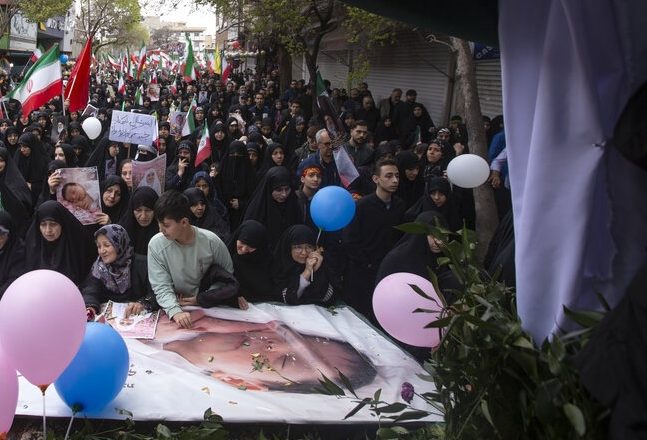
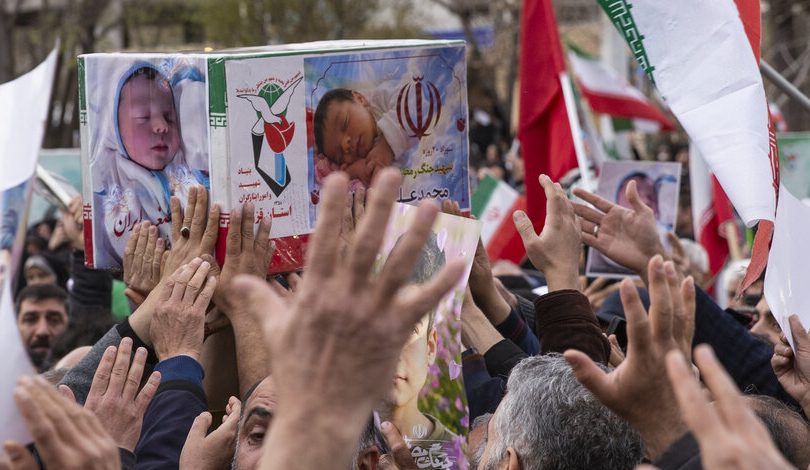
The Rostami family was large and close-knit. Sarbaz said that 16 children and grandchildren made a pilgrimage from Tehran to Qazvin every Friday. “We would spread a large tablecloth and eat together,” she said. After the bodies of her children and grandchildren were pulled from the rubble, the eight deceased made a last trip to their ancestral home for a funeral procession and burial.
A large crowd gathered outside Sarbaz’s home on March 23. “They were crying,” she recalled. “People came from everywhere. They were chanting ‘Death to America’ and mourning my children.” Azadeh, who accompanied the bodies back to Qazvin, recalls being deeply affected as Sarbaz received the corpses. “When we returned the bodies, I saw the mother arrive carrying an Iranian flag. She was the only surviving immediate family member there,” he said of Sarbaz. “She said the reason she was crying was because she herself had not been martyred alongside them.”
Footage from Iranian state television of the martyrs’ procession shows a huge crowd with women pushing children in strollers, men waving Iranian flags, and others carrying poster-sized photos of the dead, behind decorated funeral trucks bearing the bodies of the victims. Photos from the Iranian Students’ News Agency show crowds carrying coffins wrapped in the green, red, and white of the Iranian flag and a cleric clad in a black robe and turban holding the body of a white-shrouded baby aloft.
The funeral was attended by thousands of people, Sarbaz remembered.
In June, just after agreeing to a ceasefire that quickly collapsed, Trump returned to threatening to kill Iranians. “If they ?don’t behave,” he said, “we’ll go right back to dropping bombs ?right smack in the middle of their head.” Attacks followed. “We can knock down their bridges in one hour. We can knock out their energy supply,” he said in July. “We can knock out their electricity and power generating plants. … Every plant will be gone.” Later that month, Trump posted: “Every time Iran kills an American Soldier, they will pay for that killing many times over!”
Sarbaz now lives with the fallout of Trump’s war of choice and his disregard for civilian lives. “After three sons, God gave me this daughter, and she was all my hope. We had named her Fatemeh, but because her father loved the name Hannaneh, we used to call her that,” she explained. “But today, I no longer say Hannaneh or Fatemeh.”
As his war in Iran has imploded, Trump has increasingly lashed out, calling for cataclysm, slaughter, and even genocide. “We’re knocking the hell out of it,” he said of Iran earlier this month. “I do not want to kill people. But at some point we’re gonna.” But Trump has already killed many thousands of Iranians — including school children, hospital patients, the elderly, and, in Tehran’s Pirouzi neighborhood on March 18, most of a family, including its youngest member. “Knocking the hell out of them,” said Trump as he continued to rant about his attacks on Iranians last week. Mohammad Ali Kialha was one of those people; perhaps the youngest killed by Trump’s war.
And Sarbaz wants an answer from Trump about why he had to die: “What sin had my 20-day-old grandchild committed that he had to be martyred?”
This article is published in collaboration with Egab.
#Short #Life #Newborn #Iran #War