
Alain Stephens is an investigative reporter covering gun violence, arms trafficking, and federal law enforcement.
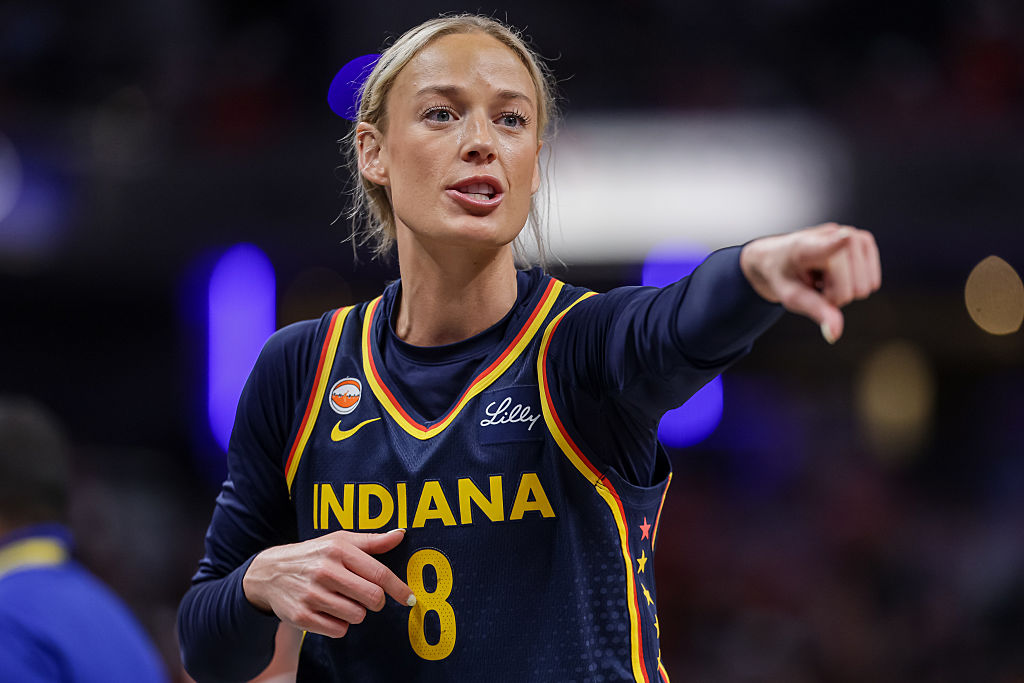
In the ever-shifting theater of America’s culture wars, conservative media has found its newest gladiatorial conscript: Indiana Fever guard Sophie Cunningham.
It’s an unlikely promotion—and from backers who, until recently, probably couldn’t have named five WNBA players.
The reason for her esteem probably has little to do with her faultless three point precision. In an interview with ESPN, Cunningham declared she opposed transgender women—whom she referred to as “biological men”—competing in women’s sports, arguing the issue was about “protecting young girls.” Later, she cheekily doubled down on the statement, posting an outfit photo on Instagram with the caption: “I said what I said” with a saluting emoji.
That was enough.
Almost overnight, Cunningham became more than a WNBA player. She became one of conservatism’s newest culture-war combatants: blonde, white, conventionally attractive, and playing in a league overwhelmingly composed of players of color, and with one of the largest openly LGBTQ+ player populations in professional sports.
For generations, conservative movements have sought to anoint and weaponize cisgender white women as public-facing enforcers of social and racial hierarchy.
Within days of Cunningham’s remarks, conservative media had found its new protagonist.
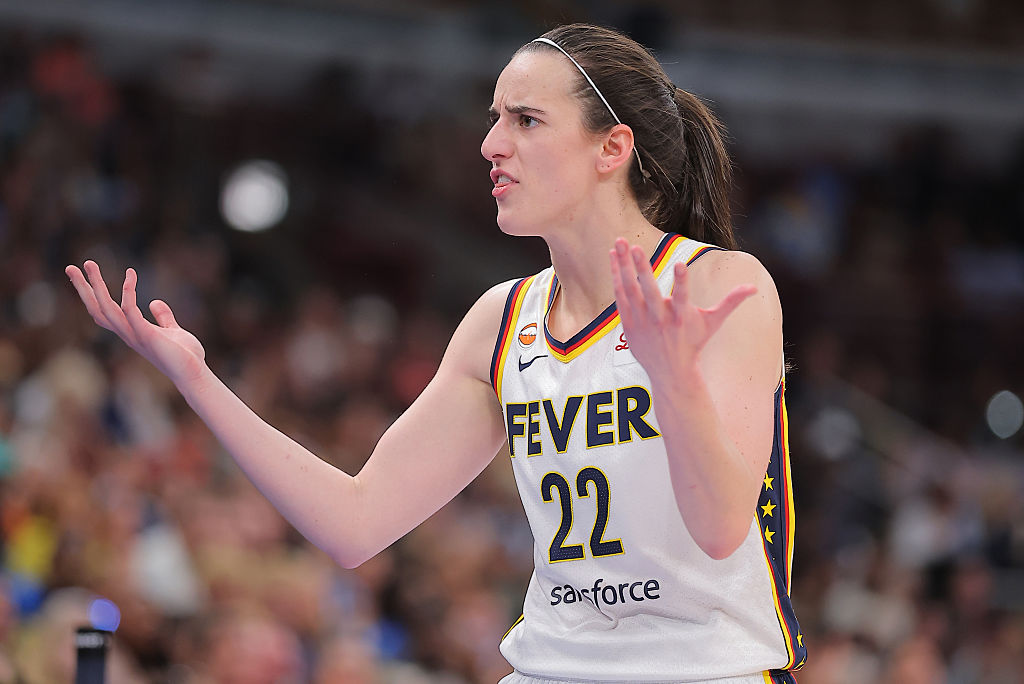
Fox News host Riley Gaines, who herself rose to prominence as an anti-trans NCAA swimmer, called Cunningham “the first current high-level female athlete” willing to publicly oppose transgender participation in women’s sports, and praised her for speaking out from inside what Gaines called “the most woke league of all time.” The Daily Wire cast the now-famous finger-pointer—and on-court defender of Caitlyn Clark, another white player whose first season with the WNBA sparked racialized conversations that cast her Black opponents as too “aggressive”—as someone “now fighting for us.” Trump’s Department of Education joined in, posting a Grok AI-generated image of Cunningham wearing a crown with the caption: “Common sense prevails.”
Cunningham’s ascent into the right’s zeitgeist is by design. For generations, conservative movements have sought to anoint and weaponize cisgender white women as public-facing enforcers of social and racial hierarchy.
While the specific rallying cry has changed throughout history, their use and ideological framing to the conservative movement has remained largely intact: They serve narratively as bulwarks against some grave impending demographic or social upset, which if allowed to come to fruition would be an assault on the current status quo of women at large.
Ride of the Valkyries
American political history is thick with appeals to white womanhood as something endangered and therefore requiring protection, particularly against the encroaching civil rights gains of Black, brown, and LGBTQ+ communities. Since the Academy Award-winning Birth of a Nation, the idea that straight white women are in peril simply by living in proximity to minority groups has been repeatedly used to justify racial exclusion and stir up moral panic.
In the wake of Brown v. Board of Education, southern governments launched what’s now known as the “Massive Resistance,” a series of laws to prevent integration. The campaign mobilized a movement of white women to organize through schools, newspapers and civic groups in an effort they sold as defending white children, neighborhoods, and public education. It was largely these communities that performed the on-the-ground enforcement of segregation, going so far as to pluck out children suspected of being mixed-race from white schools. This changed the packaging of the politics of segregation: Rather than snarling racism, the message could be framed more politely as a threat to the sanctity of motherhood and child welfare.
By the 1970s, overt defenses of racial segregation had become politically untenable on the national stage. The conservative movement’s next great cultural fight shifted toward gender. As the sexual revolution, second-wave feminism, and the promise of the Equal Rights Amendment changed family structures and challenged traditional gender roles, conservatives increasingly looked to white women to make the case against the nation’s expanding vision of female equality.
In the impeccably dressed mother-of-six Phyllis Schlafly, the conservative movement found its most formidable duelist against progressive feminism. Through her “STOP ERA” campaign, Schlafly argued the Equal Rights Amendment wouldn’t liberate women—it would endanger them by exposing women to the military draft, undermining mothers’ custody rights, and destabilizing the American family.
Her message was overwhelmingly effective; the Equal Rights Amendment was never ratified. As prominent legal scholar and feminist theorist Joan Williams put it, “the ERA was defeated when Schlafly turned it into a war among women over gender roles.”
For decades, conservative politics has repeatedly tapped into this vein, transforming cultural anxieties—over motherhood, children’s safety, crime, sexuality, and gender roles—into mass movements by placing cisgender white women front and center.
At the turn of the late 70s, conservatives promoted Anita Bryant, a wholesome pop singer who warned that gay rights threatened America’s children. During the rise of evangelical moralism of the 1980s, the religious right elevated Patricia Pulling, the suburban Virginia mother whose campaign against Dungeons & Dragons helped ignite the Satanic Panic. From matronly children’s book authors to buxom blue jean models, the conservative avatar is exceedingly familiar: a woman whom white men are encouraged to protect and one whom other white women are encouraged to empathize with and emulate.
The Girls We Don’t Protect
In her research on anti-feminist women, sociologist Rebecca Klatch found “most…are white, middle-aged, housewives, married or widowed, new to politics, and oriented toward single issues.”
But by screaming to “remember straight white women,” the right aims to make us forget anyone who sits at the edges of that definition, those long underserved by America’s promise of a truly free and equitable land. It dehumanizes women of color even further in a league where all athletes still earn a fraction of the paychecks their male counterparts take home. It shuts down any future good-faith conversations on how to allow trans athletes to compete and the sheer danger to a trans community increasingly excluded from social participation. It also serves to drown out the voices of women who support trans athletes, and often becomes a political Rorschach test to attack civil rights far beyond who makes a starting line up.
I don’t know if that’s what Cunningham signed up to represent, and quite frankly, I don’t know if she did either. She most recently told the press that she wants to “get back to basketball.”
In a free-speaking democratic society, Cunningham, and every athlete, is entitled to be human: to hold opinions, and feelings, and have a political voice. She is not the first, nor will be the last, fair maiden to be cast as a sword-bearing champion for a conservative culture war.
But if a movement’s cause is about truly protecting women, then perhaps the more revealing question to interrogate is which women it has deemed worthy of protection in the first place. Whose womanhood is treated as universal, whose safety becomes a national rallying cry, and whose voices—including those of Black women, queer women, and transgender women—are left at the margins. That hierarchy often tells us more about the movement behind it than the woman standing under the net.
#WNBAs #Sophie #Cunningham #AntiTrans #Rights #Mascot