WEST BANK — On a hillside overlooking the Palestinian village of al-Mughayyir, a crowd of Israelis and Jewish visitors from abroad gathered for an inside look at how settlement works. They listened intently as Netanel, an Israeli settler-soldier in olive fatigues with a rifle strapped to his back, advertised his group’s impact in the Israeli-occupied West Bank.
“It started with this hilltop,” he said, referring to the current settlement push that has crept ever closer to al-Mughayyir. “We ended up putting the area in Jewish hands. There are no Arabs here.”
Netanel was speaking on a tour aimed at English-speaking Jews, some of whom expressed interest in moving to the settlements. He described his “mission” to support his fellow settlers and shepherds in their return to “Judea and Samaria,” the biblical name Israeli settlers and the Israeli government use for the West Bank.
The settlement movement is accelerating, recruiting outsiders to join and bringing in reinforcements from the military’s Hagmar battalions, regional defense units staffed largely with settlement residents that have exploded in size since October 7, 2023. The government has issued thousands of rifles to civilian security squads, at times distributed personally by Israel’s far-right national security minister, Itamar Ben-Gvir. Israeli watchdog groups describe the push as an unprecedented state-backed land grab, one that settlers are carrying out with an odd combination of tools: government-supplied rifles alongside herds of sheep and goats.
Reservist settler-soldiers like the Hagmar battalions “are not simply self-organized militia groups,” said Marko Milanovic, a professor of public international law at the University of Reading. “In essence, they should be treated in the same way as IDF soldiers as a legal matter.”
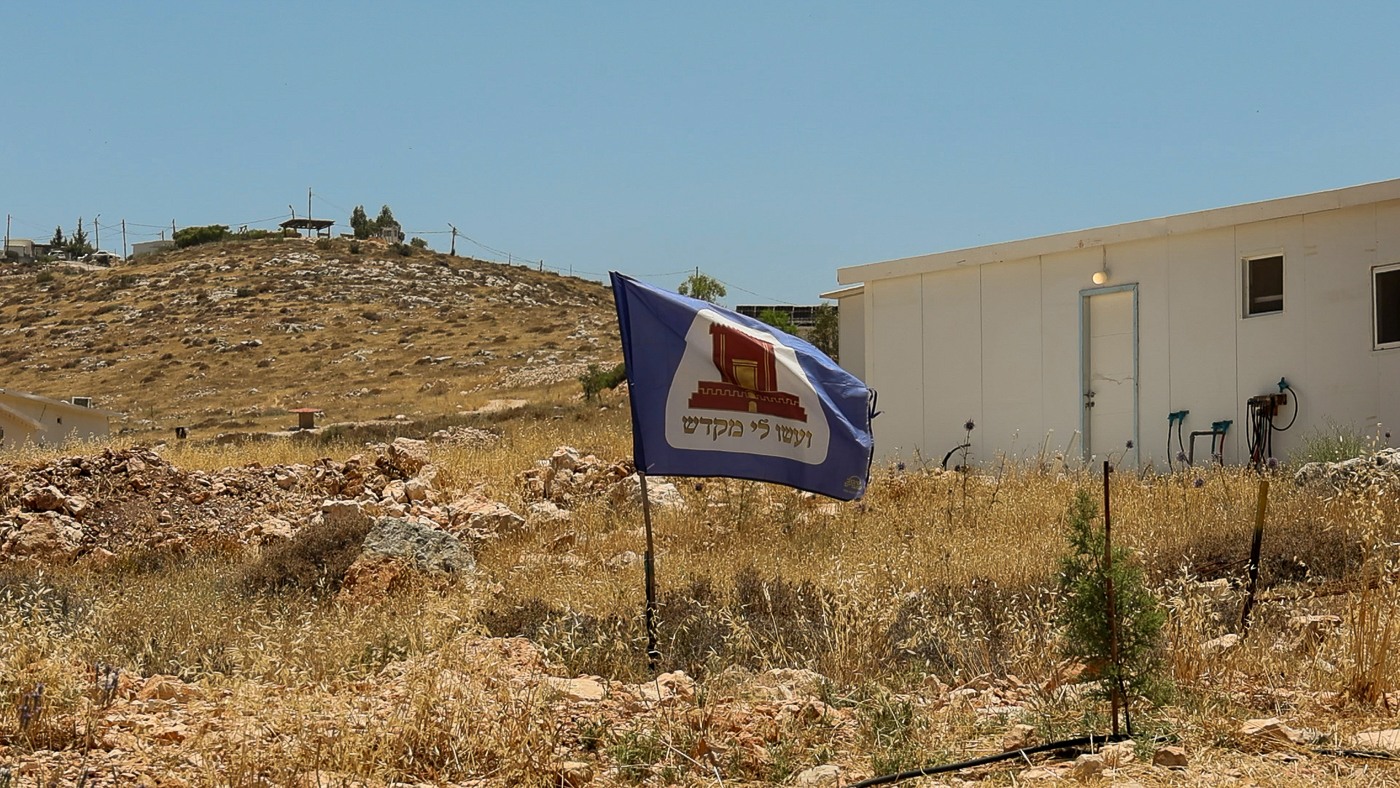
Established in 2025, the Metzudat David is illegal, even under Israeli law. It is one of 10 Israeli outposts that now surround al-Mughayyir as settlements expand at a rapid clip in the Israeli-occupied West Bank. At one stop on the tour, a group of Israeli youths could be seen building a new housing unit for a family slated to move into the settlement.
“The ultimate goal is for people to leave their homes and villages. But the settlers aren’t acting alone, they’re backed by the Israeli government, which uses them as instruments to get what it wants,” Amin Abu Alia, the council head of al-Mughayyir, told The Intercept.
Settlers have taken over more than 38,000 dunams of al-Mughayyir’s grazing and farmland, the equivalent of nearly 9,400 acres. Across the West Bank, settlers living in farm outposts now effectively control roughly 1 million dunams — nearly a fifth of the entire territory — according to a report published this month by the Israeli watchdog groups Peace Now and Kerem Navot. The report found that roughly 750,000 of those dunams were seized since the current Israeli government took office in late 2022.
Of al-Mughayyir’s roughly 41,000 dunams, Palestinians today have practical access to only 1,200 to 1,500, Abu Alia said. The village’s eastern gate, which opens onto the Alon Road, has been closed by the Israeli military since 2023. COGAT, the Israeli defense body that administers the West Bank, did not respond to questions about the outposts’ legal status or the land and gate closures.
“Once [the Metzudat David] outpost went in, it effectively closed off the village’s access to land to the east, displacing the community from that land,” Dror Etkes, the head of the Israeli settlement watchdog Kerem Navot, told The Intercept. Residents describe a growing sense of foreboding, a feeling that their time is running short before life in al-Mughayyir becomes untenable. And that fear has only grown. On Saturday, a 17-year-old resident, Fadi Naasan, died of wounds he sustained when he was shot during a raid on the village earlier that month, according to the al-Mughayyir village council.
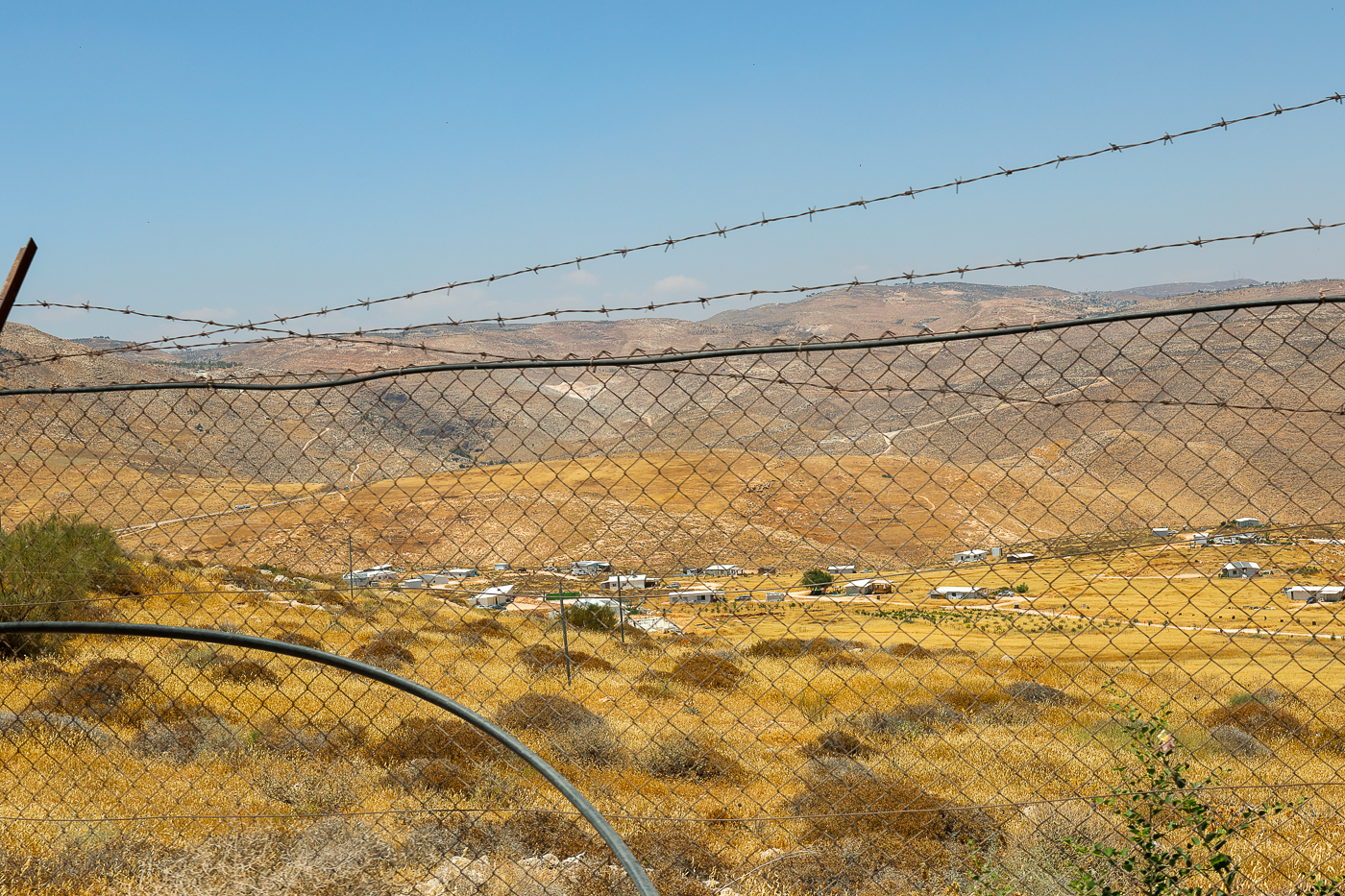
Only a handful of settlers like Netanel oversee the Metzudat David outpost. Otherwise, dozens of animals fan out across the land to claim as much space as possible, requiring very little manpower.
On the tour in June, Netanel showed off the more than 100 sheep and goats that do the settlers’ work for them. The herds graze out Palestinian crops, and their steady, intimidating presence — backed by the threat of settler violence — pushes farmers off land they can no longer safely use, clearing the way for the outpost to absorb it.
These outposts now control at least 786,000 dunams, roughly 14 percent of all land in the West Bank. Some 70 percent of the land seized by grazing outposts was taken in the past few years, according to Kerem Navot and Peace Now.
For now, the settlers don’t make any money from the livestock, Netanel said. The milk and meat aren’t profitable, but “the other work they do,” he said, “is invaluable.”
Palestinians living in al-Mughayyir are unable to enter the Alon Road, the main artery connecting the eastern half of the West Bank, and must exit through the western side of the village, via Khirbet Abu Falah. Residents say this adds at least an hour to any trip.
Even the fallback route is under threat. One of the new outposts, built inside Area B on al-Mughayyir’s northwestern lands, also encroaches on the very villages the detour runs through, according to the United Nations Office for the Coordination of Humanitarian Affairs.
“They can do whatever they want. You can’t do anything about it.”
“If you go through the IDF checkpoint, it’s a gamble. They can arrest you, beat you, steal your money, steal your belongings,” Omar Mohammed, who lives in al-Mughayyir, told The Intercept. “They can do whatever they want. You can’t do anything about it.” The Israeli military did not respond to questions about mistreatment of residents at checkpoints.
Hodaya, who led the tour and knew a reporter was present, gave only her first name, like Netanel. “On the other side of two hills, there are also another settlement,” she said. “So now, you know, the [farms] are surrounded by Jews, and that helps to make the place more safe.”
During the tour, an Israeli military armored personnel carrier was stationed at the village’s yellow gate — the kind that has become a distinct marker of movement restrictions across the West Bank since October 7, 2023 — was shut.
When one of the participants on the tour asked whether Palestinians resisted attempts to confiscate their land, Hodaya answered, “They don’t accept it and say, ‘Oh, very nice, we’re going away.’ Of course they’ll fight. They’re on the land, and they were permanent … but they understand that there’s a change.”
There was a sense of excitement on the tour about a Jewish return to what participants called Judea and Samaria, and an explicit recognition that doing so would require displacing Palestinians from their land. “The assumption is that ‘We cannot get rid of [the roughly 3 million] Palestinians right now in the West Bank,’” Etkes, of the watchdog group Kerem Navot, said, describing the settler thinking. “‘So what we have to do is isolate them and take from them their means of livelihood.’”
Al-Mughayyir was the village most affected by settler violence in the West Bank in 2025, when there were more than 70 recorded settler-related incidents, according to Nasser Khoudr, Middle East assistant research manager at the Armed Conflict Location & Event Data, known as ACLED. It is on track to earn the same distinction in 2026.
“One of the main reasons behind this is the expansion of nearby settlements and farming outposts, especially since 7 October,” Khoudr said. “This expansion has gone together with Israeli government policies that gave more power to settler security structures.”
In April, a settler shot and killed Aws al-Naasan, a 14-year-old student, and Jihad Abu Naim, a 32-year-old parent, at the boys’ school in al-Mughayyir, according to the United Nations and village officials.
Video of the attack, verified by multiple news outlets, shows a man in military fatigues advancing on the village and firing repeatedly toward the school.
The Israeli military said the shooter was a reservist traveling in a car with other Israeli civilians who exited the vehicle and opened fire at “suspects in the area,” alleging that they had thrown stones at the car. The military said the reservist was dismissed from reserve duty and his weapon confiscated, and that military police are reviewing the killings. No one has been arrested for the shooting.
Mohammed was one of the first to reach his friend’s body after the settler-reservist shot Aws in the head. “They come in half uniform, wearing the green pants, but not the shirt,” Mohammed said. “We can’t tell if they are a settler, a soldier, or, well, both.”
The distinction has dissolved. Even in regular army units, settler ideology has taken root. In March, reservists detained CNN correspondent Jeremy Diamond and his crew in the village of Tayasir while guarding an illegal outpost, telling the journalists on camera that the entire West Bank belongs to Jews and that they were avenging a settler’s death.
“We can’t tell if they are a settler, a soldier, or both.”
According to the U.N., no Israeli soldier has served prison time for killing a Palestinian in the West Bank since at least 2017, and the Israeli rights group Yesh Din found that 93.6 percent of investigations into settler violence between 2005 and 2025 were closed without indictments.
Last August, after a Palestinian gunman allegedly opened fire on a settler grazing his sheep on al-Mughayyir’s land, the Israeli military declared a closed military zone and uprooted olive trees across roughly 74 acres of the village’s land — at least 3,100 trees by the military’s own count, and far more according to village officials who spoke with The Intercept.
The military said that the clearing was necessary because vegetation near the road obstructed “the identification of enemy movement.” But the head of the army’s Central Command, Maj. Gen. Avi Bluth, told troops the village would “pay a heavy price,” prompting two Israeli human rights groups to demand a criminal investigation into him, suspecting he was ordering collective punishment. None ever occurred.
Netanel described participating in the uprooting. He said it was sad to see the olive trees die, but “it is for security, security of this outpost. We need a clear line of sight into the land.” As Netanel spoke, the roots of the trees still pointed up into the air.
“It’s a process, a process that we are progressing,” Netanel said. “That’s what’s happening here.”
#West #Bank #Eviction #Tour #Israeli #Settlers #Advertise #Arabs