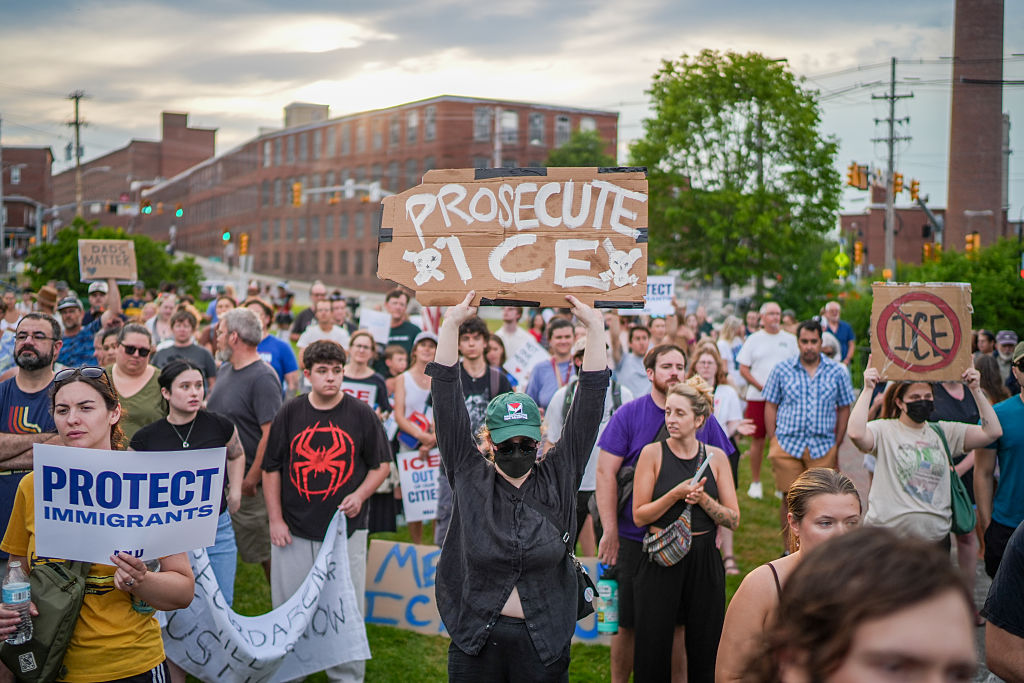
For the second time in a week, Immigration and Customs Enforcement agents have shot a man dead. Joan Sebastian Guerrero, a 26-year-old father from Colombia, was driving slowly in Biddeford, Maine, when an agent shot into his vehicle.
As is now par for the course, ICE representatives are already lying about the incident. Homeland Security Secretary Markwayne Mullin reportedly at first told Maine Sen. Angus King that the driver had attempted to use his car as a weapon — the same lie used to justify shooting 52-year-old Lorenzo Salgado Araujo dead just one week ago in Houston and Renee Good months before that. ICE has made the same bogus claim in a number of recorded incidents involving agents shooting into moving cars.
In a contradictory but equally baseless statement, the Department of Homeland Security claimed on X that the “vehicle attempted to flee the scene and, fearing for public safety, an officer discharged his weapon.” An eyewitness told reporters that before the victim died, his face covered in blood, he could be heard saying, “I tried to stop.”
Both shootings highlight the agency’s pattern of violent racial profiling and reckless indifference to human life.
Like Araujo in Texas last week, Guerrero had not been the target of ICE operations. This is not to say that either death would be any more justified had ICE been seeking the men for arrest; no immigration violation should carry a death sentence. But both shootings highlight the agency’s pattern of violent racial profiling and reckless indifference to human life.
Thousands protested in Houston following Araujo’s killing. Immediately after news spread of the Maine shooting, protesters took to the streets and rushed to Republican Sen. Susan Collins’s Biddeford office. Collins cast a deciding vote in the Senate last month to deliver a staggering $70 billion in funding over three years to ICE and Border Patrol. “Vote her out,” the demonstrators chanted.
Every elected official who is complicit in this border regime should be ousted. It should be a minimum requirement for Democrats running for Congress that they commit to abolishing ICE. Wherever there is legislative, municipal, city, or local power to do so, political leaders must combat ICE with more than words or face organized pressure campaigns and removal.
Following the high-profile ICE killings of Good and Alex Pretti, two Minnesotans, in January, people took to the streets nationwide. Minneapolis residents responded with work stoppages, blockades, and powerful community resistance. The need to escalate organized resistance to ICE nationwide is again all too clear. Community mutual aid networks, neighborhood defenses, mass strikes, and major disruptive protests are as necessary as ever. But all such actions face the challenge of sustainability when opposing President Donald Trump’s endlessly resourced deportation machine.
Guerrero’s killing in Maine is the eighth fatal ICE shooting in Trump’s second term, according to The Trace. At least fifty-two people have died in ICE custody over that same period, which Human Rights Watch called a “soaring mortality rate.” Meanwhile, ICE is further scaling up its quotidian activities to serve Trump’s project of ethnic cleansing: In just five days at the end of June, ICE agents quietly made a reported 10,000 arrests.
The vile spectacle of city-based ICE surges, which were the agency’s calling card under former DHS Secretary Kristi Noem, have given way to dispersed but constant round-ups. The terror for immigrant communities is no less acute; the difficulty when it comes to fighting back has only sharpened. It is high time that anti-ICE action receives more robust political and institutional support.
It is not sufficient, for example, for New York Mayor Zohran Mamdani to assert that the New York Police Department does not coordinate with ICE for deportation operations if the NYPD is dispatched to clear streets for ICE vehicles to travel through disruption-free. It is not enough to have a court order in place barring ICE from making arrests at New York City immigration courts if that order isn’t enforced. “Sanctuary city” has to be a label with meaning beyond Trump using it as a slur against blue cities. It’s a promise, one that must also entail taking action against the racist municipal policing under which immigrants suffer and antifascist organizing is targeted.
Houston Mayor John Whitmire vowed last week to “pursue an independent and transparent” local investigation into the ICE shooting in his city. He also said that the federal government has taken control of the evidence, making such an investigation extremely difficult. The idea that the federal government will hold its jackbooted thugs accountable is, of course, utterly laughable.
But so, too, is the idea that an investigation by Houston or Texas law enforcement will deliver justice to Araujo’s loved ones, let alone the millions of people whose lives are being destroyed by the American deportation machine. An independent investigation into ICE killings is not even the floor, it’s the basement.
As the federal government expands extremist efforts to criminalize and imprison antifascist activists and ICE watchers as terrorists, political leaders — especially those who claim to represent so-called sanctuary cities — must step up to support and protect targeted organizers. It is a disgrace, albeit not a surprise, that Democratic leaders have not spoken out against the unprecedented, draconian sentences — ranging from 30 to 100 years in federal prison — handed down to eight people in Texas over an ICE detention center protest.
The struggle against Trump’s border regime will continue to be led by immigrant communities and their neighbors. The front-line work on the neighborhood level remains the most crucial — from street to street, workplace to workplace, building to building — and in collective efforts against detention centers and in the direct surveillance of and confrontation with ICE agents on the ground. No work of legislation or policy can supplant that. But as the stakes for taking part in anti-ICE work heighten, as immigrant round-ups grow and the death counts climb, it’s high time that Democrats join the work of abolishing ICE with everything at their disposal — or be replaced.
#ICE #Arrests #Quiet #Deadly