Iraq started shutting oil production at its biggest fields and is set to make even deeper reductions in the coming days, the clearest sign yet of stress on Middle East producer giants from the closure of the Strait of Hormuz.
OPEC’s second-biggest producer has begun closing both the Rumaila field, the nation’s biggest, and the West Qurna 2 project, people familiar with the matter said, asking not to be identified because the information isn’t public. When complete, the halts will stop a majority of the country’s output.
The war has all-but halted ship traffic through Hormuz, leaving just a handful of empty tankers inside the Persian Gulf and still available to load. The result is that some of the world’s biggest producers are filling up their storage tanks — a situation that’s already become critical for Iraq and will eventually test others if the waterway isn’t unblocked. Saudi Arabia is also considering alternative export options.
“With the Strait of Hormuz still inactive, the clock is ticking,” JPMorgan Chase & Co analysts including Natasha Kaneva said in a note.
The ship shortage and concerns over navigating Hormuz drove the cost of shipping Middle East oil to unprecedented levels on Tuesday. Day rates for supertankers to deliver the region’s oil to China are now at about $481,000, according to data from the Baltic Exchange in London.
It’s a sign of how the number of ships in the Persian Gulf is dwindling. Between six and 12 very-large crude carriers are in the Gulf and able to be booked, according to Oil Brokerage Ltd. and ship-tracking sources.
For Iraq, the ship shortage is now backing up output. The country has begun closing both the Rumaila field, the nation’s biggest, and the West Qurna 2 project, with about 1.2 million barrels a day of output going offline on Tuesday, the people said, asking not to be identified as the information isn’t public.
ADVERTISEMENT
CONTINUE READING BELOW
The shutdowns may extend to about two-thirds of Iraq’s total output in the coming days if the Strait of Hormuz remains effectively out of bounds for ships, they said.
Baghdad has also halted oil exports from its northern semi-autonomous Kurdistan region to the port of Ceyhan in Turkey, people with direct knowledge of the situation said earlier.
Still, the country expects that the reduced crude output won’t impact its refining operations, according to a statement from Iraq’s oil ministry.
Loading slowdown
Traffic at Iraq’s main loading terminal in the south has now slowed to a trickle. Three ships have collected cargoes so far this month at the Basrah terminal, fewer than half the month-earlier number.
Only three tankers are currently berthed at Iraq’s seven loading points. There are also at least 10 vessels that loaded Iraqi oil since Feb. 21 that are still in the Persian Gulf and unable to transit Hormuz.
Earlier, insurers expanded the areas where they charge for war risk cover to include a larger amount of the waters off the coast of Oman. It’s the latest sign of the heightened cost of sailing into the region.
ADVERTISEMENT:
CONTINUE READING BELOW
The hostilities in the Middle East that started over the weekend have rattled energy markets worldwide with oil in London topping $85 a barrel on Tuesday and European natural gas prices surging over 65% in the past two sessions.
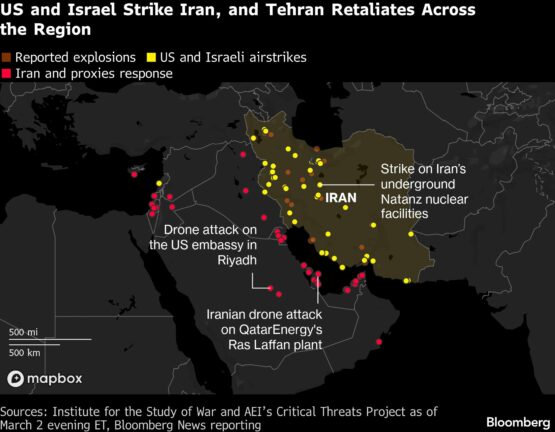
Energy assets across the Middle East have been targeted by retaliatory strikes after the US and Israel attacked Iran over the weekend. On Monday, Saudi Arabia closed its biggest oil refinery while Qatar stopped production from the world’s largest liquefied natural gas export plant following drone attacks.
BP manages the Rumaila field, one of the world’s biggest, jointly with Iraq and PetroChina Co. The project pumped more than 1.4 million barrels a day in 2024, and was at roughly 1.2 million a day early last year, according to the company’s data. Output at West Qurna 2 was just short of 500,000 barrels a day.
Saudi Arabia, the world’s biggest crude oil exporter, is considering alternative routes for its crude after the slowdown in Hormuz traffic. It’s exploring using a pipeline that runs across the kingdom to the Red Sea coast to get the oil to customers, but that plan is also not risk-free because of concerns over the Iran-backed Houthis resuming attacks on shipping.
The US Embassy in Riyadh was hit by an attack and the State Department also issued an alert on Tuesday warning of attacks in Dhahran, the Persian Gulf city where state oil giant Aramco is headquartered. Saudi Arabia’s major oil fields are also located around the area.
© 2026 Bloomberg
#Iraq #starts #huge #oil #cuts #Hormuz #blockage #fills #storage