The US-Israeli attack on Tehran on Saturday marks a turning point for President Donald Trump, who is wagering that a war — the kind he once vowed not to start — will strengthen his second-term agenda.
In a break from his campaign promises to keep the US out of foreign wars, Trump decided to attack — despite what Arab mediators described as significant progress in nuclear talks with Tehran, and in the face of polling showing most Americans oppose fresh military action.
Read:
Iran leader Ali Khamenei is dead after US-Israel airstrikes
Iran strikes disrupt thousands of flights, Dubai Airport shutdown
It came less than two months after he ordered a high-stakes US military raid inside Venezuela, another signal that his second term has tilted toward muscular intervention abroad.
The Iran strikes are the biggest gamble yet for the US leader, whose approval ratings have plunged in recent weeks, with surveys showing Americans think he is concentrating too much on foreign policy and too little on the US economy.
Forecasts suggest Republicans may lose the House of Representatives in November’s midterm elections, with the outcome in the Senate less clear.
-
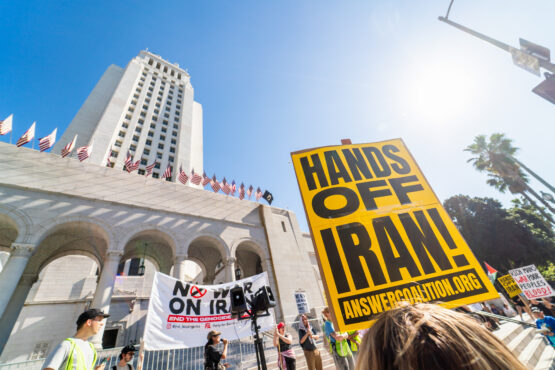
A demonstrator holds a sign reading “Hands Off Iran” during a protest against war in Iran at City Hall in Los Angeles, California, US, on Saturday, 28 February. Image: Kyle Grillot/Bloomberg
-
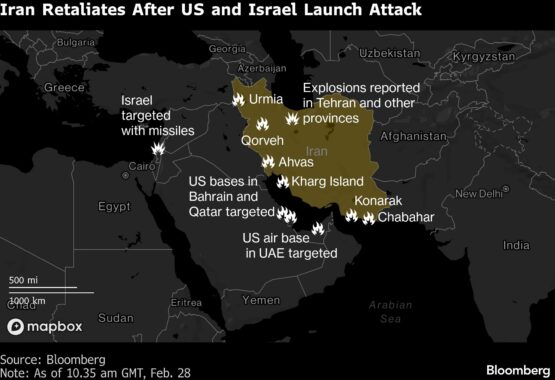
Image: Bloomberg


The US has bombed at least seven countries since Trump returned to office, but none of those operations was as significant as the latest. It deepens his focus on foreign affairs over domestic concerns like inflation and affordability. It also ties his political fate more tightly to events he cannot fully control.
“It could very well be that this is something that’s attractive to Donald Trump, who is facing a lot of problems at home,” said Paul Musgrave, a scholar of US foreign policy at Georgetown University in Doha, referring to politicians using foreign wars to bolster support at home.
“Given the amount of praise that he got for the military side of Venezuela, which was one of the few bright spots in the past few months for him, he might be looking to recapture that on a broader level.”
ADVERTISEMENT
CONTINUE READING BELOW
Wars often define American presidencies in a way that the occupant of the Oval Office never intended.
Vietnam consumed Lyndon Johnson’s tenure, and Iraq came to define George W. Bush’s and Barack Obama’s. Even clear battlefield victories offer no guarantee of political rescue. The swift Gulf War triumph in 1991 wasn’t enough to save Bush’s father when voters turned back to the economy.
Trump “suddenly seems to be preparing the American people for a longer and bloodier conflict,” Musgrave said. “If he is thinking about something longer, something diversionary, then this might end up very poorly for him in the long run.”
US casualties
Before taking office, Trump himself had repeatedly warned that US presidents could use strikes on Iran to rescue presidencies gone awry.
“In order to get elected, @BarackObama will start a war with Iran,” he wrote on Twitter in 2011.
A year later he predicted Obama would “attack Iran in order to get re-elected,” and in 2013 said he expected an assault by Obama to “save face.” Later that year, he predicted that “President Obama will attack Iran because of his inability to negotiate properly—not skilled!”
Trump conceded on Saturday that “the lives of courageous American heroes may be lost, and we may have casualties.”
Beyond that, an extended conflict threatens to drive up consumer prices months ahead of the midterms, in which the already-high cost of living is top of mind for US voters. Any move by Iran to close the Strait of Hormuz in response to the attacks could disrupt supply chains and trigger panic among investors.
Oil price impact
ADVERTISEMENT:
CONTINUE READING BELOW
Oil prices — already up almost 20% this year, mostly on the US-Iran standoff — could well spike when financial markets open in Asia on Monday morning. That could mean costlier gasoline for Americans.
Vice President JD Vance, who had previously been a vocal opponent of foreign wars, has dismissed the idea that any campaign would be protracted.
“There’s no chance that we’re going to be in a Middle Eastern war for years with no end in sight,” Vance said Thursday, before the attacks began.
Yet there are plenty of military analysts that say regime change in Iran cannot be achieved swiftly via an air campaign alone, and maybe not at all.
Inside the Trump administration, senior officials have long argued that diplomacy would likely not be enough to stop Iran’s nuclear ambitions — even as the country denied it wanted to build a weapon.
Outside the White House, Republican hawks such as Senator Lindsey Graham have openly urged decisive military action, framing it as a historic opportunity to cripple Tehran’s capabilities and oust the Islamic Republic, a US adversary for almost 50 years.
Netanyahu
Hovering over the debate has been Israeli Prime Minister Benjamin Netanyahu, who has made neutralizing Iran the central objective of his political career.
Since returning to office 13 months ago, Trump has often moved in lockstep with Netanyahu, despite the misgivings of his own base. Trump called for a pardon in Netanyahu’s bribery trial, describing him as an exceptional wartime leader. That’s riled some in his base, exposing a fissure on the right over Israel and the prospect of war with Iran.
“The United States is moving toward a big war, a real war with Iran, a regime-change war, the biggest war we’ve had since the invasion of Iraq in the spring of 2003,” right-wing commentator Tucker Carlson said last week.
“And Israel is driving that. We are doing this at the behest, at the demand of the Israeli Prime Minister, Benjamin Netanyahu,” said Carlson.
ADVERTISEMENT:
CONTINUE READING BELOW
Some American allies have also come out to question the attacks. Finland’s President Alexander Stubb said the US is “operating largely outside traditional international law” following the strikes, in an interview aired Saturday on public broadcaster YLE.
The cost of escalation is not only political. Iran’s missile barrages against Israel last year burned through vast quantities of interceptors. US forces are estimated to have expended roughly 150 THAAD missiles in that conflict alone, nearly a quarter of the American inventory, according to the Center for Strategic and International Studies.
Iran protests
The US and Israeli calculus may have changed in the weeks since the mass protests that rocked Iran in December and January. The demonstrations represented the greatest threat to the Islamic Republic since its inception in 1979 and highlighted a deep discontent among many of the country’s people.
There is the possibility that Trump is pursuing a strategy similar to what he attempted in Venezuela — trying to decapitate the system by removing those at the top while leaving the rest of it standing.
The wager is that cutting off the head won’t require the US to take responsibility for what comes next.
Whatever the case, toppling the regime will be difficult in a country of 90 million with entrenched, well-armed security forces that have tight control over dissent. And while the protests last month made clear the government is hugely unpopular among Iranians, they have a history of rallying around the flag when confronted with hostile actions from abroad.
“This is an existential moment for the Islamic Republic of Iran’s rulers, and both its security and ideological base is now prepared for a sustained war against the US and Israel,” said Ellie Geranmayeh, senior policy fellow, at the European Council on Foreign Relations.
“That has immediately opened the door for regional havoc, with widespread counter strikes by Iran underway,” she said.
© 2026 Bloomberg
Follow Moneyweb’s in-depth finance and business news on WhatsApp here.
#Iran #airstrikes #mark #biggest #Trump #gamble