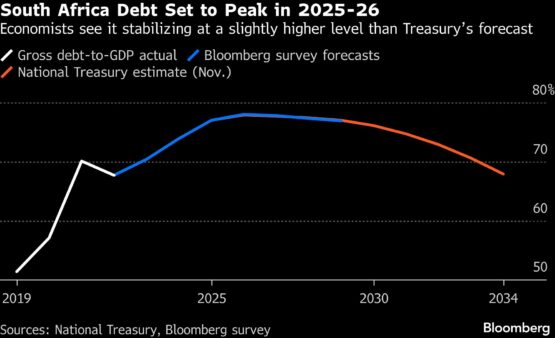
South African government debt is finally set to peak after rising for nearly two decades, a payoff from years of spending restraint and a commodities-driven revenue windfall.
Finance Minister Enoch Godongwana is due to deliver his annual budget at 2 p.m. in Cape Town and has signaled that debt as a share of gross domestic product will stabilise in the current fiscal year. That would lower the state’s interest bill and free up resources for education, health care and infrastructure investment as municipal elections approach.
Economists surveyed by Bloomberg see the debt-to-GDP ratio peaking at 78% — slightly above the National Treasury’s 77.9% forecast — before easing to 76.9% by 2029. They expect Godongwana to outline how those gains will be sustained through a new fiscal rule to be adopted by next year.
“The market is expecting a very bullish budget with a substantial revenue overrun feeding through to higher primary surpluses and a clear decline in the debt-to-GDP ratio,” Carmen Nel, head of multi-asset at Terebinth Capital, said in an interview.
Gains in South African assets could have further room to run if Godongwana meets those expectations, according to analysts at Morgan Stanley. Yields on the benchmark 10-year government bond have already fallen more than 300 basis points from an April 2025 peak to about 8%, while the rand has strengthened more than 20% against the dollar over the same period.
Working in Treasury’s favor is a renewed commodities boom that has driven mining profits sharply higher, lifting corporate income tax and royalty collections. The higher-than-expected revenue, combined with restrained spending, is set to not only bolster the 2025-26 fiscal framework but also the following year’s, with elevated precious-metal prices yet to fully filter through to tax receipts.
ADVERTISEMENT
CONTINUE READING BELOW
Economists anticipate tax collections to exceed the Treasury’s November forecast by R10 billion ($627 million) and expenditure to significantly undershoot in the year through March. That’s likely to lower the consolidated budget deficit to 4.4% of GDP, better than the Treasury’s previous 4.7% projection. Hitting those numbers would widen South Africa’s primary surplus, whereby revenue exceeds non-interest expenditure.
The fiscal gains reflect deliberate policy choices rather than merely favourable external tailwinds, said Goldman Sachs Group Inc. economist Andrew Matheny.
“The fiscal improvement is mostly Treasury’s doing,” he said. “Corporate income-tax receipts have come in somewhat stronger than expected, but not dramatically so.”
The turnaround marks a sharp contrast to last year, when divisions within the governing coalition over proposed tax increases forced the Treasury to revise the budget three times. This year, broader political backing for a framework centered on spending restraint and shifting outlays from consumption toward infrastructure should smooth its passage through parliament.
ADVERTISEMENT:
CONTINUE READING BELOW
“This is a reflection of good policy choices and a fiscal strategy which has been effective,” Matheny said, noting a change from the approach adopted by some of Godongwana’s predecessors, whereby the protection of social spending was prioritized and tax windfalls were utilized while cutting expenditure was a secondary concern.
The anticipated fiscal improvements — together with South Africa’s removal from a global watchdog’s dirty-money list and the adoption of a 3% inflation target — could strengthen the case for ratings upgrades. Economists expect Fitch Ratings and Moody’s Ratings to shift the country’s outlook to positive when they deliver their next assessments.
Godongwana is also expected to maintain a hard line on support for state-owned enterprises. “We do not expect major SOE bailouts in this budget, but note that this is a persistent risk,” Nel said, citing pressures at Transnet, and the Road Accident Fund.
The brighter outlook gives Godongwana scope to trim local bond issuance — as he did in November. But most analysts expect him to hold off until at least October’s mid-term budget, enabling the Treasury to build cash buffers to smooth funding needs in 2026-27 and step up redemptions the following year.
“On the whole, disciplined cash management and a cautious issuance mix reinforce consolidation and have the potential to reduce risk premia further,” Morgan Stanley’s analysts said.
© 2026 Bloomberg
Follow Moneyweb’s in-depth finance and business news on WhatsApp here.
#Government #debt #peaking #landmark #budget