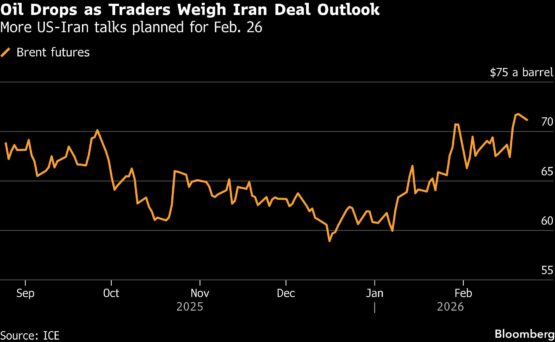
Oil eased from its strongest close since July, with US-Iran talks set to resume this week against a backdrop of massed American forces in the Middle East.
Brent traded below $72 a barrel, after jumping almost 6% last week as US President Donald Trump said he was considering a limited military strike on Iran. The next round of talks in Geneva is slated for Thursday.
Iranian Foreign Minister Abbas Araghchi told CBS on Sunday he saw a “good chance” of a diplomatic solution to the standoff over his country’s nuclear program, while reiterating Tehran won’t be pressured by the US military buildup.
Concerns about a Middle East conflict, coupled with several supply disruptions, have driven crude higher despite broad expectations for a global supply glut. A potential war would put shipments at risk in the Strait of Hormuz – the choke point for exports from the world’s top oil-producing region.
ADVERTISEMENT
CONTINUE READING BELOW
Longstanding bear Goldman Sachs Group Inc. boosted its oil price forecasts, citing a lower stockpiles build in developed countries. The bank said it still sees declines from current levels, with Brent ending the year at $60, but that a combination of sanctions and hits to supply are keeping prices higher than previously thought.
“Markets can tolerate headlines but won’t ignore lost supply,” said Haris Khurshid, chief investment officer at Karobaar Capital LP. “If exports out of Iran are hit or there’s credible interference in the Strait of Hormuz — highly likely if things go south — that’s when crude reprices fast.”
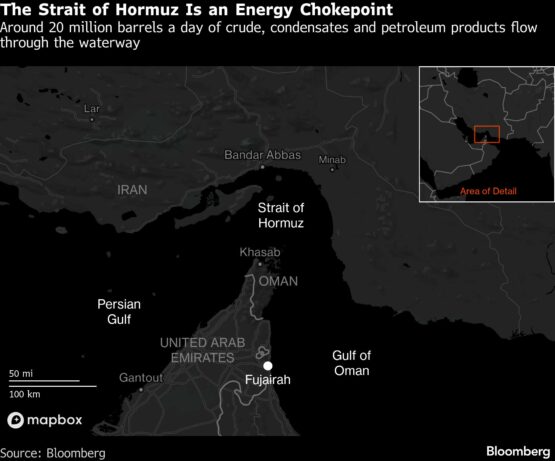
Hormuz is a narrow passage separating Iran and the Arabian Peninsula, and tankers carrying crude and liquefied natural gas from several Persian Gulf nations transit through the waterway daily to deliver cargoes worldwide. Tehran would only need to disrupt flows, rather than fully blockade the strait, to impact global oil markets.
ADVERTISEMENT:
CONTINUE READING BELOW
Saudi Arabia, Iraq and Kuwait all ship oil through Hormuz, with the majority of their cargoes heading to Asia. Iran pumps more than 3 million barrels a day of crude, and most flows to China.
The moves are already starting to impact freight markets, with rates for supertankers sailing from the Middle East to China rising above $150 000 a day last week.
There’s also been a flurry of bullish options activity as traders rush to hedge against the risk of a spike.
| Prices: |
|---|
|
© 2026 Bloomberg
Follow Moneyweb’s in-depth finance and business news on WhatsApp here.
#Oil #dips #USIran #nuclear #talks #resume #week