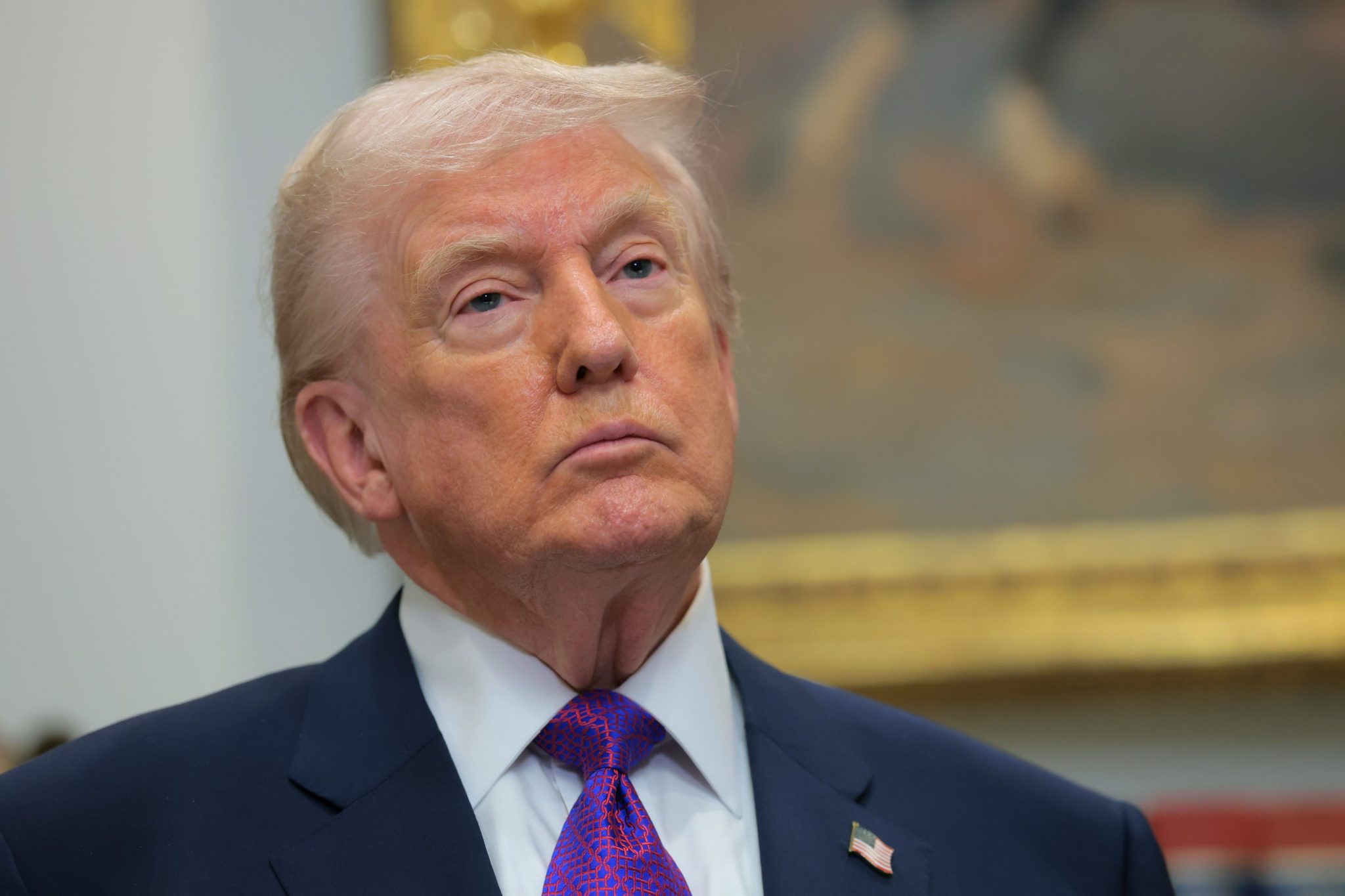
President Donald Trump wasted little time responding to the Supreme Court decision that ruled his global tariffs unconstitutional.
He blasted the six justices who struck down his levies invoked under the International Emergency Economic Powers Act, saying he was “deeply disappointed.”
“I’m ashamed of certain members of the court, absolutely ashamed for not having the courage to do what’s right for our country,” Trump told reporters. “I’d like to thank and congratulate justices Thomas, Alito and Kavanaugh for their strength and wisdom and love of our country.”
But speaking of the six who voted against the tariffs, he added later, “they also are a frankly disgrace to our nation those justices.”
“They’re just being fools and lap dogs for the RINOs and the radical left Democrats,” he said. “And not that they should have anything at all to do with it, they’re very unpatriotic and disloyal to our Constitution. It’s my opinion that the court has been swayed by foreign interests.”
When pressed repeatedly on his claim of foreign influence, he didn’t offer any evidence. But his tirade against the justices, including a few who were appointed by Trump, sets up a potentially dicey situation coming just days before his State of the Union address.
Trump used IEEPA to impose so-called reciprocal tariffs on global trading partners as well as tariffs on China, Canada and Mexico related to the fentanyl trade.
But he has invoked separate tariffs under other laws, and Trump vowed Friday that he can use them to replace the levies the high court struck down.
He said he will sign an order to impose a 10% “global tariff” under section 122 of the 1974 Trade Act “over and above our normal tariffs already being charged.”
That authority allows the president to enact duties of up to 15% for as long as 150 days to address a balance-of-payments or foreign exchange issues. Any extensions would require congressional approval, which Trump said he wouldn’t seek.
He also said the administration would initiate investigations under section 301 of the 1974 law that are meant to combat unfair trade practices or violations of trade agreements. The tariffs can’t be enacted until the investigations are complete, which could take two to three months under an expedited process.
Trump has used tariffs as a linchpin of his trade and economic agenda, including as leverage to negotiate deals with top economies.
When asked is those deals would remain in place given that the IEEPA duties are not longer valid, he replied that they would and pointed to the recently signed U.S.-India pact, saying it will continue using different tariff laws.
Trump noted that efforts to replace the levies that were struck down could result in higher rates than before the decision.
“It depends, whatever we want them to be,” he explained. “But we want them to be fair for other countries. And you know we have some countries that have treated us really badly for years, and it’s going to be high for them. And we have other countries that have been very good and it’s going to be very reasonable for them.”
#Trump #calls #justices #struck #tariffs #disgrace #nation #vows #fresh #duties