Mozambique is navigating a fiscal crisis and has built up debt-servicing arrears with a raft of bilateral and multilateral lenders, the International Monetary Fund said, painting a bleak picture of the southeast African nation’s battered economy.
Accessing a financial lifeline from the IMF requested last year will require implementing critical reforms that the government has failed to do over the past two years, the Washington-based lender said in an annual health check of Mozambique’s economy, known as an Article IV.
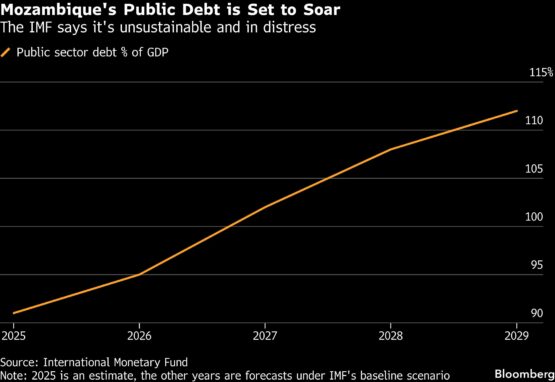
The report, published late Thursday, suggests the government is far from reaching a deal for a new bailout. The fund has limits to lending to nations in official arrears to bilateral and multilateral lenders. It also said Mozambique’s debt was now unsustainable, downgrading its outlook from 2024.
“Under existing policies, chronic fiscal deficits and reliance on costly domestic debt, combined with weaker economic growth, result in an unsustainable debt path,” the IMF said. “Overall public debt is in debt distress, due to persistent debt-service arrears, while external debt is assessed at high risk of debt distress.”
Mozambique’s $900 million in notes due 2031 fell by as much as 2.5 cents on the dollar — the biggest drop since October — before recovering slightly to lie around 1.6 cents lower at 85.4 cents on the dollar by 11:21 a.m. in Maputo, the capital. They were the worst performers on the Bloomberg Emerging Market index on Friday.
A spokesman for the finance ministry declined to comment, referring Bloomberg to a statement the department issued earlier this week, which said it had hired New York-based Alvarez & Marsal as financial advisers for its reform program.
ADVERTISEMENT
CONTINUE READING BELOW
“We remain committed to constructive dialogue with all stakeholders, including creditors and development partners, as we advance in this process of economic transformation,” it said in the February 18 statement.
Mozambique’s economy has struggled to recover since it was scuttled in the so-called Tuna Bond scandal that exploded into view a decade ago and led to a default on its debt. The country abandoned an existing IMF program last year, with President Daniel Chapo opting to pursue talks on a new one after taking office in January 2025.
His election victory was tainted by allegations of vote rigging and post-election protests in which hundreds of demonstrators were killed in clashes with security forces, according to local human rights observers.
The unrest lasted months, compounding Mozambique’s existing economic troubles. While protests have subsided, the socially charged climate, in a country where two-thirds of the population live below the national poverty line, makes it politically hard to implement changes sought by the IMF, including currency depreciation that may fan inflation.
The Washington-based lender assessed Mozambique’s debt as unsustainable primarily due to the “political infeasibility” of the required comprehensive policy adjustments. In its previous assessment, the IMF determined the debt was sustainable due to prospects of future liquefied natural gas revenue. The change makes it more difficult to agree to a new bailout.
“Progress towards agreement will depend on implementation of critical reforms,” the IMF said of talks for a new program, pointing out that the government was yet to implement the policy recommendations it made in 2024, including “fiscal consolidation and greater exchange rate flexibility.”
ADVERTISEMENT:
CONTINUE READING BELOW
LNG prospects
The fund sees Mozambique’s economy growing by 1.9% this year, jumping to 11.9% in 2030, by when large LNG projects are due to start production. Still, it warned that these projects, while capital-intensive, don’t create many jobs which was a critical need for Mozambique going forward.
S&P Global Ratings last year downgraded Mozambique’s local currency rating to default, after the government undertook domestic debt exchanges that the company viewed as distressed.
The state has become increasingly reliant on local currency debt auctions to pay its bills, but this is becoming more difficult.
“Domestic banks — the main source of financing of large and persistent fiscal deficits — have become increasingly reluctant to increase their holdings of government debt amid concerns over debt-service delays,” the IMF said.
“A front-loaded fiscal adjustment through wage-bill containment and revenue measures is critical to restore stability,” it said. “Voluntary, market-based liability management may also be needed to address severe near-term financing pressures.”
© 2026 Bloomberg
Follow Moneyweb’s in-depth finance and business news on WhatsApp here.
#IMF #sounds #alarm #Mozambique #debt #distress #budget #crisis