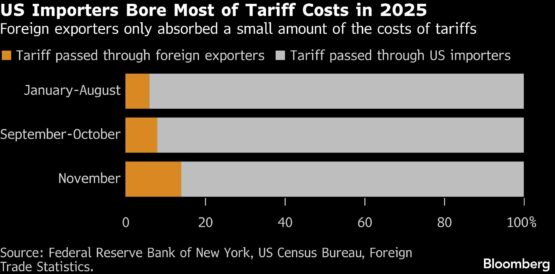
Nearby, 90% of the economic burden from tariffs in 2025 was borne by US companies and consumers, according to a new study by economists at the Federal Reserve Bank of New York.
Using data through November 2025, the study finds that about 94% of the tariff costs were passed through to US firms and consumers in the first eight months of the year.
Read:
Trump rebuked over Canada tariffs as midterm anxieties grow
Shipping firms face tough 2026 as reopening of Red Sea looms
Agoa deal sealed – tariff pressure stays
By November, foreign exporters were absorbing slightly more — a 10% tariff was associated with a 1.4% decline in export prices — but pass-through still stood at 86%.
“This result means that a 10% tariff caused only a 0.6 percentage point decline in foreign export prices,” Mary Amiti, Chris Flanagan, Sebastian Heise and David E. Weinstein wrote in the report.
ADVERTISEMENT
CONTINUE READING BELOW
ADVERTISEMENT:
CONTINUE READING BELOW
After April 2 — President Donald Trump’s “Liberation Day,” when he announced expansive new import levies — the average US tariff rate rose sharply from 2.6% to 13%, with a major spike in April and May driven by steep, but temporary, increases on Chinese goods, the study found. Although exemptions and supply shifts lowered the effective duty, the economic burden largely fell on Americans.
These higher costs in tariffs also accelerated supply chain shifts away from China toward countries like Mexico and Vietnam, the study found.
The researchers analysed monthly trade data through November 2025 and used a statistical approach similar to one they applied to the 2018 and 2019 tariffs. Specifically, they compared 12-month changes in foreign export prices with 12-month changes in tariff rates, while controlling for broader product-level and global price trends, allowing them to estimate the direct effect of tariffs on prices.
© 2026 Bloomberg
Follow Moneyweb’s in-depth finance and business news on WhatsApp here.
#firms #paid #tariff #costs