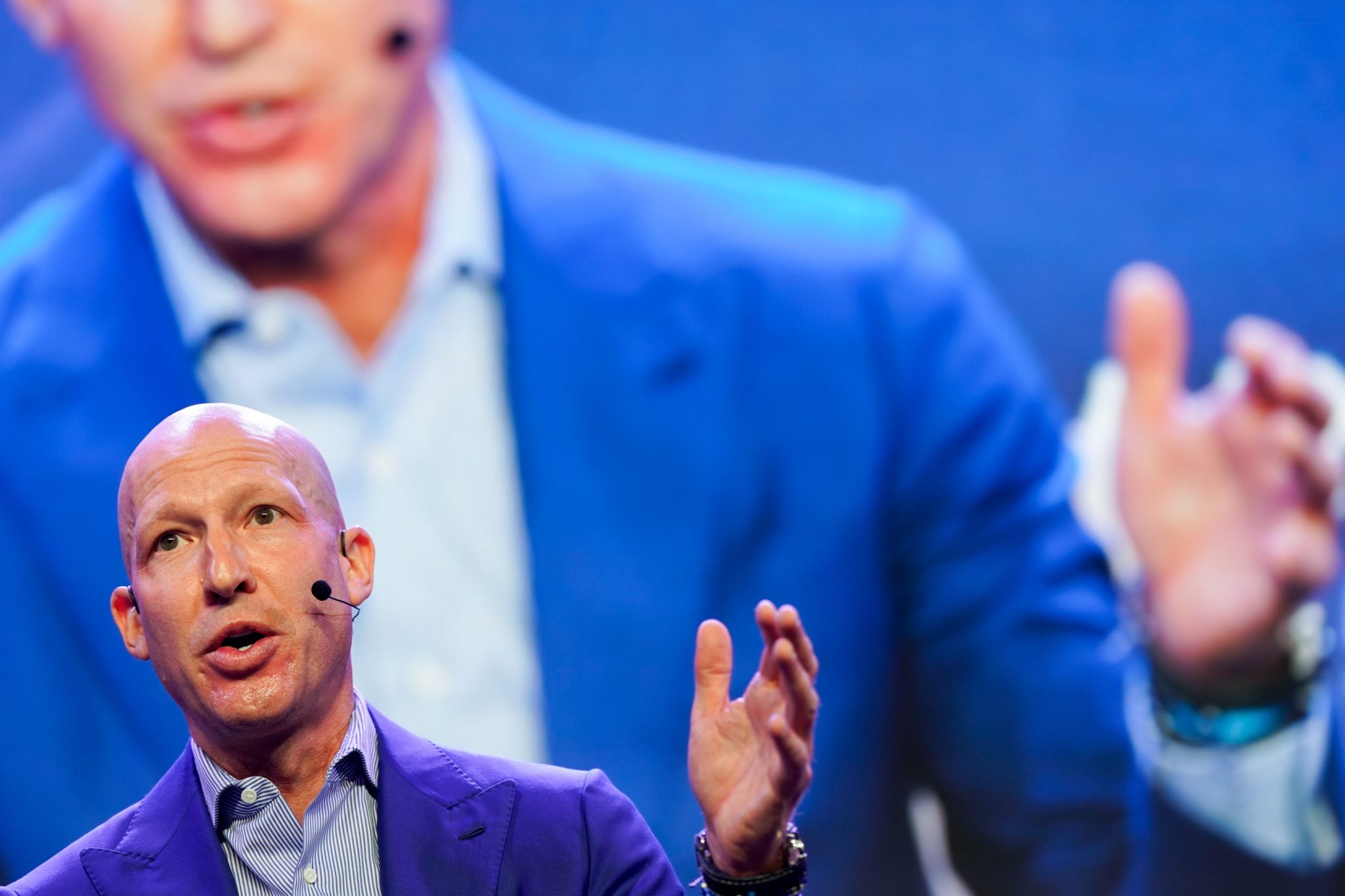
When TRM Labs cofounders Esteban Castaño and Rahul Raina moved to San Francisco in 2018 to create a startup, their mentors told them that great companies are built when you believe something about the world that others don’t. Along with a passion for technology and national security, the pair shared a conviction that billions of people would use digital assets to move money around the world.
“Then we asked ourselves, ‘What’s the second order consequence?’” Castaño said. “The world would need intelligence to make sense of that data to ultimately manage risk, and thankfully, that turned out to be true.”
Today, thanks to its blockchain analytics software, TRM Labs is a familiar brand to law enforcement agencies across the world, and to a growing number of private companies that employ crypto to move money. On Wednesday, the San Francisco-based startup announced a $70 million Series C funding round, led by its seed investor Blockchain Capital, along with a who’s who of traditional firms including Goldman Sachs, Bessemer, Brevan Howard, Thoma Bravo, and Citi Ventures. The new funding round values TRM Labs at $1 billion, vaulting it into the ranks of so-called crypto unicorns.
TRM’s success was not always a given, especially because its main competitor, Chainalysis, had a four-year headstart. But an early strategic decision to track multiple cryptocurrencies and blockchains at a time when they paled in comparison to Bitcoin, as well as a deep bench of former government investigators, allowed TRM to gain a firm foothold in a crowded ecosystem as governments and private industry realized that blockchain technology was here to stay. Now, as the spread of tokenization and AI upends global payments once again, TRM is poised to enter another period of hypergrowth.
“We’ve seen a 500% increase in AI-enabled use in scams and fraud,” said Ari Redbord, a former federal prosecutor who came onboard as one of TRM Labs’ earliest employees and currently serves as the global head of policy. “This is a civilization-level threat…and we’re building the company for that moment.”
Crypto crime fighting
For Jarod Koopman, a longtime agent at the IRS, blockchain analytics has been part of the job for over a decade. “Without third-party tools, it would be infinitely more time consuming and inefficient,” he told Fortune.
Government crypto operations are the stuff of lore, from the arrest of Ross Ulbricht, the architect of the dark web marketplace Silk Road, to the multinational effort to take down the child exploitation site Welcome to Video. (One of the latter operation’s leading agents, Chris Janczewski, is the head of global investigations at TRM.)
Koopman, who is taking over as chief of Criminal Investigation at the IRS in March, said that the agency started working with TRM Labs soon after it launched. Though they had already been using Chainalysis for years, the IRS made an effort to not put “all of our eggs in one basket,” as Koopman put it, especially as cybercriminals began to expand beyond using just Bitcoin for illicit transactions. “We were staying on par because of the companies that existed, like TRM,” he said.
James Barnacle, the assistant director in charge of the FBI’s New York field office, said that the bureau has gone from a handful of crypto cases in 2015 to thousands today. He pointed to the fallout from the October 7 Hamas terror attacks in Israel, when the FBI learned crypto donations to Hamas-owned wallets had helped fund the attacks. “TRM, and other companies as well, came forward and said, we’re seeing this issue,” Barnacle told Fortune. “The partnership between the FBI and the private sector is critical for us to be successful. There’s nothing the FBI can do all on its own.”
TRM’s close relationship with governmental agencies has at times created tension with the broader crypto industry, which was founded on libertarian ideals of decentralization. Many in the sector were incensed by reports of Hamas using crypto wallets that cited blockchain analytics groups like TRM Labs, especially after critics like Sen. Elizabeth Warren (D-Mass.) pounced on the revelation to call for stricter regulation.
Castaño pushed back on the idea that TRM Labs was at odds with the rest of the industry, arguing that his company has a symbiotic relationship with the rise of blockchain technology. “Bringing security to digital assets…is very much aligned with the crypto industry,” he said. “There’s a real brand issue for crypto and digital assets.”
On the flip side, TRM has also struck up partnerships with many of the companies charged with facilitating illicit finance, opening up the blockchain analytics firm to accusations of hypocrisy. For years, TRM published reports highlighting the widespread use of the stablecoin Tether on the blockchain Tron by cybercriminals, before announcing a task force launched in conjunction with Tether and Tron in late 2024. (TRM still publishes reports that analyze illicit flows using Tether on Tron.)
Redbord said the partnership came about after Tether and Tron approached TRM about the reports with the goal of mitigating the illicit activity. “Our mission is to stop bad actors,” Redbord said. “You don’t stop bad actors working only with the most regulatory compliant places where there’s no illicit activity.”
Still, as the Trump administration takes a more lax approach to crypto regulation and welcomes one-time outlaws like Tether’s Paolo Ardoino into the U.S., Redbord insists that TRM’s approach hasn’t shifted. “We were having conversations with Tether and Tron long before they were having conversations with the White House,” Redbord said. “Our mission is, frankly, so far outside of politics. We’re critical infrastructure for building this new economy of digital assets.”
The next era of crypto
Blockchain Capital led TRM Labs’ seed round at a time when growth investments weren’t commonplace in the industry. Now, seven years later, the crypto venture firm is leading TRM’s Series C. While general partner Spencer Bogart said there isn’t any particular metric that convinced his firm to double down, he pointed to TRM’s revenue, which has grown around 50% for the past four years. “This is not a company that has gone through the same types of crypto winters that we see more broadly across a lot of our portfolio companies,” Bogart told Fortune.
The crypto industry once again finds itself in a tenuous position, with Bitcoin prices at a yearly low. But as Wall Street embraces tokenization, or issuing different digital assets on blockchains, Bogart believes TRM will be able to weather any impending downturn. “It’s one of those things that becomes absolutely table stakes for anybody that’s going to be touching something in the [crypto] space,” he said. “A large swath of both the private and public sector is going to need a tool like this.”
According to Castaño, around 40% of TRM’s customers are in the private sector, though he said that segment is growing as financial organizations explore tokenized deposits, equities, and other assets.
The accelerating role of AI, both in cybercrime and analytics, also adds to TRM’s value proposition. “If you’re operating in a world where there’s trillions of transactions, how in the world do you find the needle in the haystack without using AI?” Castaño said. “Criminals are getting all of these amazing technologies, while our defenders on the front lines—the compliance professionals and our law enforcement analysts and officers—are oftentimes still using spreadsheets.”
With a rapidly growing team of 350 employees, TRM Labs is capitalizing on its founders’ early vision that blockchain would dominate the rails of global finance. Their 20-year time horizon might just have been too conservative.
#Crypto #crimefighting #startup #TRM #Labs #notches #billion #valuation #million #funding