While the Tshwane mayor was presenting a plan to stabilise the metro’s electricity supply on the morning of Tuesday 3 February, many business owners and their staff in large parts of Tshwane’s key Silvertondale industrial area were doing – nothing.
It was the fifth day of the latest power failure, with no indication of when the electricity supply would be restored. By late afternoon, a senior metro official said: “Let’s give it until 21h30 or so.”
Read:
City of Tshwane, where ‘load shedding’ has never stopped [Jun 2025]
‘Unstable electricity stifles business growth in Tshwane’ [Mar 2025]
This was just one of several outages that have paralysed business activity in the area. Businesses located in Fascia Street, where a mini-substation was damaged beyond repair after it exploded days ago, were still in the dark about when repairs would be completed.
The business community in Silverton, Silvertondale and the neighbouring area of Waltloo feels powerless in the face of ongoing failures in municipal service delivery – and many cannot carry the cost any longer.
Read: SA’s municipal electricity failure, a structural economic risk
In November, Silvertondale was powerless for six days, although, a small area was without electricity for 30 days. In January, parts of the area were affected by a major outage in neighbouring East Lynne, which lasted more than 10 days.
Apart from numerous small businesses, several national names like Ford, Albany and Premier Milling operate in the area.
At least four major petroleum companies also have depots in Silvertondale.
“We employ thousands of people from Mamelodi and support a large number of suppliers and logistics providers. The products we manufacture end up in every shop all over the country,” one businessman said during a meeting with Moneyweb.
ADVERTISEMENT
CONTINUE READING BELOW
Read: Eskom keeps the lights on for 231 straight days [Jan 2026]
Some of the businesspeople asked not to be named, for fear of retribution by the metro.
To explain the extent of the electricity problem, one of them went through his records and shared with Moneyweb the experience at four business premises he manages over the past 16 months, up to the morning of 3 February:
| Business | Area | Number of power failures | Total hours without electricity | Fixed monthly electricity charges | Average monthly usage charges | Dead phases or low-voltage events |
| 1 | Silvertondale | 72 | 148.5 | R18 133 | R10 000 | 16 |
| 2 | Silverton | 55 | 346 | R21 023 | R25 000 | 1 |
| 3 | Silverton | 47 | 171.5 | R19 808 | R27 000 | 1 |
| 4 | Silverton | 43 | 266 | R5 741 | R1 000 | 125 |
Damages to machinery
Even if a power failure is short, it disrupts production and the trouble is, businesses never know how long an outage will last. Do you send your staff home, or not? If electricity is off for the entire day and staff are sent home, they are paid for only three hours, which has a huge impact on households.
Mike Cummings, director of Maugene Engineering Services, explains that if a power failure occurs while steel is being cut to manufacture a gear, the entire process has to start again once power is restored.
He says running his generator costs R10 000 a day, and his company spent R800 000 on equipment repairs last year.
Another business owner says if he has to recover generator costs, it will mean charging his clients 83% more, which will never fly.
Trying to catch up on lost production by rearranging working hours can result in overtime payments, as well as production during peak periods when electricity is multiple times more expensive.
Power spikes when supply is restored can also cause a business to exceed its notified maximum demand, which comes with big penalties.
ADVERTISEMENT:
CONTINUE READING BELOW
Such costs can cripple businesses, to the detriment of the wider business community.
One of the country’s largest companies involved in hot-dip galvanising closed its Tshwane operation because of the high cost of running generators during load shedding. Manufacturers and clients must now go to Springs or Rustenburg for the service.
Listen/read: Energy costs, not exports, threaten SA’s chrome industry [Dec 2025]
Craigen de Klerk manufactures sportswear. At the beginning of the year, sports teams and schools place orders for winter sports gear, and these must be delivered by the end of February. Deadlines are tight, and if the business cannot meet them, customers will cancel their orders and take their business elsewhere.
“The business will go under,” he says.
Gerrie Claassen, owner of ice producer Ice Fanatic, says he has been in the area for 13 years. In the past, electrical faults were usually resolved within two to three hours. “Now it is anything between 24 hours and three days.”
His main inputs are electricity and water – both supplied by the City of Tshwane, or not.
Read: First power, now water … [Aug 2024]
He adds that there is a persistent problem with low water pressure in Waltloo, which the municipality has been unable to resolve. “They come out, take measurements and declare it to be eight bar, but I question the accuracy of those readings,” he says.
ADVERTISEMENT:
CONTINUE READING BELOW
Anton Scholtz says he is battling to get a certificate of occupancy for one of his buildings as the fire service refuses to certify it due to low water pressure. Such certification is required before an occupancy certificate can be obtained.
As a result, he is unable to obtain fire insurance.
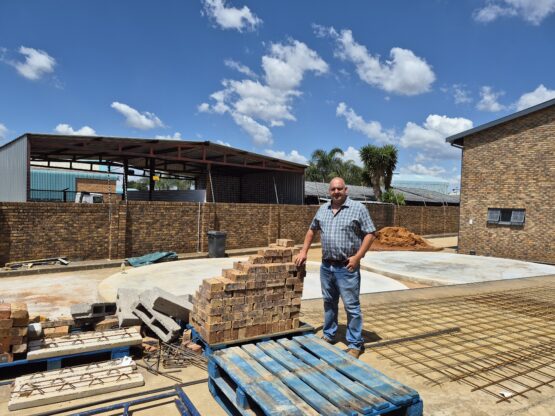
Businessman Anton Scholtz is constructing two 320 000-litre water tanks on his business premises in Waltloo to ensure water is available in the event of a fire. This has become necessary due to the low water pressure in the area, which the City of Tshwane has been unable to resolve. Image: Supplied
He is now spending millions to construct two 320 000-litre tanks at one of his premises to ensure at least some water is available in case of fire.
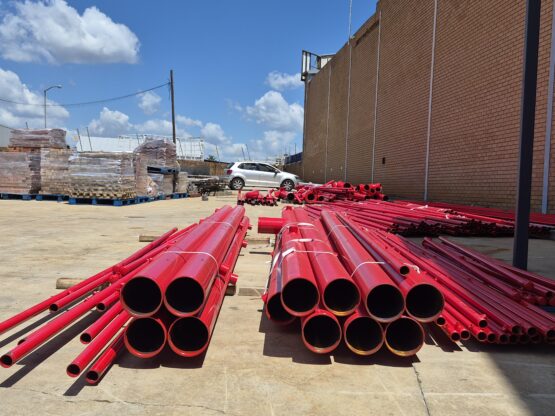
The pipes are ready for installation as part of the 640 000-litre water storage system that businessman Anton Scholtz is installing at his business premises for fire protection. Image: Supplied
The Silverton/Waltloo Industrialists Forum meets monthly with municipal representatives, and there are more than 500 people in a lively WhatsApp group including very senior municipal officials, but it doesn’t help them at all, the group says.
The current city administration, led by ActionSA Mayor Dr Nasiphi Moya, explained on Tuesday that the city’s electrical infrastructure is old and dilapidated.
She announced a plan, which Moneyweb will still unpack for readers, to stabilise the system in the next three months and then switch gear to proactive maintenance.
As she spoke, businesspeople in Silvertondale were praying for their power to be restored after five full, powerless days.
Read:
Follow Moneyweb’s in-depth finance and business news on WhatsApp here.
#days #electricity #counting