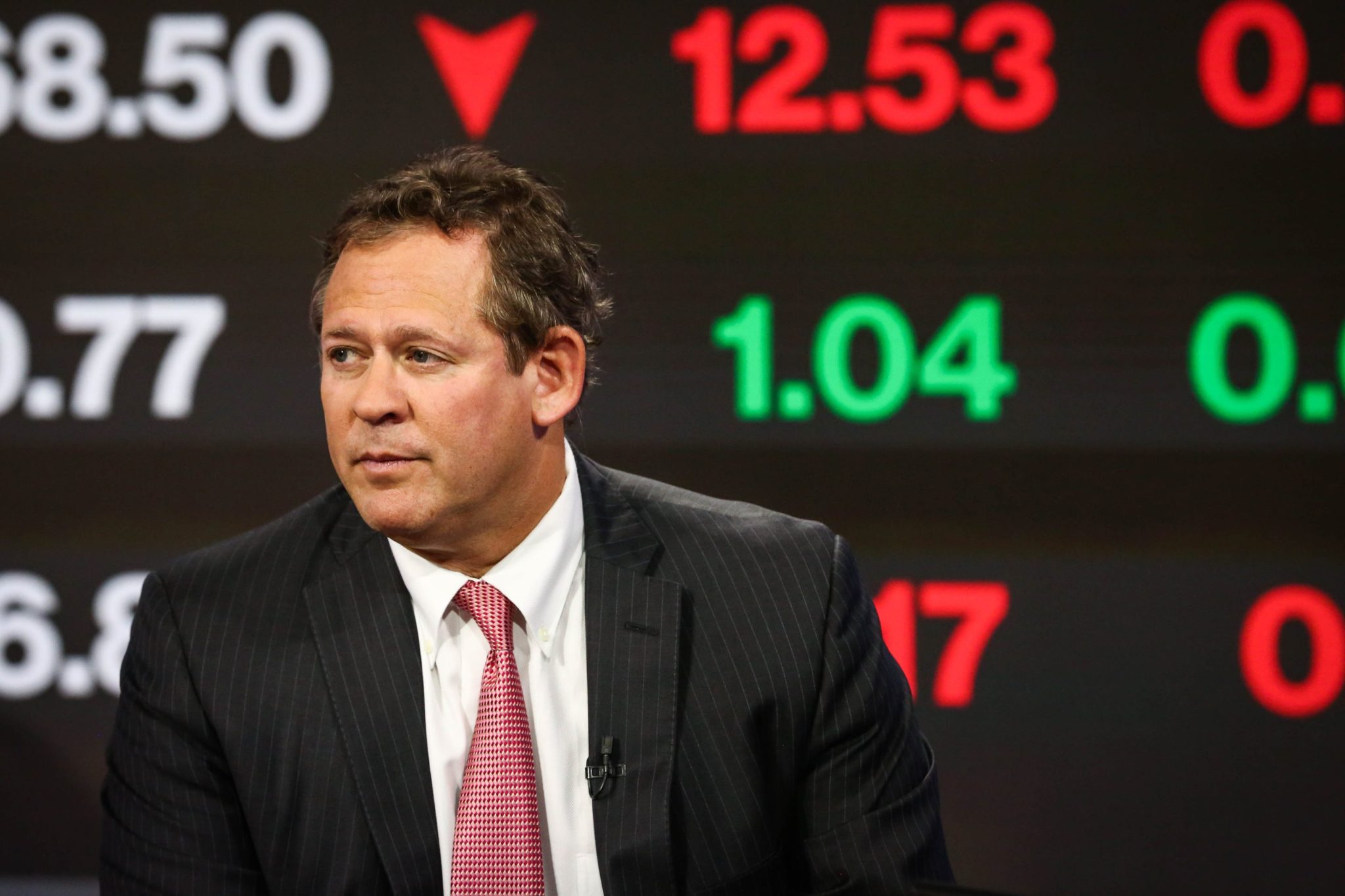
Sometime in the early 1970s, a young Rick Rieder sat in his elementary school cafeteria, not eating. Instead, he stared at his lunch money—a quarter—and weighed the probability of an Oakland Raiders victory. He would obsess over microdata, like how the football team played on turf versus grass, searching for a marginal edge that would turn his 25 cents into 50. Then, he’d bet. When he lost, he went hungry, he told podcaster and author William Green.
That hunger never really went away. He told Green he “gets grumpy during bull markets,” and prefers when the market loses its nerve. Now chief investment officer for fixed income at BlackRock, Rieder has what he admits is a “maniacal” obsession with data that helps him to pick through the wreckage, find the arbitrage, or get out early. “The whole gig,” he said, is managing risk well enough to know when it is time to leave.
In the last week, Rieder has surged on prediction markets like Kalshi and Polymarket, overtaking institutional favorites like the “Two Kevins” (Hassett and Warsh) to become a leading contender to replace Jerome Powell as the next chairman of the U.S. Federal Reserve.
His career has been a masterclass in institutional survival. In July 1987, a 25-year-old Rieder joined former brokerage E.F. Hutton just months before “Black Monday” sent the markets plunging 22% in a single day, forcing the 80-year-old firm into a fire-sale merger with Lehman Brothers. He survived the transition—by his own telling, due to a “lucky” sudden opening—and spent nearly two decades at Lehman.
He departed in May 2008, narrowly before Lehman collapsed into the largest bankruptcy in U.S. history, to found his own firm, R3 Capital. When BlackRock CEO Larry Fink acquired R3 a year later, he installed Rieder at the helm of what would become the largest investment platform in the world, making him a “super investor” managing $2.3 trillion dollars in global bond markets, a sum larger than the annual GDP of most countries in the world.
Through the implosions of these two august institutions, Rieder never lost his cool, former colleagues say. Josh Tarnow, a former BlackRock Managing Director who followed Rieder from Lehman to BlackRock and has watched him “daily in conflict” for three decades, attested to Rieder’s ability to hone in when it mattered.
“He is very good at accessing his resources, and he is incredibly calm,” Tarnow told Fortune.
That temperament is why Tarnow and other longtime colleagues describe Rieder as “made for” what may be the riskiest job in the world: managing the U.S. economy.
His momentum on Polymarket has surprised the economic establishment. Rieder hasn’t worked at the Fed before, unlike the other main contenders. Stephen Moore, a former advisor to President Donald Trump, telling Fortune the candidacy a “curveball.” He added he didn’t know much about the Wall Street candidate.
“I should probably be studying up on him,” he said.
But those who have watched Rieder since his early days at Lehman are less surprised. Several of his old colleagues told Fortune that the Fed is a natural next challenge for a man who “lives for the markets.”
“Especially over the last five years—and maybe over the last 10, 20 years—there’s been an argument in the market that the Fed tends to be late, and that they don’t like looking forward,” a former colleague who worked with Rieder at BlackRock, said. “And so I think Rick will do a great job bridging the gap between a forward-looking approach—everything about his job today is to look forward and project and invest for the future—as opposed to looking backwards.”
Green, having interviewed Rieder years ago, said he was surprised that markets underestimated the bond trader for so long. He fits Trump’s model of “central casting”–hiring people who look the part–extrodinarily well, he said.
“There’s something about a powerful man, with a lot of money under his control who’s so clearly a winner, I think is very seductive to [the President],” Green said.
From academic probation to star student
Rieder’s arc, in retrospect, could look inevitable. It wasn’t. Before he was managing crises for others, he had to work his way out of his own. In high school, Rieder was not just a “mediocre” student, but what he describes as completely “motivationally challenged” and “directionless,” he told podcaster Jon Schultz. While he struggled with liberal arts subjects like history, English literature, and philosophy, which “didn’t sink in,” he did display a specific aptitude: he excelled in typing and accounting, finding the latter logical and “intuitive,” he told Green. Despite this spark, he admits he was a “gym rat” who spent most of his time hanging out and watching movies rather than studying.
The “catalyzing event,” as Rieder calls it, occurred while sitting on a rock, on a golf course behind his parents’ house, in Scarsdale. After receiving a set of dismal grades during his freshman year at Hobart College, which placed him on “social and academic probation,” Rieder sat on that rock for four hours, terrified by the thought of his father’s reaction. His father was an entrepreneur who ran an office products company called American Unifax. Rieder had watched his father work relentlessly to keep his typewriter ribbon and correction fluid business alive, even as computer technology rendered the products “quickly antiquated” and put the family through tough times, he said.
Paralyzed by that contrast with his own trajectory, Rieder realized he had gained weight, was drinking too much beer, and “going nowhere,” he told Green. He credits his roommate for reinforcing the idea that they had to “move on” from their lifestyle of watching movies and hanging out in the gym. He overhauled his life, and the pair transferred from Hobart to Emory University. He found a curriculum that mirrored his internal wiring: business. Once he began taking finance, marketing, and management classes, Rieder said he felt “the ball start rolling downhill”; he transformed from being a near-dropout on probation to an award-winning finance student, ultimately finishing third in his class (though he notes in interviews that his wife, whom he met at Emory, finished first).
A religion of the downside
The ball rolled down the hill, and into the abyss of obsession. Rieder, it seems, does everything at either 100% or at 0%.
At Wharton, where he earned his MBA, Rieder recalls a visiting executive from the Golden Nugget casino explaining how casinos really make money. Rieder raised his hand and said it was because the odds favored the house. The executive corrected him. Casinos win, he said, because gamblers arrive with $200—and when they lose it, they’re forced to leave. The house, by contrast, has infinite liquidity and time.
“And I thought, gosh, when you oscillate, you hit the down 200, you leave,” Rieder told Green. “So almost, statistically, you’re always going to hit the down 200 if you stay there long enough. It just emblazoned in my mind the philosophy around the random walk alongside of a trend, and just making sure you’re being thoughtful about optimizing it versus being on the wrong side of it.”
That realization, that survival is a matter of staying in the game long enough to let the trend play itself out, transformed Rieder’s life. It wasn’t as simple as adopting a work ethic. He engineered a lifestyle designed to prevent ever hitting his own “down 200” moment, a state of being that his colleagues find both impressive and bewildering.
Rieder “doesn’t sleep,” Tarnow said. Or rather, he sleeps a maximum of four hours a night. Colleagues said you can expect emails from him as early as 3 a.m. or as late as 11 p.m. However early they came to the office, Rieder was always earlier, and no matter how late they stayed, Rieder stayed later, they said.
“He’s the hardest worker in the room,” two former colleagues said. His house in Florida is covered with massive flat-screen TVs set to markets. He checks Apple’s earnings reports on vacation. And during the Green interview, he even requested permission to execute a trade because he “can’t sit still” while the bond yield curve moves. The effort comes from a distinct passion, his colleagues said, but Rieder has also said it comes from an acute anxiety.
Rieder told Green that he tracked his biometric data with the Whoop ring, and found that his stress levels peaked at 11:30 p.m., the moment he was forced to disconnect and sleep despite Asian markets being open. They plummet at 3:45 a.m., the moment he finally gets to wake up and grab his phone.
“I hate the feeling of not being in control while sleeping,” he told Green. He only relaxes once he can see the markets moving.
Trading fixed income is a distinctly different game than trading stocks. In the stock market, traders typically hunt for the upside, trying to find the next big thing that they can ride to the moon. Bond traders like Rieder, by contrast, are constantly staring down the cliff of what could go wrong. For Rieder, managing $2.7 trillion in fixed income means overseeing a massive sea of debt that is constantly under threat from inflation, rising interest rates, and other geopolitical “exogenous” events. There are pressures and risks you cannot prepare for, but you just have to learn how to “make a little bit of money a lot of times,” one of his former colleagues said. The way to win out over decades—often beating benchmark indexes—is just to ensure that you are always hedged enough, and have enough liquidity, to never hit the statistical “down 200” that forces you to leave.
How do you measure success in that kind of game? Rieder has said he doesn’t feel successful. “I still feel like I’m going to get fired every day,” he told Green.
Who follows a bond trader: 42 people
To the average person, Rieder’s work style sounds crazy. But to fellow finance people, it’s magnetic. Since Lehman, Rieder has accumulated a distinct group of 42 people who followed him from Lehman to B3 to BlackRock, endlessly loyal to their boss, because they knew when push came to shove, they’d never lose because they didn’t try hard enough, his former colleagues said.
“Rick was able to find a good balance between being super-competitive and very demanding, while also trying to take great care of the people that were working alongside of him,” a colleague who worked with him at Lehman and BlackRock said. He understands if people don’t share his same lifestyle aspirations, and during particularly tough weekends, he was known to buy new tech gadgets to share with the team like the Meta sunglasses where you could listen to music while playing sports, a former colleague said. Another colleague said that after a rough year early on in his career, Rieder bought him a “brightly colored tie” as a fun gift.
He also, Tarnow said, took time to help his people when the company was transitioning; finding the right opportunities here and there for others.
“This is a guy that’s always worried about people more than himself,” Tarnow said.
Quiet power
Ultimately, the constant assessment of what could go wrong has made Rieder a distinctly humble figure in an industry often defined by ego. Every colleague and partner interviewed by Fortune used the word “humility” to describe him. In high-stakes environments, like meetings with powerful CEOs or angry clients, Rieder is known as a listener rather than a talker. “He holds the room because he is a very good listener; he entertains different opinions,” Tarnow said. “He’s a seeker of truth. This is a guy that is doing the best he can to get to the truth.”
But even in lower-stakes environments, he has the same attitude. He takes on multiple charitable endeavors.
Paul Bambrick-Santoyo, who leads Uncommon Schools, the Newark charter school system that Rieder has invested in and sat on the board for 20 years, noted that most people at the school would never recognize how influential he is in the global economy because of how quietly he carries himself. “There’s a kindness and a gentleness to him that we get to see every day in the work he does with us,” he told Fortune. “He has an incredible sense of service and never takes credit for anything.”
Shawn Shivalkar, who co-founded a popular alternative investment club at Emory University under Rieder’s guidance, recalls a similarly disarming presence during their first meeting at BlackRock. Sitting in an office filled with messy papers and massive screens displaying markets moving, Shivalkar found a man who was “super engaged” but completely unpretentious.
“He just had all his screens up, and he was just asking us questions,” Shivalkar told Fortune. “And he was bouncing a basketball up over his head, just kind of tossing it up in the air and catching it. It wasn’t like a, ‘Alright, I’m here to trick you with a bunch of twisty questions’ kind of meeting. It was a very productive and respectful dialogue.”
Can a market animal sit still?
What does this all mean in terms of his fitness for Fed chairman? Well, for his colleagues, it seems obvious that he is the best fit for the role: “no one’s going to care more or have more passion for doing the job,” one former colleague said. No one will outwork him, or have more of a will to the truth.
But that assumes, of course, that Rieder can stay motivated without the constant, short-term pressure of the markets. One of his former colleagues was surprised that Rieder would want the role, given how staid the position is and how he would have to survive the browbeating of politics for credibility instead of operating on his own logic. Can a man who engineered in his biological hardwiring to be anxious when markets close, whose mantra, according to his old colleagues, was that “it’s not about being right, it’s about making money,” ultimately ignore markets when needing to make a tough interest rate call, pretend not to care how much money is on the line with his decision? The question matters especially now, as the White House has grown increasingly sensitive to market reactions and Trump has repeatedly criticized and threatened Fed Chair Powell for keeping interest rates high even as investors pushed for relief. Rieder’s own politics are slightly elusive. He donated and supported Senator Corey Booker (D-N.J.), but he has also donated half a million to Republican PACs to support Trump’s presidency.
His former colleagues say they’d be shocked if Rieder threw away his role to become a simple loyalist. Tarnow said the job would ultimately “free” Rieder.
“I think it’d be freeing for him, that his responsibility isn’t to make money,” Tarnow said. The data-obsessed Rieder could consider variables he hadn’t been able to before, when he was just focused on his fiduciary responsibility. “His responsibility set is to guide the country fiscally to a point where we’re at our best.”His mantra, according to former colleagues, is “work hard, play hard, give back.” Rieder told Green he has signs that say that all over his house. Now, Tarnow says, he might get the ultimate opportunity to give back.
“This is a guy that wants this,” Tarnow said.
#Arrow #Button #Icon