President Donald Trump’s announcement of new tariffs on goods from countries trading with Iran could upset the US’s one-year trade truce with China, the world’s top buyer of Iranian oil.
“Any Country doing business with the Islamic Republic of Iran will pay a Tariff of 25% on any and all business being done with the United States of America,” Trump posted on social media on Monday. He added the new duty will be “effective immediately,” without providing details about the scope or implementation of the charges.
Trump’s threat “underscores just how fragile the trade truce is between Washington and Beijing,” said Wendy Cutler, a former senior US trade negotiator now at the Asia Society Policy Institute. “Even if Trump does not actually go through with this tariff threat, some damage has already been done to our bilateral relationship and the trust that both sides have been trying to build.”
Trump and Chinese leader Xi Jinping clinched a truce in their trade dispute during a meeting in South Korea in October — a pact that provides the US with access to rare earths. China dominates the production of the minerals critical to making tech goods and military weapons, and had imposed export curbs during the spat.
The average US tariff rate on Chinese goods dropped to 30.8% from 40.8% after the two sides reached the truce in October, according to Bloomberg Economics. Now, the threat of further tariffs risks upending that agreement just as Trump eyes an April visit to Beijing.
In August last year, White House adviser Peter Navarro downplayed the idea of hitting China with more tariffs over its buying of Russian oil. “We have over 50% tariffs on China,” Navarro said at the time. “We don’t want to get to a point where we hurt ourselves.”
ADVERTISEMENT
CONTINUE READING BELOW
China’s Foreign Ministry and Commerce Ministry didn’t immediately respond to a request for comment on Tuesday.
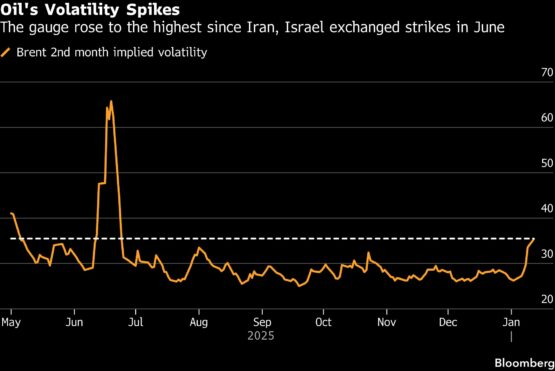
Iran has long been a flashpoint in US-China relations, with the two countries taking opposite sides in the Middle East conflict. While Washington has long backed Israel and Saudi Arabia, Beijing has moved closer to Iran, acting as a lifeline for Tehran’s economy by taking close to 90% of the country’s oil shipments. In September, Xi met with Iranian President Masoud Pezeshkian in Beijing and pledged to strengthen trade and investment ties.
While China hasn’t officially purchased Iranian crude since June 2022, third-party data providers and traders’ signal flows have been resilient despite US sanctions. That’s because the Chinese have built a supply chain outside of Western control that supports imports of more than 1 million barrels a day.
Iranian oil sold at a steep discount is vital for China’s private refining sector and a crucial source of fuel for its economy. The crude is typically held in offshore storage when it arrives. As of late December, those volumes were at a two-and-a-half-year high of more than 50 million barrels, according to data from analytics and ship-tracking firm Kpler.
ADVERTISEMENT:
CONTINUE READING BELOW
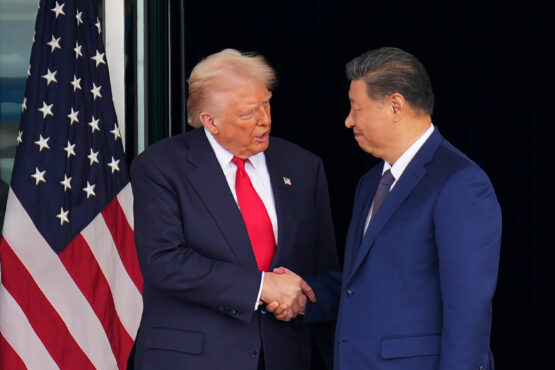
Donald Trump and Xi Jinping shake hands as they leave after their talks in South Korea.
The Trump administration has renewed its “maximum pressure” campaign on Iran, threatening sanctions on buyers of Iran oil and petrochemical products.
But in June, the US president also gave China the green light to continue buying Iranian oil. That announcement surprised both oil traders and officials in his own government as the president appeared to undermine Washington’s Iran policy under multiple administrations, which sought to cut the regime’s main source of revenue by making its top export off limits.
China’s official imports from Iran fell almost 28% year on year in the first 11 months of 2025 to $2.86 billion, according to the latest data from the Chinese customs. Top goods imported include plastic materials like polyethylene, metals such as iron ores and zinc ores, and chemicals like acyclic alcohols widely used as industrial solvents in paints and cleaning products.
Exports to Iran contracted nearly 23% in the same period to $6.2 billion, Chinese customs data show. The shipments mainly include refrigeration and air-conditioning compressors, cars, phones, and electric motors and generators. Two-way trade with Iran accounts for less than 0.2% of China’s total, according to the official figures.
© 2026 Bloomberg
Follow Moneyweb’s in-depth finance and business news on WhatsApp here.
#Trump #risks #upending #USChina #trade #truce #Iran #tariff #vow