Ben Schofieldin Cambridge

 Ben Schofield/BBC
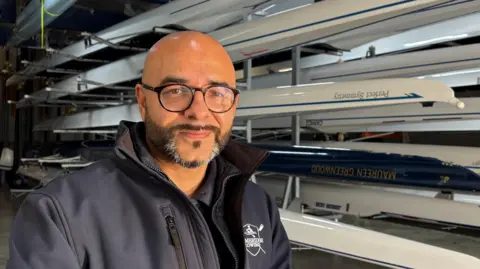
When Omar Terywall launched his company, Cambridge Rowing Limited seemed the obvious name for it.
The company runs the Cambridge Rowing Experience, which takes novice rowers on to the River Cam for a taste of the sport.
But the University of Cambridge has launched a legal objection to its trademark, which Terywall, 46, describes as “terrifying” and “bullying”.
He founded the firm in Cambridge, his home city, in 2021 and applied to register the name the following year.
But the university lodged a formal objection a few months later, saying it had to “protect trademarks to prevent misuse”.
A hearing about the challenge was held in 2025 and a decision is expected in the first months of this year.
 Ben Schofield/BBC
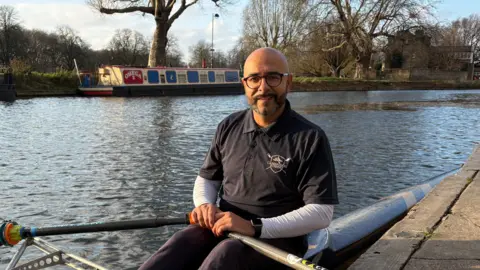
Since launching, the company has “introduced rowing to over 5,000 people”, including hundreds of “local children”, according to Terywall.
Explaining the name, he says: “The company is Cambridge Rowing Limited and it is a Cambridge rowing experience – that’s essentially it.
“It’s where we are and it’s what I do.”
 Ben Schofield/BBC
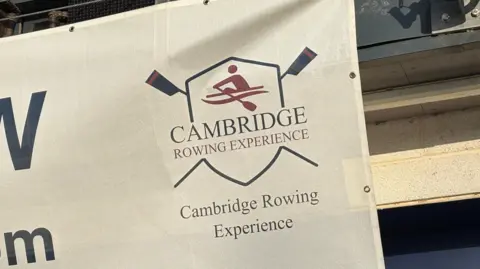
Cambridge Rowing applied to register its trademark – a shield with a rower on it and the words “Cambridge Rowing” underneath – in January 2022.
The following May, the Chancellor, Masters and Scholars of the University of Cambridge filed an opposition to the application.
It left Terywall with “no idea where to turn”.
The university was a “huge, multibillion-pound entity”, while his was a “very small local business”.
“It’s terrifying – it really is,” he says.
“When you’ve got a very big organisation like them coming after you, it is pretty scary.”
Asked if he feels the university is trying to bully his company, Terywall speaks of his “great relationship” with “the colleges and the university”.
But he adds: “The university coming along as an entity – it can be scary – and I guess, yes, there is a form of bullying there.”
UK trademarks can be registered in 45 different classifications. Cambridge Rowing applied to register its logo in class 25 for sports clothing, class 35 for merchandising, and 41 for corporate hospitality, sports events and training.
The university, founded in 1209, has registered “Cambridge” as a trademark including, in class 41, for “sporting and cultural activities” and “sport camp services”.
It has objected to several companies’ attempts to include the word “Cambridge” in their names, arguing that “the public knows that in the contexts of education, publishing, sport, academia and research the word ‘Cambridge’ always refers to the University of Cambridge”.
 Ben Schofield/BBC
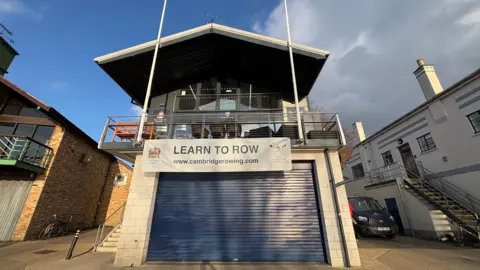
Terywall’s company operates from the City of Cambridge Rowing Club, one of several “town clubs” in the city not run by the university.
He says the city is “very proud of what the university has achieved in Cambridge”.
“They’ve done remarkably well, but Cambridge existed way before the university did, as did rowing.”
According to World Rowing, the earliest representation of a rowing boat was found in Finland and dated back to 5,800BC, while the oar was “considered to be the most important invention before the wheel”.
Its website adds the “origin of the sport of rowing as we know it today comes from England, where the world-renowned Oxford versus Cambridge University Boat Race was first held in 1829 on the River Thames”.
Terywall adds: “To take ownership of the word ‘Cambridge’ and the word ‘rowing’ – it’s bonkers.
“Nobody really owns the right to the word ‘Cambridge’ and nobody can say that they own the word ‘rowing’ either as well – it belongs to all of us.”
 Supplied
Liz Ward, an intellectual property solicitor who runs Virtuoso Legal, says she believes Terywall’s attempt to register Cambridge Rowing’s logo in class 41 for “training in sports” and “sports coaching” was “going to take him directly in conflict with the university”.
“I don’t think they’re going to succeed on class 41,” she says.
“You can’t deny that Cambridge – of all universities in the UK – is synonymous with rowing.”
 John Walton/PA Wire
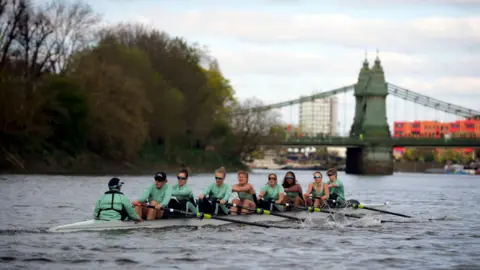
Ward points to the university’s “outstanding reputation for rowing”, including the Oxford-Cambridge Boat Race and the award of the coveted Cambridge Blue to those representing the institution at the sport.
“The university is probably trying to protect its reputation when it comes to sport, and rowing is a sport,” she says.
“You could say ‘Well, that’s something that is synonymous more with the university than it is with a newly formed company.'”
The university’s previous trademark objections have targeted several Cambridge-based science and technology companies using “Cambridge” in their names, with mixed success.
In 2021, the Intellectual Property Office ruled in the university’s favour that a brewery could not register “Cambridge Blue” as the name of a Boat Race-themed lager.
The hearing officer in that case said the name could lead to the “false message that the goods had been authorised, recommended or approved of” by Cambridge University, giving the brewery an “unfair advantage”.
 Joe Giddens/PA Wire
A spokesperson for the University of Cambridge says it is “often subject to fraudulent actors misrepresenting their association to the university” and that it spends “a lot of time supporting people who have been misled and are often in considerable distress”.
They add: “While we recognise this is not the intention in every case, we have to protect trademarks to prevent misuse.
“If there is no protection, fraudulent use would increase.
“We will always try to work constructively with others who want to use our trademark for legitimate reasons.”
Asked whether he could change his company’s name, Terywall says that is not an option “because that would imply that I’ve done something wrong and I haven’t”.
“My company name reflects what it is that I do – so it’s ‘Cambridge Rowing’ and that’s exactly what we do.”
#University #Cambridge #trademark #battle #rowing #company